Last updated on May 23, 2026, by Lucy
Modern CNC shops face rising labor costs, tighter tolerances, and shorter delivery times. Many factories still lose money through machine downtime, scrap, and unstable production quality.
Intelligent manufacturing uses smart monitoring, automation, AI, and connected CNC systems to reduce downtime, lower scrap, improve machining precision, and keep production costs under control. It helps factories produce consistent parts faster with less manual intervention and better overall efficiency.

I have worked with many engineers who care less about marketing terms and more about stable production results. Most buyers simply want fewer delays, lower scrap rates, and repeatable quality. That is where intelligent manufacturing creates real value in CNC machining.
What Is Intelligent Manufacturing?
Many factories still rely heavily on manual decisions. Operators check machines by experience. Maintenance often happens only after a problem appears. Production data usually stays disconnected between departments.
Intelligent manufacturing is a production system that combines automation, AI, machine data, sensors, and connected software to improve CNC machining efficiency, reduce human error, lower downtime, and maintain stable product quality in real time.
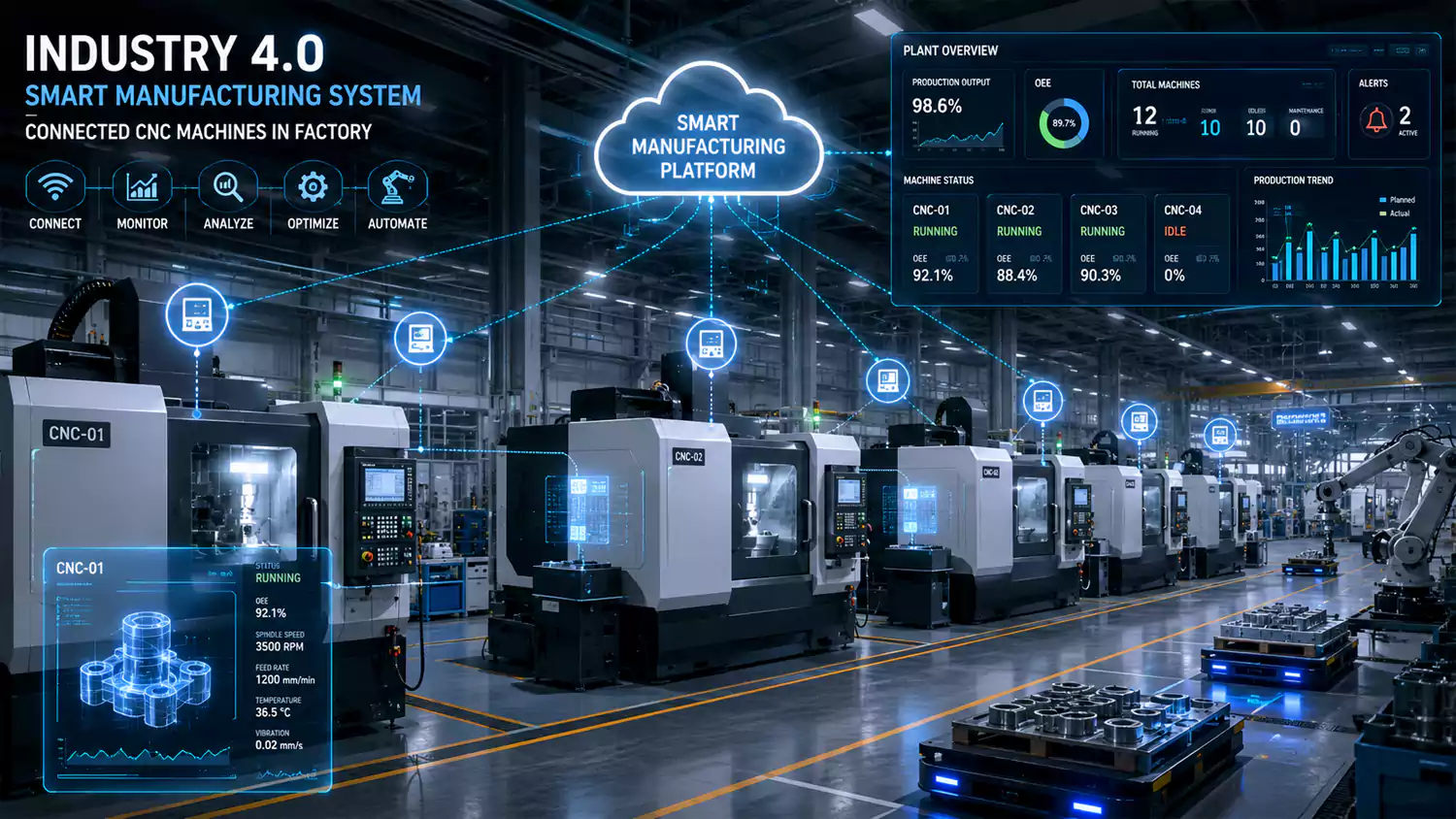
I see intelligent manufacturing as more than automation alone. It is about building a factory where machines, software, operators, and production data work together continuously. The main goal is simple. Produce better parts faster and at lower cost.
Definition and Core Concepts
At its core, intelligent manufacturing connects CNC machines, production software, quality systems, and supply chain data through digital communication. Every machine becomes part of a larger connected network. Sensors collect production data continuously1. Software analyzes the information and provides feedback automatically.
In a CNC machining shop, this can include:
| Technology | Main Function |
|---|---|
| CNC machine sensors | Monitor spindle load, vibration, and temperature |
| MES software | Track production progress |
| AI systems | Predict tool wear and optimize machining2 |
| Industrial robots | Automate loading and unloading |
| Cloud platforms | Store and analyze production data |
Traditional factories often react after problems happen. Intelligent manufacturing focuses on preventing problems before they affect production. Many modern smart manufacturing systems are built around this idea.
Intelligent Manufacturing vs Traditional Manufacturing
I still visit factories where operators write production records on paper sheets. Quality checks happen only after a full batch finishes. Machine downtime is often discovered too late.
Here is the difference I usually explain to customers:
| Traditional Manufacturing | Intelligent Manufacturing |
|---|---|
| Manual machine checks | Real-time machine monitoring |
| Reactive maintenance | Predictive maintenance |
| Human-based scheduling | Automated production planning |
| Separate systems | Connected systems |
| Higher scrap rates | Lower material waste |
The biggest difference is visibility. Managers can instantly see machine performance, production status, and quality trends.
Why Intelligent Manufacturing Matters in Modern Industry
Modern buyers expect fast delivery and stable quality. Small production problems can now create major delays across global supply chains.
Intelligent manufacturing helps solve several common CNC machining problems:
- Unexpected machine downtime
- Inconsistent tolerances
- Tool breakage
- Long setup times
- High labor costs
- Material waste
- Delayed production schedules
I worked with one customer producing aluminum automation brackets. Before upgrading their production monitoring system, they lost nearly 12% of production time to unplanned downtime. After installing machine sensors and predictive maintenance software, downtime dropped below 4% within six months.
The Relationship Between Intelligent Manufacturing and Industry 4.03
Industry 4.0 is the broader industrial transformation movement. Intelligent manufacturing is one of the main ways factories apply Industry 4.0 technologies in real production environments.
Industry 4.0 usually includes:
- Industrial IoT
- AI and machine learning
- Robotics
- Cloud computing
- Big data
- Smart factories
Intelligent manufacturing turns these technologies into daily factory operations. In CNC machining, this means machines communicate with software systems automatically and production decisions become data-driven instead of relying only on operator experience.
Core Technologies and Systems in Intelligent Manufacturing
Many people think smart manufacturing only means robots. In reality, the biggest improvements often come from machine data, connected systems, and production visibility.
The core technologies behind intelligent manufacturing include Industrial IoT, AI, robotics, digital twins, and real-time monitoring systems that help CNC factories improve efficiency, reduce downtime, and maintain stable machining quality.
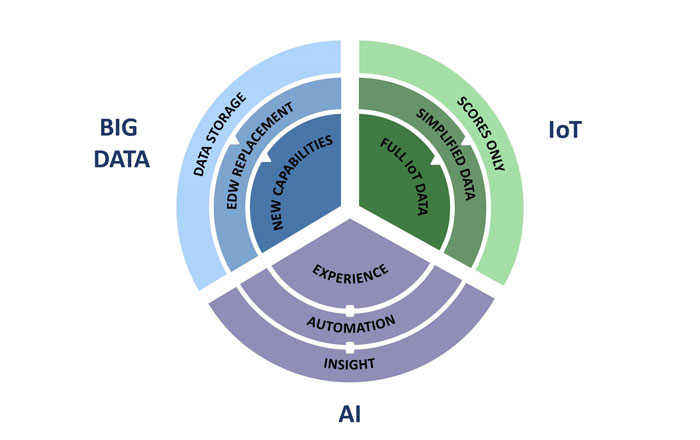
When these technologies work together properly, factories can reduce downtime, improve machining accuracy, and support both prototype machining and large-scale production more efficiently.
Industrial IoT (IIoT) and Connected Machines
IIoT allows CNC machines to share production data continuously. Sensors track spindle temperature, cutting forces, vibration levels, and machine utilization.
This data helps operators identify:
- Tool wear
- Machine overload
- Abnormal vibration
- Idle machine time
- Production bottlenecks
I once visited a shop where one CNC machine repeatedly produced unstable tolerances during long production runs. After installing spindle vibration monitoring, they discovered thermal expansion problems caused by excessive spindle heat.
Artificial Intelligence and Machine Learning
AI systems learn from production data over time. They identify patterns that humans may miss.
In CNC machining, AI can help with:
| AI Application | Result |
|---|---|
| Tool wear prediction | Fewer sudden tool failures |
| Adaptive feed rate control | Better surface finish |
| Production scheduling | Faster throughput |
| Quality prediction | Reduced inspection time |
Some advanced AI in CNC machining systems can automatically adjust cutting parameters based on real-time spindle load data.
Robotics and Automation Systems
Automation reduces repetitive manual work. Robots can load raw materials, unload finished parts, and transfer components between operations.
This improves:
- Production consistency
- Labor efficiency
- Cycle time stability
- Night shift production capability
For high-mix production environments, collaborative robots are becoming more common because they can work safely beside operators.
Digital Twin Technology
A digital twin creates a virtual model of a machine or production process. Engineers can simulate machining operations before real production starts.
Benefits include:
- Reduced setup time
- Better collision detection
- Faster process optimization
- Improved machining simulation
This becomes especially useful for aerospace or medical parts with complex geometries.
Big Data and Real-Time Production Monitoring
Real-time dashboards give production managers instant visibility into machine performance.
Typical monitored data includes:
- OEE performance
- Scrap rate
- Machine uptime
- Tool life
- Cycle times
Factories no longer need to wait until the end of a shift to discover production problems.
Smart Factory Communication and Integration
The biggest challenge is often system integration. CNC machines, ERP software, quality systems, and supply chain software must communicate smoothly.
When integration works properly, engineers can trace every production step from raw material to final inspection.
How Intelligent Manufacturing Improves CNC Machining
Many CNC shops focus only on faster cutting speeds. In reality, the biggest savings usually come from reducing downtime, scrap, and production instability.
Intelligent manufacturing improves CNC machining by using machine monitoring, predictive maintenance, AI optimization, and automated inspection systems to reduce errors, improve machining precision, and increase overall production efficiency.
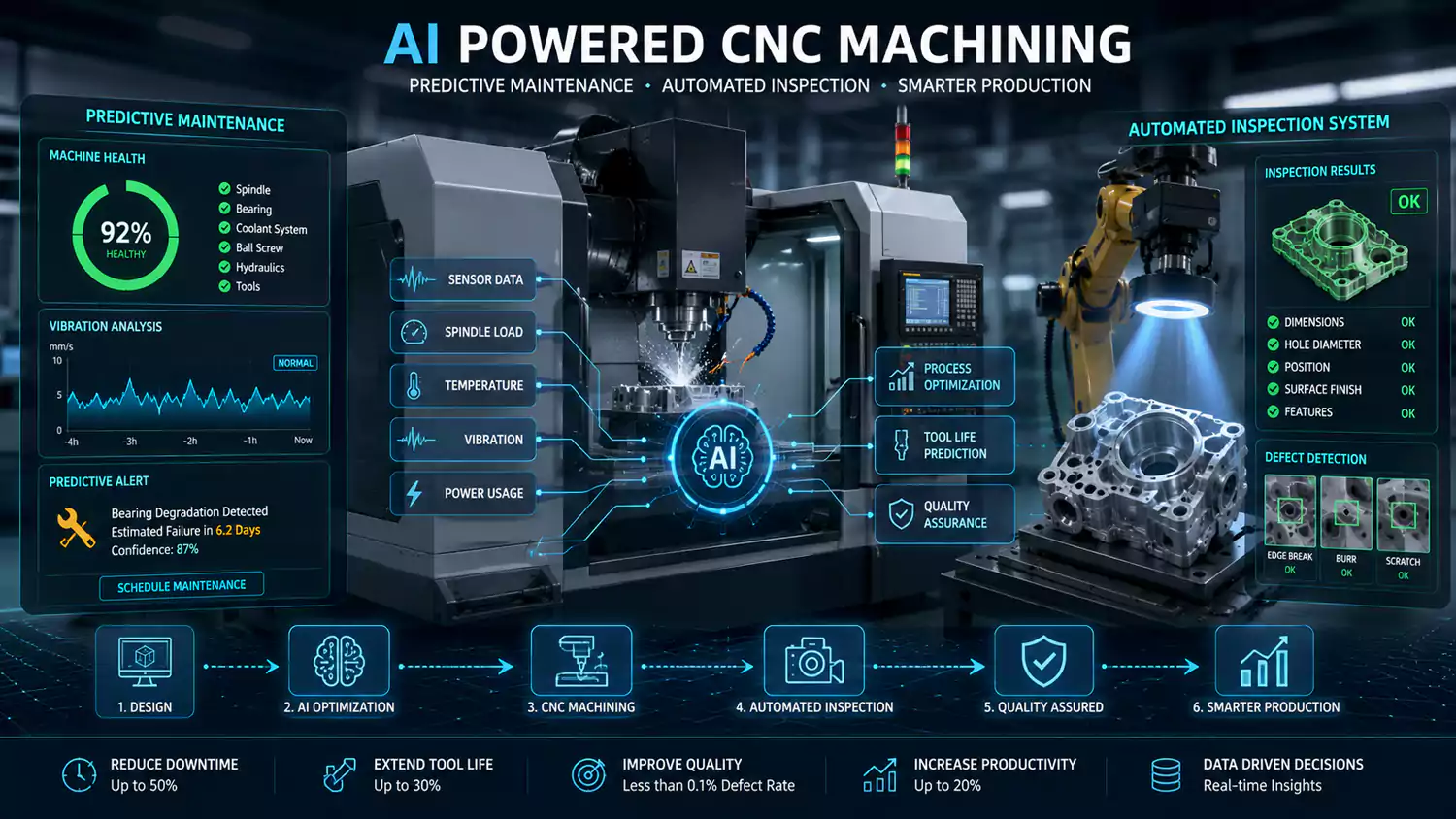
I have seen factories invest in expensive CNC equipment but still struggle with unstable production because they lacked machine visibility and real-time process control. Smart systems help factories understand what is actually happening during machining.
Smart CNC Machine Monitoring
Connected CNC systems continuously track machine conditions. Operators receive alerts before problems become serious.
Key monitoring areas include:
| Monitoring Item | Production Benefit |
|---|---|
| Spindle vibration | Prevent bearing failure |
| Coolant condition | Improve tool life |
| Machine utilization | Increase productivity |
| Cutting load | Stabilize machining quality |
Predictive Maintenance for CNC Equipment
Traditional maintenance often happens too late. Predictive maintenance analyzes machine data to predict failures before breakdowns occur.
This reduces:
- Emergency repairs
- Production interruptions
- Spare part costs
- Scrap caused by unstable machines
AI-Driven Tool Path Optimization
AI software can optimize cutting strategies automatically.4 It adjusts feed rates and cutting paths based on tool condition and material behavior.
Benefits include:
- Faster machining cycles
- Better surface finish
- Lower tool wear
- Reduced chatter
Many advanced CNC machining services now combine automation and AI optimization to improve both prototype and production machining efficiency.
Automated Quality Inspection and Process Control
Smart inspection systems use cameras, probes, and AI analysis to detect defects during production.
This helps factories:
- Catch defects earlier
- Reduce manual inspection
- Improve consistency
- Maintain tight tolerances
Case Study: Intelligent CNC Production Upgrade
I worked with a supplier producing stainless steel valve housings for industrial automation systems. Their biggest issue was unstable production efficiency and high tool replacement costs.
After implementing intelligent manufacturing systems, the results improved significantly.
| Production Parameter | Before Upgrade | After Upgrade |
|---|---|---|
| Average spindle uptime | 71% | 89% |
| Scrap rate | 6.8% | 2.1% |
| Tool life | 14 hours | 23 hours |
| Average lead time | 18 days | 11 days |
| Manual inspections per batch | 5 | 2 |
| Monthly downtime | 42 hours | 15 hours |
The factory mainly improved through predictive maintenance, spindle monitoring, and automated in-process inspection.
Reducing Human Error and Improving Precision
Manual adjustments often create inconsistency between production shifts. Automated process control keeps machining parameters stable.
This becomes very important for:
- Aerospace components
- Medical implants
- Semiconductor parts
- Precision automation equipment
Faster Lead Times and Better Production Efficiency
Smart scheduling systems help balance machine workloads automatically. Production managers can quickly identify bottlenecks and reassign jobs.
Lower Manufacturing Costs and Material Waste
Less scrap and fewer machine failures directly reduce production cost.
Many shops focus only on machine hourly rate. In reality, hidden waste from unstable production often costs much more.
Flexible Low-Volume and High-Mix Production
Modern CNC customers increasingly demand small batch customization. Intelligent manufacturing allows faster setup changes and more flexible production scheduling.
This helps suppliers handle:
- Prototype machining
- Small production runs
- Custom automation parts
- Rapid product iteration
Real-World Applications and Industry Impact
Different industries apply intelligent manufacturing in different ways. The main goal stays the same. Improve consistency, traceability, and efficiency.
Intelligent manufacturing helps aerospace, automotive, medical, electronics, and automation industries improve CNC machining precision, increase production efficiency, strengthen quality control, and create more transparent supply chains.
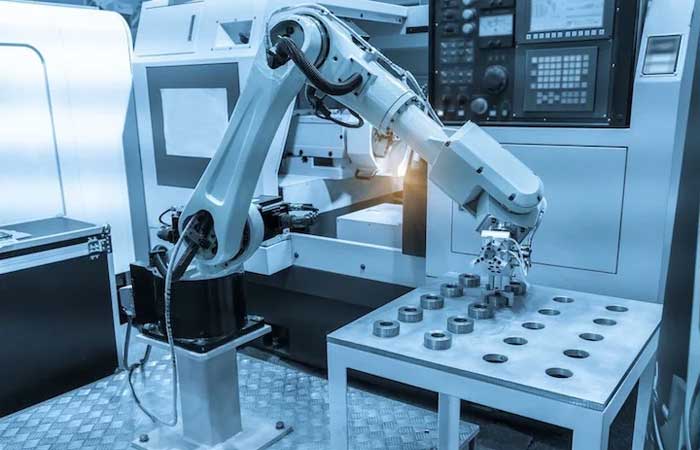
I notice that customers from advanced manufacturing industries now expect suppliers to provide far more production visibility and traceability than before.
Aerospace CNC Components
Aerospace machining requires extremely tight tolerances and complete traceability.
Smart manufacturing systems help track:
- Material batches
- Tool history
- Machining conditions
- Inspection records
Automotive Precision Manufacturing
Automotive suppliers use automation heavily because production volumes are very high.
Smart systems improve:
- Cycle time consistency
- Quality repeatability
- Production scalability
Medical Device Production
Medical machining often requires micron-level precision and strict documentation.
Automated monitoring helps maintain stable production conditions during long machining cycles.
Electronics and Semiconductor Parts
Semiconductor components often involve difficult materials and ultra-fine tolerances.
AI monitoring helps prevent thermal instability and vibration issues.
Industrial Automation Equipment
Automation equipment manufacturers increasingly demand flexible low-volume production.
Intelligent CNC systems help suppliers switch between part designs more efficiently.
Supply Chain Coordination and Manufacturing Transparency
Customers now expect real-time production updates.
Connected systems allow buyers to track:
- Production progress
- Inspection reports
- Delivery schedules
- Material traceability
The Impact of Intelligent Manufacturing on the CNC Industry Chain
Smart manufacturing affects the entire supply chain:
| Area | Impact |
|---|---|
| Suppliers | Better production planning |
| CNC shops | Higher efficiency |
| Engineers | Faster development cycles |
| Buyers | More reliable delivery |
Factories that fail to modernize may struggle to stay competitive over the next decade.
Challenges and Future Trends of Intelligent Manufacturing
Smart manufacturing creates major opportunities, but implementation is not always easy. Many factories still face integration and workforce challenges.
The biggest challenges of intelligent manufacturing include system integration, investment cost, cybersecurity, and workforce training, while future trends focus on AI-driven automation and fully connected smart CNC factories.
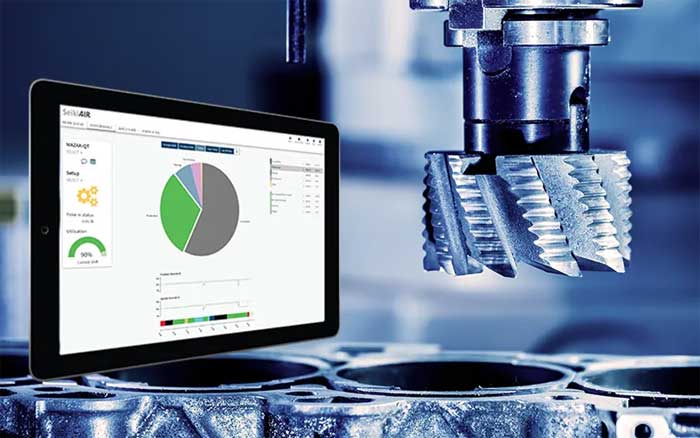
I often tell factory owners that intelligent manufacturing is not a one-time upgrade project. It is a long-term production strategy that requires continuous improvement.
High Initial Investment and System Integration
Upgrading CNC factories can require:
- New sensors
- Network infrastructure
- Software integration
- Automation equipment
Many smaller factories worry about return on investment.
Cybersecurity and Data Protection
Connected factories create cybersecurity risks. Production systems must protect:
- Customer drawings
- Production data
- Machine control systems
This becomes especially important for aerospace and defense suppliers.
Workforce Training and Skill Gaps
Operators now need both machining knowledge and digital system skills.
Modern CNC technicians increasingly work with:
- Data dashboards
- Automation software
- Machine analytics
- AI-assisted systems
AI-Powered Autonomous Manufacturing
Future factories will rely more on autonomous decision-making systems.
AI may eventually manage:
- Tool replacement
- Production scheduling
- Process optimization
- Quality adjustments
Smart Factories and Industry 5.0
Industry 5.0 focuses more on collaboration between humans and intelligent systems instead of replacing workers completely.
Human experience still matters greatly in complex machining environments.
The Future of Intelligent CNC Machining
I believe the future CNC shop will look very different from traditional machine shops.
Machines will communicate continuously. Production scheduling will become more automated. Quality systems will operate in real time. Small batch production will become much faster and more cost-effective.
Factories that focus today on reducing downtime, lowering scrap, improving machine visibility, and increasing process stability will be better prepared for the next generation of CNC manufacturing.
Conclusion
Intelligent manufacturing is changing CNC machining from reactive production into data-driven production. With smart monitoring, AI optimization, and connected systems, factories can reduce downtime, lower waste, improve consistency, and deliver precision parts faster and more efficiently in increasingly competitive global markets.

-
"Performance Analysis of IoT-Based Sensor, Big Data Processing ...", https://pmc.ncbi.nlm.nih.gov/articles/PMC6164307/. Research on cyber-physical production systems and smart factories explains that embedded sensors and industrial networks enable continuous acquisition of machine and process data for monitoring and control. Evidence role: mechanism; source type: paper. Supports: Sensors collect production data continuously in intelligent manufacturing environments.. Scope note: The source would support the general mechanism of sensor-based data collection, not every specific CNC sensor configuration used in a given shop. ↩
-
"Tool Wear Prediction in Milling-A comparative analysis based on ...", https://www.academia.edu/66563190/Tool_Wear_Prediction_in_Milling_A_comparative_analysis_based_on_machine_learning_and_deep_learning_approaches. Peer-reviewed studies on machine-learning-based tool condition monitoring report that AI methods can estimate tool wear and inform machining parameter optimization, supporting the stated function of AI systems in CNC machining. Evidence role: mechanism; source type: paper. Supports: AI systems can predict tool wear and optimize machining.. Scope note: The evidence is likely to be based on specific materials, tools, and machining conditions, so it should be treated as support for technical feasibility rather than a guarantee of performance in all CNC operations. ↩
-
"[PDF] INDUSTRY 4.0 - UNIDO Knowledge Hub", https://hub.unido.org/sites/default/files/publications/UNIDO%20Background%20Paper%20on%20Industry%204.0_FINAL_TII.pdf. A source defining Industry 4.0 as the integration of industrial production with digital technologies such as IoT, cyber-physical systems, data analytics, cloud computing, AI, and robotics would substantiate the article’s characterization of Industry 4.0 as the broader transformation framework within which intelligent manufacturing is applied. Evidence role: definition; source type: institution. Supports: Industry 4.0 is the broader industrial transformation movement, and intelligent manufacturing is one of the main ways factories apply Industry 4.0 technologies in real production environments.. Scope note: The source may define Industry 4.0 broadly but may not specifically rank intelligent manufacturing as one of its “main” applications without additional supporting evidence. ↩
-
"Machine learning and artificial intelligence in CNC machine tools, A ...", https://www.sciencedirect.com/science/article/pii/S2667344423000014. Studies on AI and machine-learning applications in machining report that algorithms can optimize cutting parameters and tool paths by modeling relationships among machining conditions, tool wear, surface quality, and productivity. Evidence role: mechanism; source type: paper. Supports: AI software can optimize cutting strategies automatically.. Scope note: The source would support feasibility and research evidence, not guarantee automatic optimization results in every commercial CNC environment. ↩
