Last updated on May 22, 2026, by Lucy
Poorly designed motorcycle exhaust systems often look aggressive but hurt real riding performance. Wrong pipe sizing, weak welds, and poor airflow balance can reduce torque, increase heat, and shorten exhaust lifespan.
A motorcycle exhaust system controls airflow, engine heat, emissions, and sound. Proper exhaust design improves power delivery, balances back pressure, reduces weight, and increases durability for street, touring, racing, and aftermarket motorcycle applications.

I have worked with many aftermarket brands and engineers that focused only on exhaust appearance in the beginning. Later, they realized that true exhaust performance depends on airflow efficiency, material selection, and manufacturing precision. A good exhaust system is far more than a simple metal pipe.
What Is a Motorcycle Exhaust System and How Does It Work?
Many riders install aftermarket exhaust systems for louder sound or appearance. Then they notice weaker low-end torque, unstable throttle response, or excessive heat because the exhaust design does not match the engine setup.
A motorcycle exhaust system removes combustion gases while managing airflow velocity, back pressure, heat, emissions, and noise. Exhaust pipe diameter, header length, and muffler design directly affect engine torque, horsepower, throttle response, and riding performance.
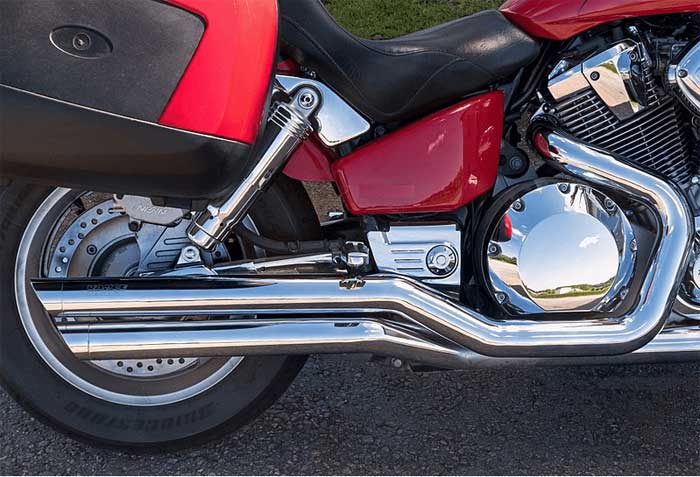
A motorcycle exhaust system starts at the engine exhaust port and ends at the muffler outlet. Every section changes airflow behavior and engine efficiency. I learned this while helping a customer develop a custom stainless steel exhaust for a 650cc parallel-twin motorcycle platform. The first prototype used oversized tubing because the customer wanted more top-end power. Dyno testing showed better peak horsepower, but low-speed torque dropped sharply.
Main Functions of Motorcycle Exhaust Systems
The exhaust system performs several critical tasks:
| Function | Purpose |
|---|---|
| Gas evacuation | Removes combustion gases efficiently |
| Heat control | Transfers heat away from the engine |
| Noise reduction | Reduces harmful sound levels |
| Emission control | Supports catalytic conversion |
| Power tuning | Balances airflow and back pressure |
Exhaust scavenging is especially important. Proper header length and pipe sizing help pull exhaust gases out faster and improve cylinder filling during the next combustion cycle.
Main Components of an Exhaust System
Most systems include:
- Exhaust headers
- Mid-pipes
- Catalytic converters
- Resonators
- Mufflers
- Exhaust tips
- Heat shields
- Mounting brackets
Each component affects airflow characteristics. Even small welding steps inside tubing can disturb exhaust flow and reduce efficiency.1 Many modern motorcycle exhaust system parts are now developed with tighter tolerances to improve consistency and durability.
How Exhaust Design Affects Motorcycle Performance
Exhaust diameter is one of the most important design factors. If the pipe is too large, gas velocity drops and low-end torque suffers. If the pipe is too small, restriction increases at higher RPM.
I usually explain it like this:
| Design Factor | Result |
|---|---|
| Larger diameter | More top-end power |
| Smaller diameter | Better low-end response |
| Longer header | Improved mid-range torque |
| Shorter header | Faster high-RPM response |
Modern motorcycle exhaust engineering is mostly airflow management. Even small geometry changes can completely change how a motorcycle feels on the road.
Materials and Manufacturing Processes for Motorcycle Exhaust Systems
Many aftermarket exhaust systems fail early because the wrong materials were selected. Some systems look impressive online but crack, corrode, or discolor badly after only one riding season.
Stainless steel offers the best balance of durability, corrosion resistance, and cost for most motorcycles. Titanium reduces weight for racing applications, while carbon fiber is mainly used for lightweight outer muffler shells and cosmetic finishes.
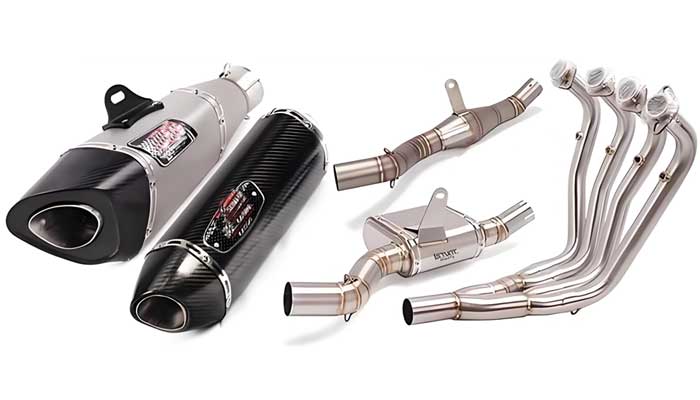
I have seen many customers choose titanium only because it sounds premium. Later, they realize the motorcycle is mostly used for commuting or touring. In real-world riding conditions, high-grade stainless steel often delivers better long-term durability at a much lower production cost.
Stainless Steel vs Titanium vs Carbon Fiber
Here is a practical comparison:
| Material | Advantages | Disadvantages |
|---|---|---|
| Stainless Steel | Durable, affordable, corrosion resistant | Heavier |
| Titanium | Extremely light, premium appearance | Expensive, harder to weld |
| Carbon Fiber | Lightweight, attractive finish | Poor heat resistance alone |
304 stainless steel remains the most common material for production exhaust systems2 because it balances strength, weldability, and corrosion resistance very well.
Choosing the Right Material for Different Applications
Application matters more than marketing.
| Motorcycle Type | Recommended Material |
|---|---|
| Daily commuting | Stainless steel |
| Adventure touring | Stainless steel |
| Racing | Titanium |
| Premium aftermarket | Titanium + carbon fiber |
| Budget custom builds | Mild steel with coating |
Tube Bending and Mandrel Forming
Tube bending quality directly affects exhaust airflow3. Cheap crush bending reduces inner diameter at the bend location, which creates turbulence and flow restriction.
Mandrel bending prevents pipe collapse during forming and keeps internal diameter consistent through curves. This helps maintain smooth exhaust flow.
TIG Welding and Surface Finishing
TIG welding is widely used for premium motorcycle exhaust manufacturing because it provides:
- Cleaner welds
- Better heat control
- Stronger joints
- Better visual appearance
Surface finishing also affects durability and heat resistance. Common finishes include:
- Brushed stainless
- Mirror polishing
- Ceramic coating
- Powder coating
- Heat-resistant anodizing
Many manufacturers now focus heavily on enhancing motorcycle exhaust systems through advanced coatings, airflow optimization, and precision welding techniques.
Quality Control in Exhaust Manufacturing
One project I remember involved a sportbike exhaust system developed for a European aftermarket brand.
| Parameter | Prototype A | Prototype B |
|---|---|---|
| Pipe Diameter | 54 mm | 48 mm |
| Material | Titanium | 304 Stainless |
| Weight | 4.8 kg | 6.2 kg |
| Peak HP Gain | +6.1 HP | +4.3 HP |
| Mid-Range Torque | -8% | +3% |
| Manufacturing Cost | +62% | Baseline |
The customer finally selected the stainless steel version because it delivered better real-world riding performance and lower manufacturing cost for street applications.
Key Design Considerations for Real-World Motorcycle Applications
Some exhaust systems perform well on dyno charts but fail during actual riding conditions. Excessive heat, vibration, weak brackets, and poor mounting design often destroy long-term reliability.
A well-designed motorcycle exhaust system balances heat control, airflow efficiency, noise reduction, weight savings, and durability. The best exhaust systems perform consistently during real riding instead of focusing only on peak horsepower numbers.
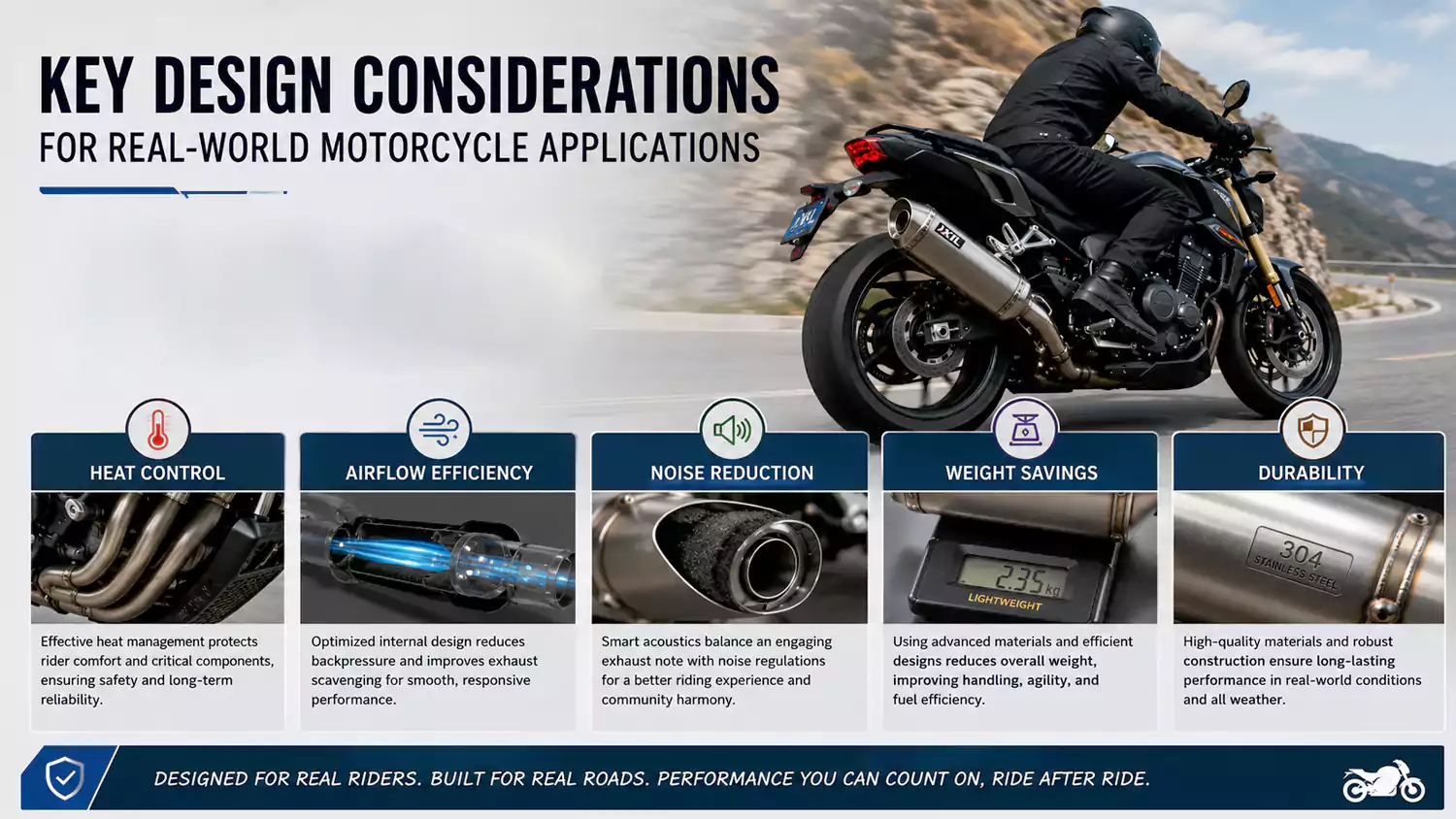
Real-world riding introduces thermal cycling, water exposure, vibration, and road debris. Exhaust systems must survive all of these conditions over long-term use.
Heat Management
Heat is one of the biggest engineering challenges for exhaust systems.
Common heat management methods include:
- Double-wall pipe structures
- Ceramic thermal coatings
- Heat shields
- Exhaust wrap
- Air-gap mounting design
Poor heat control can damage nearby fairings, rider boots, and electronic components.
Back Pressure and Performance Balance
Back pressure is often misunderstood. Zero restriction is not always better.
A balanced exhaust system maintains enough gas velocity to support scavenging while avoiding excessive restriction at high RPM.
This balance depends on:
- Engine displacement
- RPM range
- Camshaft profile
- Intake design
- Fuel mapping
Noise Reduction
Noise regulations continue becoming stricter worldwide.
Manufacturers now use:
- Multi-chamber mufflers
- Resonators
- Sound absorption packing
- Helmholtz chamber tuning
Many cheap aftermarket systems become excessively loud after internal packing materials degrade over time.
Weight Optimization
Reducing exhaust weight improves:
- Handling response
- Cornering feel
- Acceleration
- Rider control
This becomes especially important on performance motorcycles and racing platforms.
Durability for Urban, Touring, and Racing Use
Different riding environments require different design priorities.
| Riding Type | Main Design Focus |
|---|---|
| Urban commuting | Corrosion resistance |
| Long-distance touring | Heat durability |
| Racing | Weight reduction |
| Adventure riding | Impact resistance |
The best motorcycle exhaust system always depends on how the motorcycle is actually used.
Global Compliance Standards for Motorcycle Exhaust Systems
Many aftermarket exhaust projects fail because brands ignore regional compliance requirements. This creates certification delays, import restrictions, and legal risks for both manufacturers and distributors.
Motorcycle exhaust systems must comply with emissions, catalytic converter, and noise regulations such as Euro 5, EPA, and CARB standards. These regulations directly affect exhaust airflow design, internal structure, and manufacturing requirements.
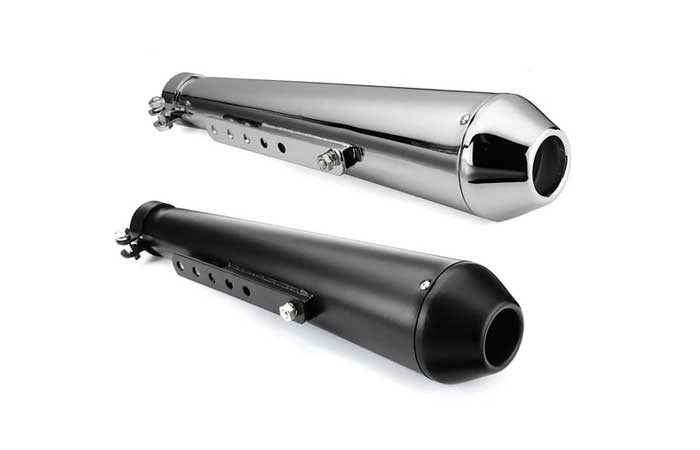
Modern exhaust regulations influence nearly every stage of exhaust development and production.
Euro 5 Regulations
Euro 5 standards are currently among the strictest motorcycle emissions regulations in the world.4
They mainly target:
- Hydrocarbon emissions
- Nitrogen oxides
- Carbon monoxide
- Noise levels
Manufacturers often redesign internal exhaust routing and catalytic systems to maintain compliance.
EPA and CARB Requirements
The United States mainly follows:
- EPA federal standards
- CARB requirements in California
CARB regulations are especially strict for aftermarket exhaust products.
Noise Compliance Standards
Noise testing uses controlled RPM ranges and fixed sound measurement distances.
An exhaust system that passes in one country may fail in another market because regulations vary significantly.
Catalytic Converter Requirements
Modern motorcycles often require integrated catalytic converters.
This changes:
- Pipe routing
- Internal temperatures
- Material selection
- Heat shielding requirements
Catalytic systems also increase manufacturing complexity and cost.
Custom Motorcycle Exhaust System Solutions for OEM and Aftermarket Projects
Many motorcycle brands struggle to find suppliers that can support both prototype flexibility and stable mass production quality. Poor communication and weak manufacturing control often create expensive delays.
A reliable motorcycle exhaust manufacturing partner should provide engineering support, prototype development, precision welding, strict quality control, and scalable production capabilities for both OEM and aftermarket motorcycle projects.
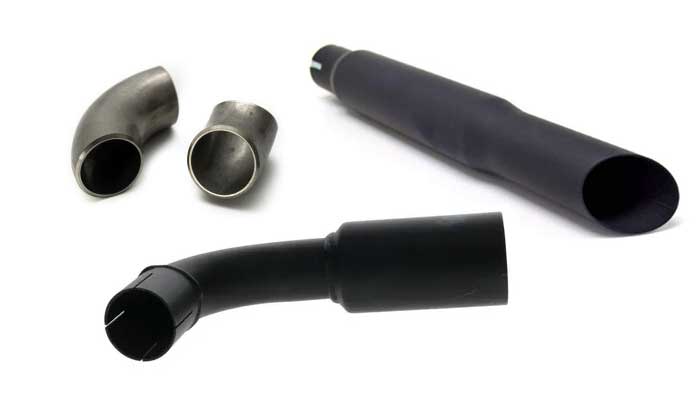
I often see projects fail because suppliers focus only on fabrication. Real exhaust manufacturing also requires engineering support, fixture development, and stable production management.
OEM & ODM Manufacturing Support
Strong suppliers can assist with:
- CAD optimization
- DFM analysis
- Fixture development
- Prototype testing
- Packaging solutions
Many motorcycle brands also combine CNC machining of motorcycle parts with custom exhaust fabrication to improve fitment precision and assembly consistency.
Prototype Development
Prototype work usually includes:
| Stage | Purpose |
|---|---|
| CAD validation | Confirm fitment |
| Flow simulation | Optimize airflow |
| Prototype welding | Build test units |
| Dyno testing | Verify performance |
| Road testing | Confirm durability |
Custom Surface Finishes and Branding
Aftermarket brands often request:
- Laser logos
- Custom anodizing
- Ceramic coatings
- Carbon fiber covers
- Branded packaging
Low-Volume and Mass Production
Good manufacturers should support:
- Small prototype batches
- Pilot production
- Full-scale manufacturing
Production flexibility matters because many aftermarket brands start with smaller order volumes before scaling up.
How to Choose the Right Exhaust Manufacturing Partner
I usually recommend evaluating suppliers using these factors:
| Evaluation Area | Why It Matters |
|---|---|
| Welding quality | Prevents cracking |
| Tube forming capability | Maintains airflow |
| QC system | Ensures consistency |
| Material sourcing | Improves durability |
| Prototype speed | Reduces development time |
| Communication | Prevents engineering errors |
A strong manufacturing partner helps optimize both riding performance and manufacturing efficiency.
Conclusion
Motorcycle exhaust systems are not only about sound or appearance. A properly engineered exhaust balances airflow, material selection, heat control, durability, compliance, and manufacturing precision to deliver reliable real-world performance. Whether for OEM development or aftermarket customization, the right exhaust design and manufacturing partner can make a major difference in long-term quality, performance, and rider experience.

-
"Big data analysis on flow characteristics according to welded ...", https://www.sciencedirect.com/science/article/pii/S2215098625001892. Fluid-mechanics references on internal pipe flow show that surface roughness, protrusions, and geometric discontinuities can increase turbulence and pressure losses, providing contextual support for the effect of internal weld steps on exhaust flow. Evidence role: mechanism; source type: education. Supports: Internal weld steps or protrusions can disturb flow and reduce exhaust-system efficiency.. Scope note: General pipe-flow evidence does not directly measure motorcycle exhaust weld steps; it supports the underlying fluid-dynamic principle rather than the magnitude of efficiency loss in this application. ↩
-
"Stainless Steels for Exhaust Systems - Comparing 304/321 and More", https://burnsstainless.com/blogs/articles-1/stainless-steels-for-exhaust-systems?srsltid=AfmBOor4jqwUu-j46LHj8ZH1M3gtR4__BVrwYGv0TgtsDz4uVeSFGg4n. Engineering and industry materials references commonly identify AISI 304 stainless steel as a widely used austenitic stainless steel because of its corrosion resistance, formability, and weldability; this contextual evidence supports its common use in exhaust manufacturing, though not necessarily a quantified market share for motorcycle exhausts. Evidence role: general_support; source type: institution. Supports: 304 stainless steel is commonly used for production exhaust systems because it balances strength, weldability, and corrosion resistance.. Scope note: The evidence may establish widespread use and suitability of 304 stainless steel, but may not directly verify that it is the single most common material in all production motorcycle exhaust systems. ↩
-
"[PDF] Modeling of Turbulent Flow in Pipe Systems with Compound Bends", https://repository.fit.edu/cgi/viewcontent.cgi?article=2266&context=etd. A fluid-dynamics or exhaust-engineering source should show that pipe-bend geometry and cross-sectional deformation affect pressure loss, turbulence, and flow capacity, thereby explaining why mandrel-formed bends preserve smoother exhaust flow than crush bends. Evidence role: mechanism; source type: paper. Supports: Tube bending quality directly affects exhaust airflow: crush bending can reduce internal diameter and increase turbulence or restriction, while mandrel bending helps maintain a consistent internal diameter through curves.. Scope note: General pipe-flow evidence may not be motorcycle-specific, but it supports the underlying airflow mechanism. ↩
-
"European emission standards - Wikipedia", https://en.wikipedia.org/wiki/European_emission_standards. European Union Regulation (EU) No 168/2013 and related implementing measures set Euro 5 pollutant-emission requirements for L-category vehicles, supporting the claim that Euro 5 imposes stringent motorcycle emissions limits in an international regulatory context. Evidence role: general_support; source type: government. Supports: Euro 5 standards are among the strictest motorcycle emissions regulations in the world.. Scope note: This source establishes the strictness and scope of Euro 5 within EU law but does not provide a comprehensive global ranking of all motorcycle emissions regimes. ↩
