Last updated on February 28, 2026, by Lucy
Salt corrosion destroys parts faster than most engineers expect. Many buyers simply upgrade to “marine grade” and hope the problem disappears. That approach often increases cost without solving the real issue.
Marine grade metals are alloys selected for strong resistance to chloride-induced corrosion, such as pitting and crevice corrosion. The correct choice depends on environment, design, and process conditions, not on marketing labels.
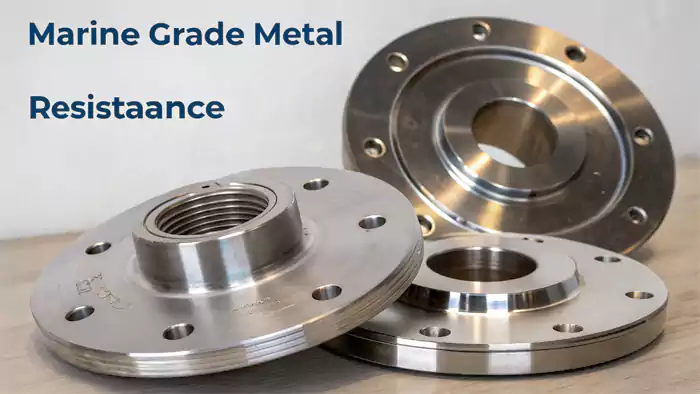
I have seen engineers overspecify 316 stainless for parts that only needed coating. I have also seen 304 fail in coastal automation systems. The difference is not branding. The difference is corrosion science and design judgment.
What Does “Marine Grade” Really Mean in Engineering Terms?
Many people use the term marine grade as if it were an official certification. It is not. That confusion creates expensive mistakes.
Marine grade is not a strict legal classification. It refers to alloys with high resistance to chloride corrosion, often evaluated using PREN values and salt spray testing such as ASTM B117.
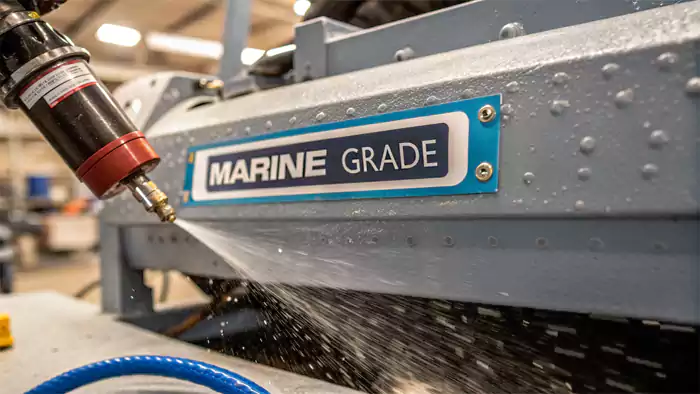
I define marine grade based on measurable performance.
Chloride Resistance
Chloride ions cause pitting corrosion. Seawater, road salt, and some cleaning chemicals contain chloride. Stainless steel resists corrosion because of chromium oxide film. Chloride breaks that film locally. Pits then grow fast.
PREN Value1
Engineers use PREN, or Pitting Resistance Equivalent Number, to compare stainless steels.
PREN formula:
PREN = %Cr + 3.3 × %Mo + 16 × %N
Higher PREN means better pitting resistance.
| Alloy | Typical PREN |
|---|---|
| 304 | ~18 |
| 316 | ~24 |
| 2205 Duplex | ~35 |
I do not trust labels. I look at PREN and environment.
Salt Spray Testing2
Many suppliers reference ASTM B117 salt spray testing. That test simulates corrosive exposure. It gives comparison data. It does not guarantee real-world life. Real conditions include stress, crevices, and temperature changes.
Marine grade is about corrosion performance, not marketing labeling.
Which Metals Truly Qualify as Marine Grade?
Many alloys are called marine grade. Only some perform well in chloride environments.
Common marine grade metals include 316/316L stainless steel, 2205 duplex stainless, 5083 aluminum, titanium Grade 2, and certain bronzes. 6061 aluminum and 304 stainless are not true marine grade in aggressive chloride exposure.
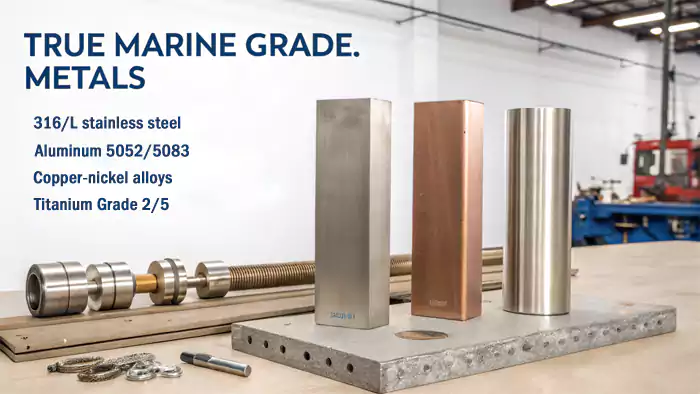
Below is a simplified engineering comparison.
| Material | PREN | Strength Level | Machinability | Cost Level | Typical Use |
|---|---|---|---|---|---|
| 316/316L | ~24 | Medium | Good | Medium | Coastal fixtures |
| 2205 Duplex3 | ~35 | High | Moderate | High | Offshore structures |
| 5083 Aluminum | N/A | Medium | Good | Medium | Marine panels |
| 6061 Aluminum | N/A | Medium | Excellent | Low | General structures |
| Titanium Grade 2 | Very High | Medium | Difficult | Very High | Chemical systems |
| Naval Bronze | N/A | Medium | Good | Medium | Marine hardware |
I often compare 316 and 2205 for industrial clients. Duplex offers higher strength and corrosion resistance. It also increases tool wear. Titanium offers extreme corrosion resistance. It also cuts slowly and costs more per hour to machine.
Material selection must match environment and budget.
When Do Automotive & Industrial Parts Actually Need Marine Grade Materials?
Many outdoor parts do not need marine grade alloys. Overdesign wastes money.
Marine grade metals are necessary when parts face chloride exposure, coastal environments, chemical washdown, or repeated sterilization. Not every outdoor part requires marine grade material.

I evaluate environment before material.
Automotive
Road salt exposure is common in Europe and North America. Underbody brackets and EV battery enclosures may see chloride splash. In those cases, 316 or coated aluminum may be required.
Industrial Equipment
Outdoor automation frames near coastal plants face airborne salt. Chemical washdown systems expose parts to chloride cleaners. Duplex stainless often performs better in those cases.
Medical Equipment
Repeated sterilization cycles use chloride-based cleaners. 316L often performs better than 304 in surgical environments.
Case Study: Coastal Automation Housing
I worked on a control housing for a coastal port automation system.
Project Data
| Parameter | Value |
|---|---|
| Environment | 1 km from coastline |
| Humidity | 85% average |
| Salt Exposure | Moderate airborne |
| Original Spec | 304 Stainless |
| Revised Spec | 316L Stainless |
| Wall Thickness | 6 mm |
| Batch Size | 150 pcs |
Results After 12 Months
| Material | Corrosion Condition |
|---|---|
| 304 | Visible pitting after 8 months |
| 316L | No visible corrosion |
Material upgrade increased part cost by 14%. Failure replacement would have cost 3× more. In this case, marine grade was justified.
What Are the Cost & Machining Implications of Marine Grade Alloys?
Many buyers assume material price is the main increase. Machining cost often rises more.
Marine grade alloys often increase machining cost due to lower cutting speeds, higher tool wear, and longer cycle times. In many cases, machining cost rises more than raw material cost.

I see these patterns often:
316 vs 304
Material cost difference: 10–25%.
Machining time difference: 5–10% increase due to work hardening.
2205 Duplex
Higher strength increases tool wear. Feed rates must drop. Tool life may reduce 20–30%.
Titanium Grade 2
Cutting speed is much lower. Heat concentration is high. Tool selection is critical. Cycle time can increase 40–60% compared to 316.
Surface Treatment Compatibility
Some coatings do not bond well to duplex. Anodizing differs between 5083 and 6061.
Lead time also increases if special stock is required.
I always tell procurement teams that marine grade often increases machining cost more than material cost.
How Can You Choose the Right Marine Grade Metal Without Overspending?
Many teams upgrade material to avoid risk. That is understandable. It is not always efficient.
You can reduce overspecification by evaluating PREN requirements, controlling galvanic corrosion, optimizing design drainage, and collaborating early with machining engineers. Early collaboration can prevent 15–30% material overspecification.

I use five checks:
1. Define Exposure Level
Is the part submerged, splashed, or only exposed to humidity? That answer changes everything.
2. Evaluate Galvanic Risk
Mixed materials can create galvanic corrosion4. I check electrical potential differences before finalizing design.
3. Consider Coatings
Sometimes coated 6061 performs well enough. That option reduces machining and material cost.
4. Improve Drainage
Poor drainage creates crevice corrosion5. Small geometry changes can improve life without alloy upgrade.
5. Start DFM Early
When engineers involve us early, we review geometry, tolerance, and environment together. That collaboration often saves more money than simply selecting a cheaper alloy.
I have learned that there is no single best alloy. The correct choice depends on environment, design, and process discipline.
Conclusion
Marine grade metals are defined by corrosion performance, not labels. The right alloy depends on environment, machining impact, and early engineering collaboration.

-
Explore this to understand how PREN Value quantifies pitting resistance, crucial for selecting marine grade stainless steel. ↩
-
Learn about salt spray testing limitations and why real-world conditions matter for marine grade corrosion performance. ↩
-
Explore this link to understand why Duplex stainless steel offers higher strength and corrosion resistance compared to 316, helping you make informed material choices. ↩
-
Explore this link to understand how to manage galvanic corrosion risks effectively in design, ensuring longer-lasting material performance. ↩
-
Learn how small geometry changes can prevent crevice corrosion, enhancing durability without costly alloy upgrades. ↩
