Last updated on May 14, 2026, by Lucy
Manufacturers lose time and money when drilled parts fail inspection or vary from batch to batch. I have seen projects delayed because a simple hole was off by less than 0.1 mm.
CNC drilling machines solve this problem by delivering fast, repeatable, and highly accurate hole machining for both prototype and production parts. They reduce labor, improve consistency, and support a wide range of materials and industries.
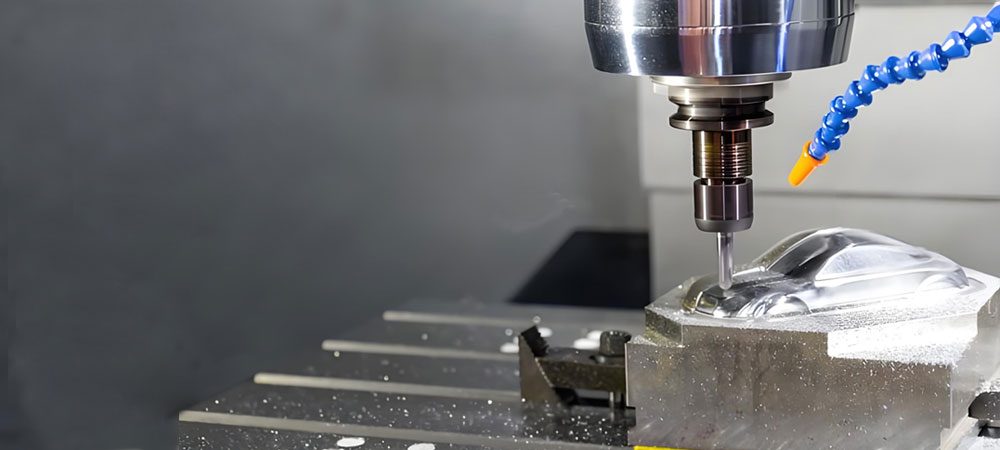
When I first worked in a machining shop, I thought drilling was one of the simplest operations in manufacturing. Later, I learned that large production runs depend heavily on drilling accuracy. One small error can affect assembly, strength, and final product quality. This is where CNC drilling machines changed the game for modern manufacturing.
What Is a CNC Drilling Machine?
Many companies still struggle with slow drilling operations and inconsistent hole quality. Manual drilling often creates alignment errors and wasted material.
A CNC drilling machine is an automated machine tool that uses computer-controlled instructions to drill precise holes into metal, plastic, or composite materials with high speed and repeatability.
How CNC Drilling Works
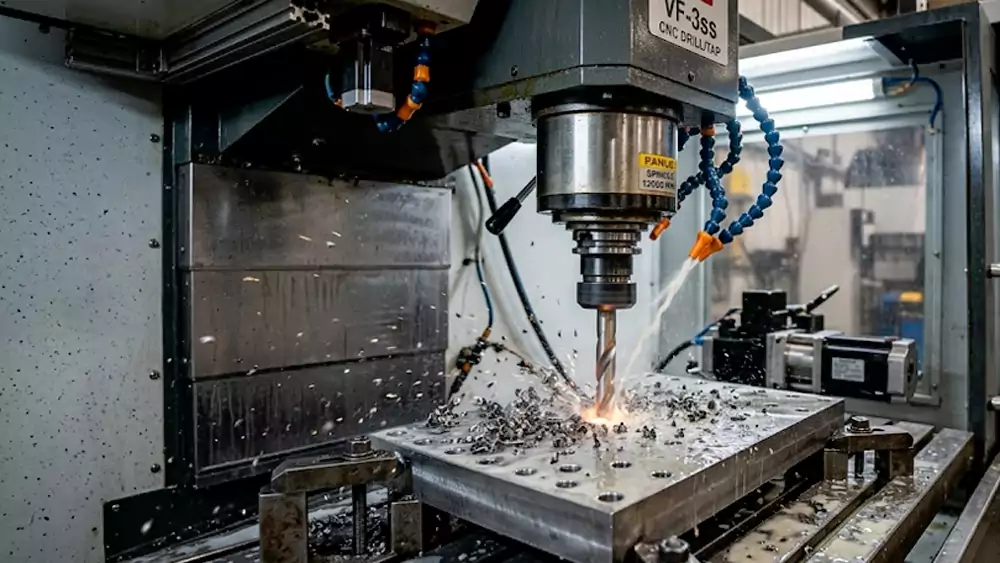
A CNC drilling machine follows digital instructions created in CAD/CAM software. The operator uploads the machining program into the machine controller. The spindle then moves along programmed axes and drills holes at exact positions and depths.
Most CNC drilling systems include:
| Component | Function |
|---|---|
| CNC Controller | Executes programmed instructions |
| Spindle | Rotates the drill tool |
| Tool Changer | Switches drill bits automatically |
| Worktable | Holds the material securely |
| Coolant System | Reduces heat during drilling |
I often explain CNC drilling to customers like this: the machine repeats the same movement thousands of times without losing focus. A human operator becomes tired. A CNC machine does not.
Common Industries Using CNC Drilling
CNC drilling supports many industries because drilled holes are required in almost every mechanical assembly.
Common industries include:
- Aerospace
- Automotive
- Medical devices
- Robotics
- Electronics
- Energy equipment
- Industrial automation
In industrial automation projects, I often see customers request mounting plates with more than 200 precision holes. Manual drilling would take too long and create too much variation.
CNC Drilling Machines vs Conventional Drilling Machines
Traditional drilling methods still work for simple jobs. Yet many manufacturers struggle when production volume increases or tolerances become tighter.
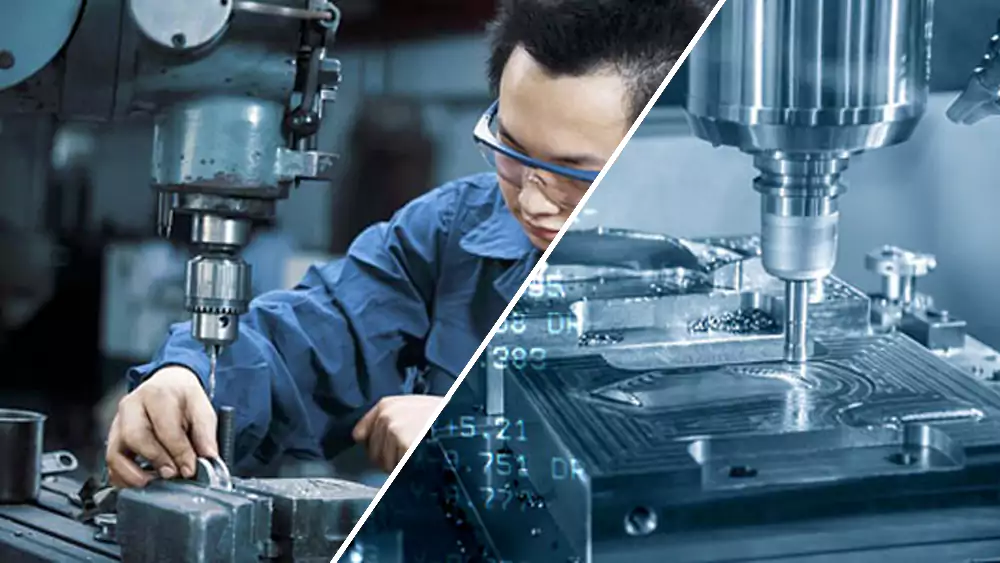
CNC drilling machines outperform conventional drilling in accuracy, production speed, labor efficiency, and long-term manufacturing cost control.
Accuracy and Repeatability
Manual drilling depends heavily on operator skill. Even experienced machinists can produce slight variations after long shifts.
CNC drilling machines maintain consistent positioning accuracy because the process is digitally controlled. Many modern systems can hold tolerances within ±0.01 mm.1
This consistency becomes critical in:
- Aerospace assemblies
- Precision fixtures
- Medical instruments
- Robotic systems
Production Speed
CNC drilling dramatically reduces machining time because the machine can automatically position, drill, and repeat operations without manual adjustment.
A manual operator may need several setup steps for each hole pattern. CNC systems complete the same operation in one automated cycle.
Labor Requirements
Traditional drilling often needs skilled machinists for every setup and adjustment. CNC systems reduce direct labor because one operator can manage multiple machines at the same time.
This helps manufacturers deal with labor shortages and rising labor costs.
Material Compatibility
Modern CNC drilling machines process many materials, including:
| Material Type | Examples |
|---|---|
| Metals | Aluminum, steel, titanium |
| Plastics | ABS, PEEK, nylon |
| Composites | Carbon fiber, fiberglass |
| Specialty Materials | Brass, copper, Inconel |
Cost Efficiency
The upfront investment for CNC equipment is higher. Yet long-term production costs are usually lower.
Reduced scrap, lower labor costs, and faster cycle times improve overall profitability.
I often tell customers that CNC drilling's real strength is not a perfect prototype. It is producing 10,000 identical parts with full quality confidence.
Types of CNC Drilling Machines
Many buyers choose the wrong drilling system because they do not fully understand machine configurations. Different projects require different drilling capabilities.
CNC drilling machines come in several designs, each optimized for specific part sizes, hole depths, production volumes, and machining layouts.
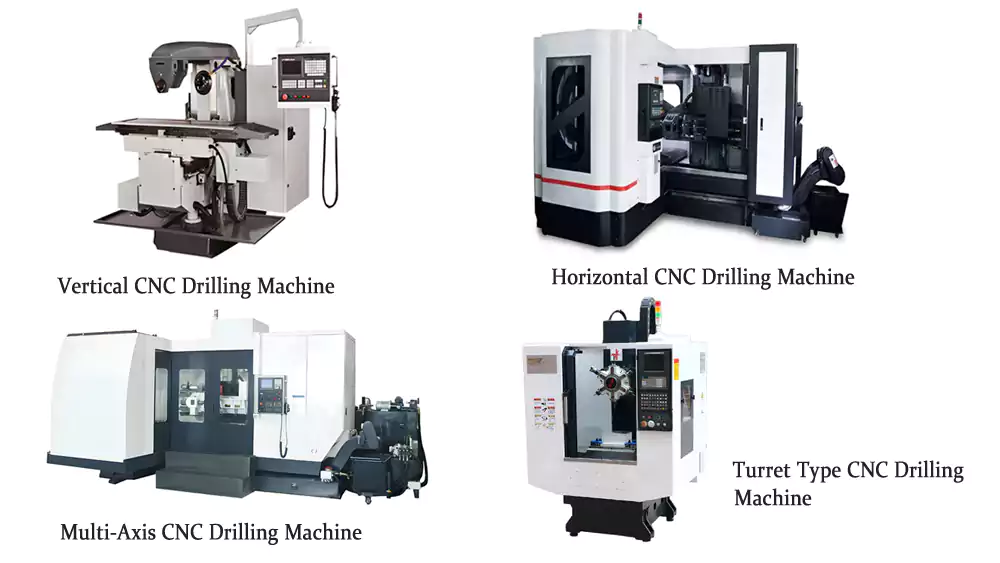
Vertical CNC Drilling Machines
Vertical drilling machines position the spindle above the workpiece. This is the most common configuration.
Advantages include:
- Simple setup
- Good visibility
- Strong versatility
- Lower equipment cost
These machines work well for plates, brackets, and general industrial parts.
Horizontal CNC Drilling Machines
Horizontal systems position the spindle sideways. They are ideal for heavy or large components.
Benefits include:
- Better chip removal
- Improved deep-hole drilling
- Easier handling of large workpieces
I often see horizontal machines used for oil and gas equipment or large machinery frames.
Multi-Spindle CNC Drilling Machines
Multi-spindle systems use several drill heads at the same time. This greatly improves production efficiency.
These machines are ideal for:
- Automotive production
- High-volume manufacturing
- Repetitive hole patterns
Deep Hole Drilling Machines
Deep hole drilling machines specialize in high depth-to-diameter ratios2.
They often include:
- High-pressure coolant systems
- Specialized carbide drills
- Precision chip evacuation systems
Industries like aerospace and medical manufacturing rely heavily on this technology.
Turret Drilling Machines
Turret systems allow fast tool changes by rotating multiple drill tools into position.
This setup reduces downtime and improves machining flexibility for parts requiring different hole sizes.
Real Factory Case Study: High-Volume Aluminum Housing Production
A customer in the robotics industry approached us with a major consistency problem. Their manual drilling process created alignment issues during final assembly.
We redesigned the process using a multi-spindle CNC drilling machine.
| Parameter | Before CNC | After CNC |
|---|---|---|
| Material | 6061 Aluminum | 6061 Aluminum |
| Hole Count per Part | 48 | 48 |
| Tolerance | ±0.12 mm | ±0.015 mm |
| Daily Output | 120 pcs | 780 pcs |
| Scrap Rate | 8.5% | 0.9% |
| Operators Required | 4 | 1 |
| Average Cycle Time | 17 min | 3.8 min |
What impressed the customer most was not only speed. It was consistency. Every housing fit perfectly during robotic assembly. That eliminated expensive rework and delayed shipments.
Key Advantages of CNC Drilling Machines for Custom Parts Manufacturing
Custom manufacturing projects often involve tight deadlines, strict tolerances, and frequent design updates. Manual drilling methods usually struggle in these situations.
CNC drilling machines help manufacturers produce custom parts faster, more accurately, and with lower risk compared to traditional drilling methods.
Higher Precision
Precision is one of the biggest advantages of CNC drilling.
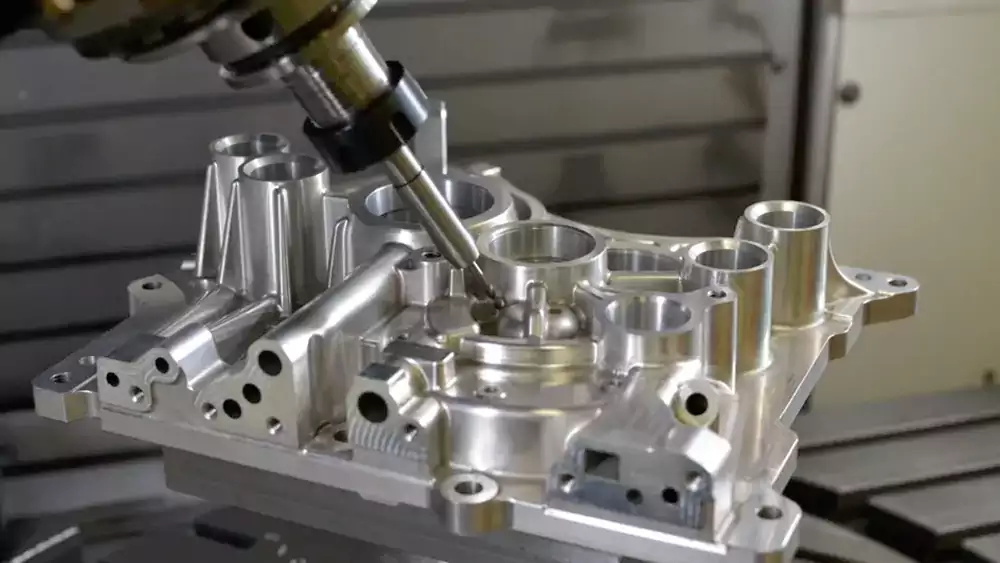
Modern CNC systems use servo motors and digital positioning systems3 that maintain exact hole placement over long production runs.
This matters greatly for:
- Assembly alignment
- Threaded holes
- Bearing locations
- Fluid channels
Faster Production
Automation removes many manual setup steps. CNC machines can run continuously with minimal interruption.
This improves:
- Lead times
- Production planning
- Delivery reliability
For customers under deadline pressure, this can make a huge difference.
Better Batch Consistency
One of the biggest problems in manufacturing is variation between batches.
CNC drilling solves this by repeating the exact same program every cycle.
This helps customers maintain:
- Stable product quality
- Easier assembly
- Lower inspection costs
Reduced Human Error
Even skilled machinists can make mistakes during repetitive work.
CNC systems reduce:
- Positioning mistakes
- Incorrect drill depth
- Wrong hole spacing
- Setup inconsistency
Lower Manufacturing Costs
Although CNC machines require investment, they reduce costs over time through:
| Cost Factor | CNC Benefit |
|---|---|
| Scrap Reduction | Fewer rejected parts |
| Labor Savings | Less manual operation |
| Faster Cycles | Higher productivity |
| Better Quality | Lower rework costs |
CAD/CAM Integration
Modern CNC drilling integrates directly with CAD/CAM software.
Engineers can move from digital design to production quickly and accurately.
This improves communication between:
- Design teams
- Production teams
- Quality departments
As someone who works closely with engineers, I know how valuable this integration becomes during design revisions.
Ideal for Custom Parts
Custom parts often include unique geometries and complex hole patterns.
CNC drilling handles these requirements efficiently because programs can be modified quickly without changing machine hardware.
This flexibility makes CNC drilling ideal for:
- Prototype development
- Small-batch production
- High-mix manufacturing
- Rapid product iteration
FAQ
What are the advantages of CNC drilling over manual drilling?
CNC drilling offers higher precision, faster production speed, better repeatability, reduced labor requirements, and lower human error compared to manual drilling.
Is CNC drilling suitable for prototype parts?
Yes. CNC drilling works very well for prototypes because programs can be adjusted quickly and complex hole patterns can be produced accurately without custom tooling.
What materials can CNC drilling machines process?
CNC drilling machines can process aluminum, steel, stainless steel, titanium, brass, plastics, composites, and many specialty engineering materials.
How accurate is CNC drilling?
Most modern CNC drilling machines can maintain tolerances between ±0.01 mm and ±0.05 mm depending on machine quality, tooling, and material conditions.
Conclusion
CNC drilling machines give manufacturers the speed, precision, and consistency needed for modern production. They help companies reduce waste, improve quality, and scale custom parts manufacturing with confidence.
-
"(PDF) The Influence of Accuracy in Establishing the Origin of the ...", https://www.academia.edu/64606165/The_Influence_of_Accuracy_in_Establishing_the_Origin_of_the_Part_on_the_Machining_Accuracy. A neutral engineering or machine-tool reference should document achievable CNC drilling or CNC machine positioning tolerances around ±0.01 mm, supporting the stated order of magnitude for modern systems. Evidence role: statistic; source type: education. Supports: Many modern CNC drilling systems can hold tolerances within ±0.01 mm.. Scope note: Tolerance capability depends on machine class, tooling, workholding, material, calibration, and environmental control; the source may support a typical capability range rather than guarantee every CNC drilling setup can achieve it. ↩
-
"Deep hole drilling - Wikipedia", https://en.wikipedia.org/wiki/Deep_hole_drilling. Deep-hole drilling literature defines the process by large length- or depth-to-diameter ratios and commonly discusses specialized coolant delivery and chip evacuation as enabling requirements. Evidence role: definition; source type: research. Supports: Deep hole drilling machines specialize in drilling holes with high depth-to-diameter ratios.. Scope note: Threshold ratios vary among references, so the citation should support the concept rather than a single universal cutoff unless a specific standard is cited. ↩
-
"Servocontrol of machine-tools: a review - Academia.edu", https://www.academia.edu/93749064/Servocontrol_of_machine_tools_a_review. A manufacturing engineering source explains that CNC machine tools commonly use servo-driven axes with digital position control or feedback to move cutting tools to programmed coordinates, supporting the mechanism behind precise hole placement. Evidence role: mechanism; source type: education. Supports: Modern CNC systems use servo motors and digital positioning systems that maintain exact hole placement over long production runs.. Scope note: This supports the control principle, but actual placement accuracy depends on machine calibration, rigidity, tooling, and operating conditions. ↩
