Last updated on April 28, 2026, by Lucy
Many engineers struggle to choose between CNC machining and 3D printing. The wrong choice can waste time, increase costs, and delay product launch.
CNC machining is best for high-precision, strong, and production-ready parts, while 3D printing is ideal for fast prototypes and complex geometries; the right choice depends on your design requirements, material, and production volume.
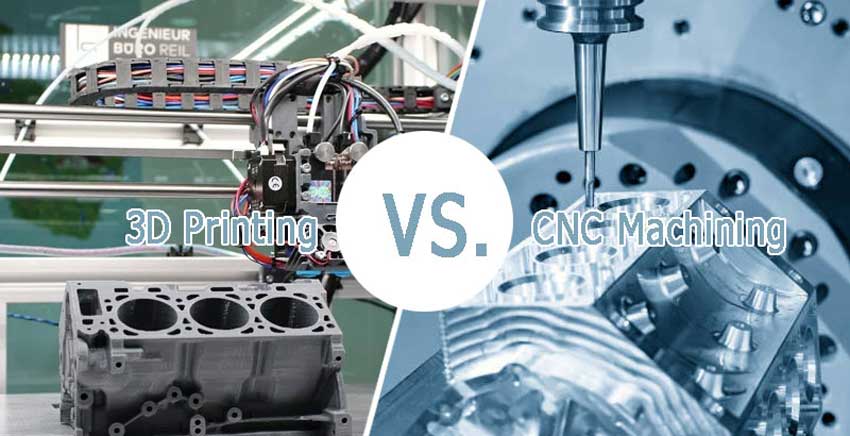
I have faced this decision many times in real projects. The choice is not just about technology. It is about risk, speed, and final performance. So I will walk you through how I actually decide in real-world scenarios.
CNC Machining and 3D Printing Explained?
Many engineers mix these two processes early in product development. That confusion often leads to wrong assumptions and poor decisions.
CNC machining removes material from a solid block to achieve high precision and strength, while 3D printing builds parts layer by layer, enabling fast production and complex geometries but with lower structural consistency.
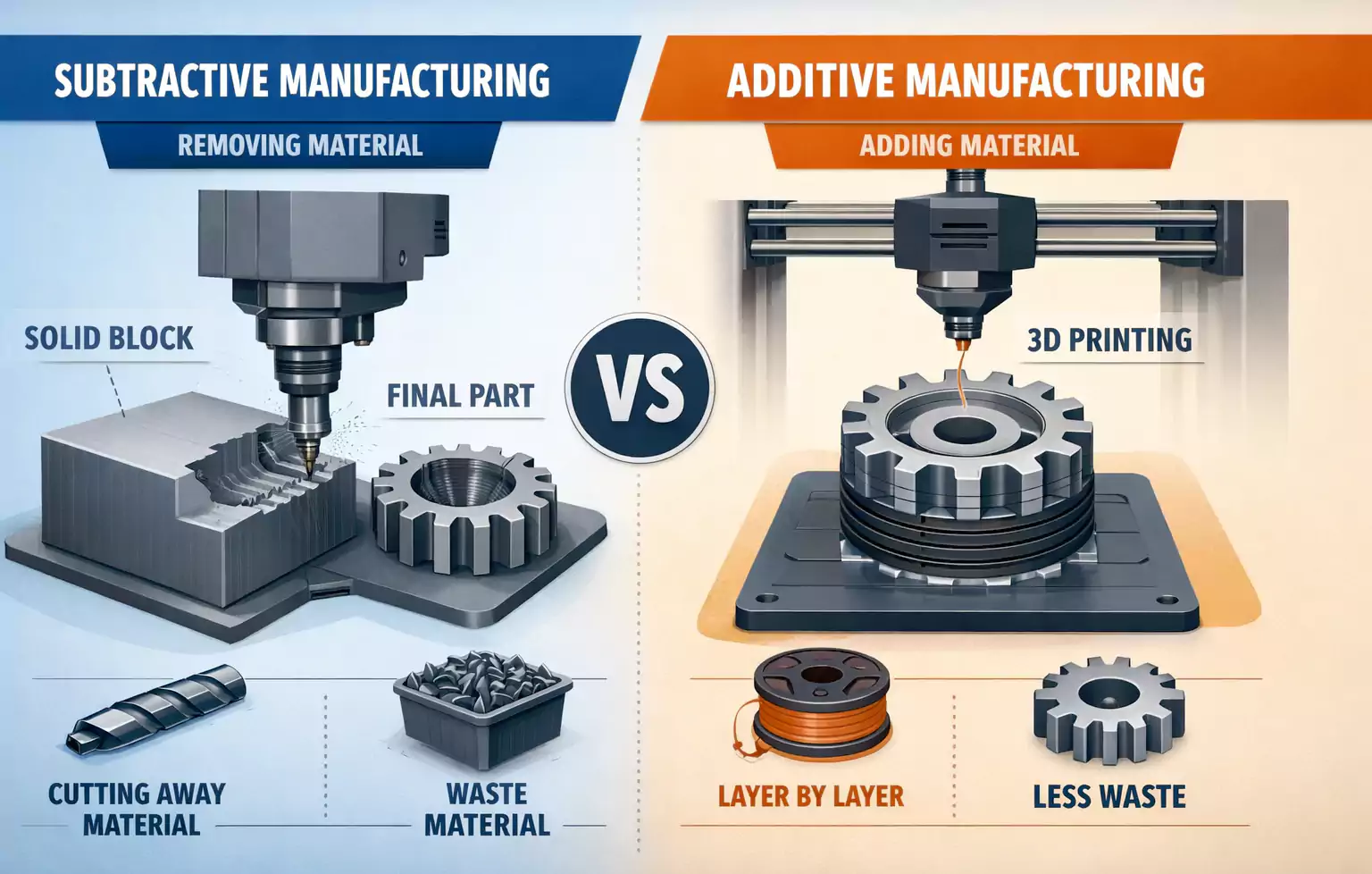
To make a confident decision, I always start by understanding how each process works at its core. That clarity prevents mistakes later.
What Is CNC Machining?
Subtractive Manufacturing Process
CNC machining starts with a solid block. I use cutting tools to remove material step by step until the final geometry is achieved.
Common Materials
I often choose aluminum, steel, titanium, or engineering plastics. These materials offer stable performance and predictable behavior.
Typical Industrial Applications
I rely on CNC machining for automotive, aerospace, and industrial systems where precision and durability are critical.
What Is 3D Printing?
Additive Manufacturing Process
3D printing builds parts layer by layer. It allows me to create shapes that are impossible with traditional machining.
Main Technologies
FDM, SLA, and SLS are the most common methods1 I use depending on the application.
Common Materials and Limitations
Most materials are polymers or resins. While convenient, they often lack the strength needed for demanding environments.
Fundamental Differences Between the Two Technologies
- CNC removes material, 3D printing adds material
- CNC produces dense parts, 3D printing may introduce internal weaknesses
- CNC ensures uniform strength, 3D printing depends on layer bonding
CNC Machining vs 3D Printing: A Detailed Comparison?
Choosing between these methods is not about preference. It is about performance under real conditions.
CNC machining delivers superior precision, strength, and surface finish, while 3D printing provides faster turnaround and greater design flexibility for early-stage development.
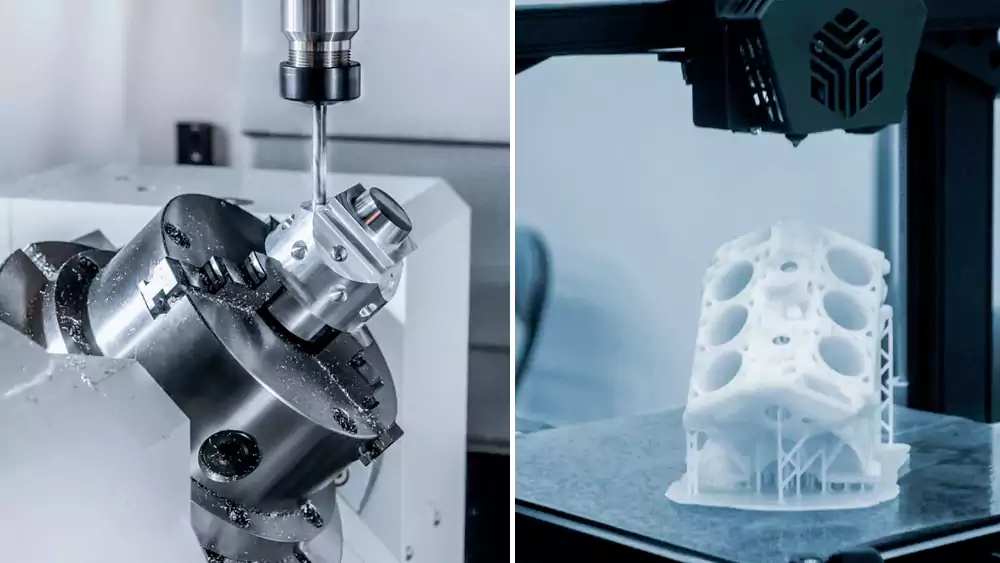
At this stage, I always compare based on measurable factors. This avoids emotional decisions and keeps the project on track.
Precision and Tolerances
CNC Machining Tolerances
I regularly achieve ±0.01 mm or tighter. This is essential for assemblies and sealing components.
3D Printing Accuracy
Accuracy varies depending on machine and material. I often see ±0.1 mm or worse.
Material Strength and Mechanical Properties
Isotropic vs Anisotropic
CNC parts are isotropic. Strength is consistent in all directions.
3D printed parts are anisotropic. Weakness exists between layers.2
Load-Bearing Suitability
For structural or load-bearing parts, I always choose CNC machining.
Surface Finish and Post-Processing
Surface Roughness
CNC delivers smooth finishes directly from the machine.
3D printed parts usually require additional finishing.
Secondary Finishing
CNC supports anodizing, polishing, and coating without issues.
Cost Comparison
Prototype vs Production
3D printing is cost-effective for single parts.
CNC becomes more economical as volume increases.
Setup vs Unit Cost
CNC has setup costs but benefits from lower unit pricing in batches.
Hidden Costs
3D printing often includes extra labor for post-processing.
Lead Time and Production Speed
Rapid Prototyping
3D printing allows me to validate designs quickly.
Batch Production
CNC machining provides consistent speed and repeatability in production.
Design Complexity and Geometry Freedom
Complex Structures
3D printing handles internal channels and organic shapes easily.
CNC Constraints
Tool access limits certain features like deep cavities or undercuts.
Quick Comparison Table
| Comparison Factors | CNC Machining | 3D Printing |
|---|---|---|
| Accuracy & Surface Quality | Superior accuracy and surface finish, ideal for tight tolerances | Requires post-processing to achieve similar quality |
| Material Selection | Works with a wide range of materials, consistent strength | Limited materials, may not meet strength requirements |
| Production Speed | More setup time, efficient for large-scale production | Faster for small batches and prototypes with minimal setup |
| Cost-Effectiveness | More cost-effective for large-volume production | More economical for small runs and custom parts |
| Part Complexity | Can handle complex shapes, but may need extra steps/tools | Excels at complex geometries and intricate designs |
| Strength & Durability | Produces stronger, more durable parts, especially with metals | Less durable, better suited for prototyping unless specialized materials used |
When to Choose CNC Machining or 3D Printing?
The real value comes from knowing when to use each process. This is where many projects succeed or fail.
Choose CNC machining for high precision, strong materials, and scalable production, while 3D printing is best for rapid prototyping, complex geometries, and low-volume parts.
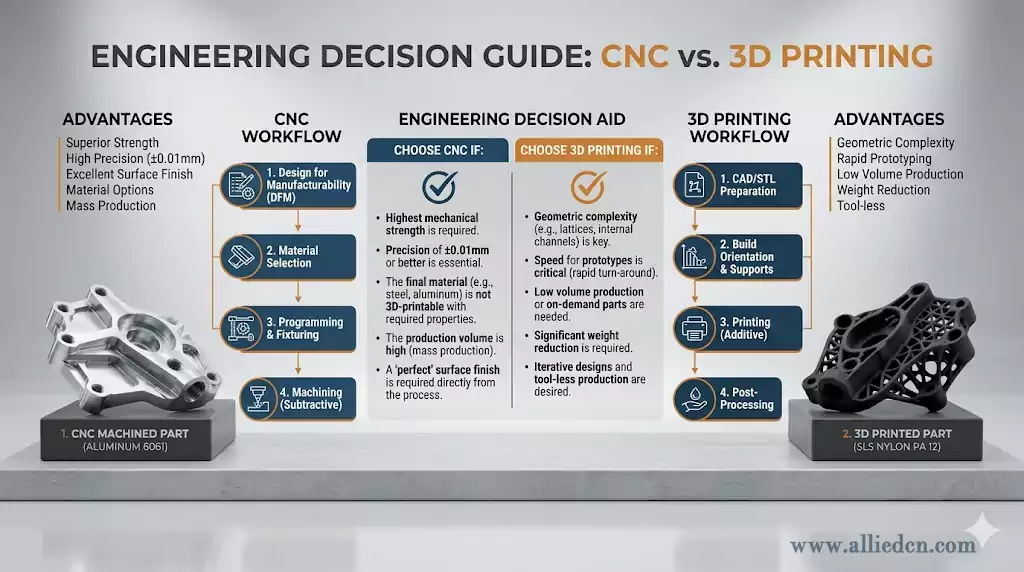
I always connect the process choice directly to the application. That approach keeps both cost and performance under control.
When CNC Machining Is the Better Choice
- High precision components
- Metal structural parts
- Medium to high volume production
- Tight tolerances and surface finish requirements
When 3D Printing Is the Better Choice
- Rapid prototyping
- Complex geometries
- Low-volume or one-off parts
Industry-Specific Recommendations
Automotive & Motorcycle Parts
I use CNC machining for engine components and structural parts that face stress and heat.
Medical Devices
Precision and reliability make CNC machining the preferred choice.
Industrial Machinery
Durability and repeatability are key, so CNC is the safer option.
Hydraulic Components
Leak prevention and pressure resistance require CNC-level accuracy.
Case Study: Real Project Comparison
I worked on a hydraulic valve housing where the client tested both processes.
| Parameter | 3D Printing (SLS Nylon) | CNC Machining (Aluminum 6061) |
|---|---|---|
| Tolerance | ±0.15 mm | ±0.01 mm |
| Surface Roughness | Ra 12.5 μm | Ra 1.6 μm |
| Pressure Resistance | 8 MPa | 25 MPa |
| Lead Time | 2 days | 5 days |
| Unit Cost (50 pcs) | $38 | $22 |
This result showed a clear pattern. 3D printing helped validate the concept quickly. CNC machining delivered the final performance needed for real use.
Combining CNC Machining and 3D Printing for Better Results?
In many projects, the best answer is not choosing one process. It is using both in the right sequence.
Use 3D printing for rapid prototyping and design validation, then switch to CNC machining for final production to achieve strength, precision, and scalability.
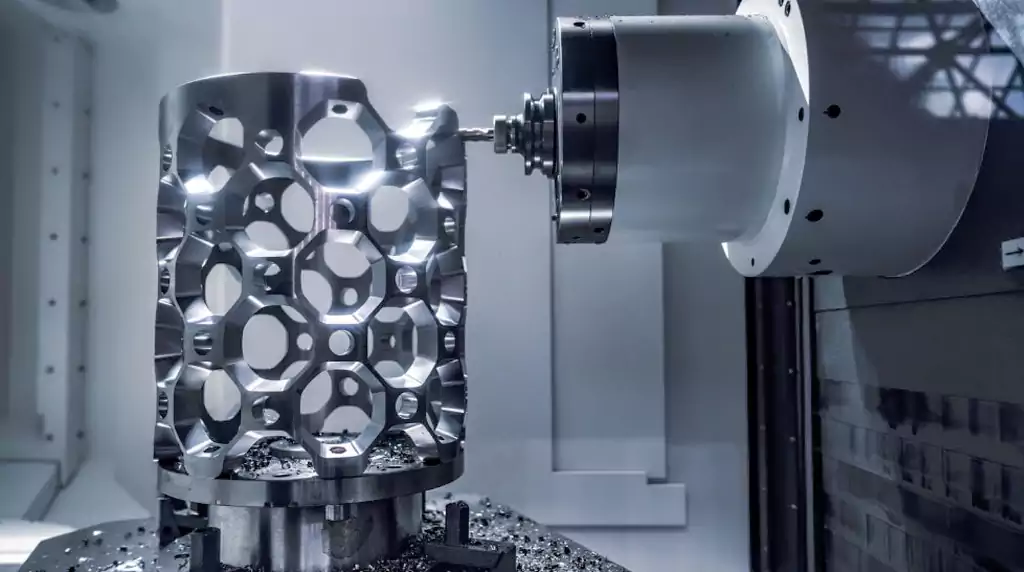
When I combine both methods, I reduce risk and move faster. This approach works especially well in product development cycles.
Hybrid Manufacturing3 Workflow
3D Printing for Prototyping
I use it to test fit4, function, and design quickly.
CNC Machining for Final Production
Once the design is stable, I move to CNC for reliability and consistency.
Reducing Time-to-Market
Faster Iteration
3D printing allows quick design changes without tooling delays.
Lower Development Risk
Early testing helps identify issues before production.
Cost Optimization Strategies
When to Switch
I switch when tolerances, strength, or surface finish become critical.
Balancing Cost
I balance flexibility in early stages with efficiency in production.
FAQs About CNC Machining vs 3D Printing?
Is 3D printing cheaper than CNC machining?
Yes for prototypes. No for batch production.
Can 3D printing replace CNC machining?
No. It cannot match mechanical performance in most industrial cases.
Which process offers better surface finish?
CNC machining provides significantly better surface quality.
Are 3D printed parts strong enough?
They are suitable for testing but limited for heavy-duty applications.
What is the typical tolerance?
CNC: ±0.01 mm
3D printing: ±0.1–0.3 mm
Which is better for metal parts?
CNC machining is the most reliable and cost-effective choice.
Conclusion
CNC machining and 3D printing solve different problems at different stages. I use 3D printing to move fast and test ideas early. I use CNC machining to ensure precision, strength, and consistency in final parts. The best results come from knowing when to switch and how to combine both to reduce risk, control cost, and deliver reliable products.

-
"3D printing processes - Wikipedia", https://en.wikipedia.org/wiki/3D_printing_processes. Industry surveys and encyclopedic sources identify FDM (Fused Deposition Modeling), SLA (Stereolithography), and SLS (Selective Laser Sintering) as the most widely used 3D printing technologies, particularly for prototyping and production applications. The prevalence of these methods may vary by industry and region. Evidence role: general_support; source type: encyclopedia. Supports: FDM, SLA, and SLS are the most common methods I use depending on the application.. Scope note: Relative popularity may differ in specialized sectors or geographic areas. ↩
-
"[PDF] Experimental Characterization of the Mechanical Properties of 3D ...", https://web.mae.ufl.edu/rapidpro/pages/3D%20Printing%20Paper%20Final%20Manuscript.pdf. Research and technical literature confirm that most 3D printed parts, especially those made by FDM and similar processes, exhibit anisotropic mechanical properties with reduced strength between layers. Evidence role: mechanism; source type: paper. Supports: 3D printed parts are anisotropic, with weakness between layers.. Scope note: The degree of anisotropy varies by printing technology and material. ↩
-
"What is Hybrid Manufacturing?", https://www.firetrace.com/fire-protection-blog/hybrid-manufacturing. The term 'hybrid manufacturing' is commonly used to describe workflows that combine additive manufacturing (such as 3D printing) and subtractive manufacturing (such as CNC machining) to leverage the strengths of both methods in product development and production. Evidence role: definition; source type: encyclopedia. Supports: Hybrid Manufacturing refers to combining 3D printing and CNC machining in a single workflow to optimize product development and production.. ↩
-
"How Rapid Prototyping with 3D Printing Transforms Product ...", https://avidpd.com/prototyping/how-rapid-prototyping-with-3d-printing-is-transforming-product-development-at-every-stage/. Testing fit is a common application of 3D printing in prototyping, as it allows designers to quickly evaluate whether parts assemble or interact as intended before committing to final manufacturing processes. Evidence role: mechanism; source type: encyclopedia. Supports: 3D printing is used to test fit, function, and design quickly during prototyping.. Scope note: This support is limited to the prototyping phase and may not address all aspects of final product performance. ↩
