Editor's Note: Last updated on May 29, 2026, by Lucy
Manufacturing sounds simple until a late shipment shuts down an entire production line. Many buyers learn too late that good design means nothing if nobody can build the part correctly.
Manufacturing is the industrial process of converting raw materials into finished products through machining, forming, molding, assembly, inspection, and other controlled production methods. Modern manufacturing improves product quality, production speed, cost efficiency, and consistency by combining engineering, automation, and precision production systems.
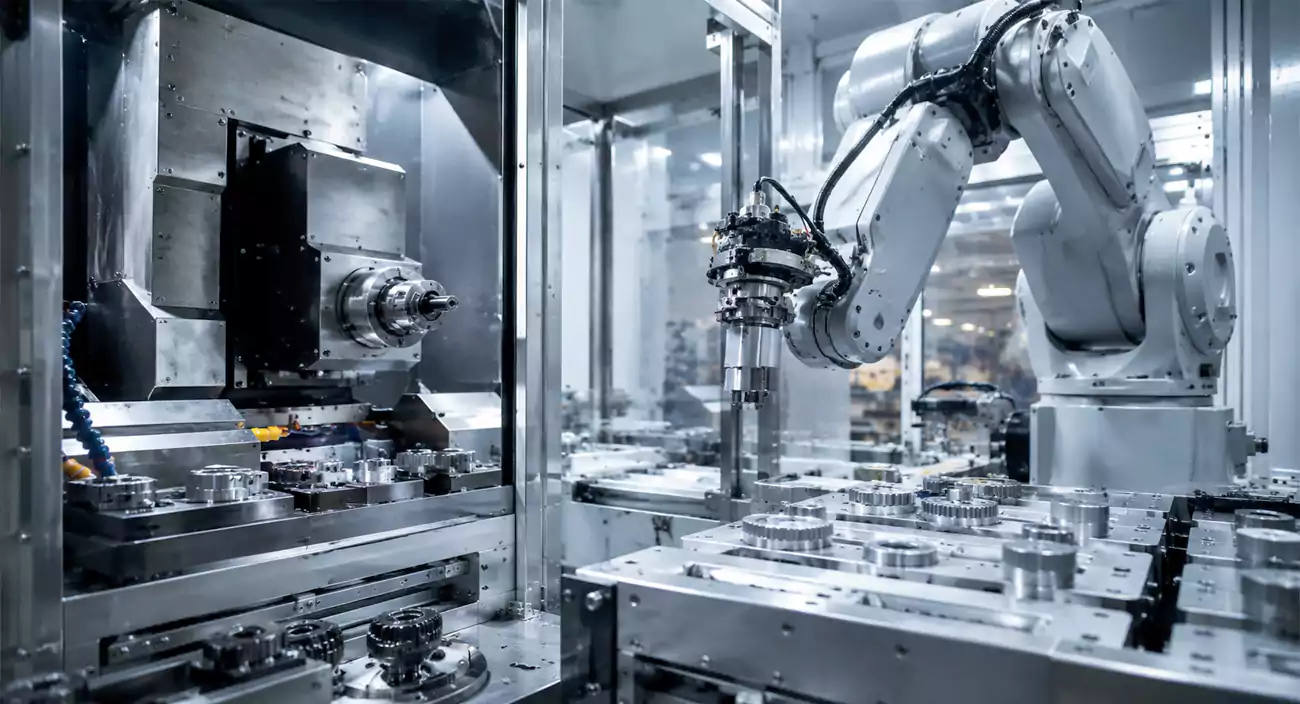
I started learning manufacturing on a noisy shop floor beside old CNC machines and inspection benches. Over time, I realized manufacturing is not only about making parts. It is about solving problems under pressure, cost limits, and delivery deadlines.
What is Manufacturing and How Has It Evolved?
Many people think manufacturing only means factories and machines. That view misses the real story. Manufacturing changes every year because materials, software, automation, and customer demands keep changing.
Manufacturing evolved from manual labor and mechanical production into automated, software-driven, and precision-controlled systems. Today’s manufacturers use CNC machining, robotics, CAD/CAM software, digital inspection, and smart factory technologies to improve production speed, dimensional accuracy, and repeatable quality.
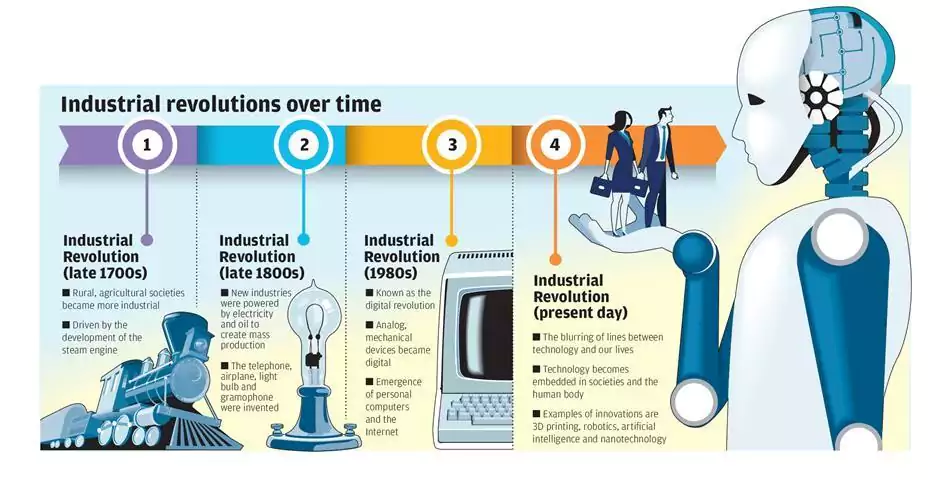
When I first entered the machining industry, many shops still depended heavily on operator experience. Some machinists could almost "feel" the correct cutting condition by sound alone. Today, software handles much of that work. Toolpath simulation, digital twins, and machine monitoring reduce human error and improve repeatability.1
From Manual Production to Automated Systems
Older manufacturing relied on hand tools, manual lathes, and mechanical setups. Production was slower. Quality varied from operator to operator. Lead times were longer. Scrap rates were higher.
Modern manufacturing uses:
| Manufacturing Era | Main Characteristics | Limitations |
|---|---|---|
| Manual Manufacturing | Hand tools, low-volume production | Slow output, inconsistent quality |
| Mechanized Manufacturing | Powered equipment and assembly lines | Limited flexibility |
| CNC Manufacturing | Programmable precision machining | Higher equipment investment |
| Smart Manufacturing | Automation, sensors, AI integration | Requires digital infrastructure |
Today, manufacturers can machine complex aerospace components within micron-level tolerances. That level of precision was difficult and expensive decades ago.
Why Modern Manufacturing Matters
Manufacturing supports almost every industrial sector. Without it, product design remains only a digital file. Engineers need suppliers who can transform CAD drawings into repeatable production parts.
I often tell customers this:
A drawing that cannot be manufactured inside budget and tolerance is only theory.
That is why manufacturability matters during product development.
What Are the Main Types of Manufacturing Processes?
Many buyers focus only on CNC machining. In reality, manufacturing includes many production methods. Each process solves different engineering problems.
The main manufacturing processes include CNC machining, casting, forming, fabrication, injection molding, additive manufacturing, and assembly. The best manufacturing method depends on material type, production volume, part geometry, tolerance requirements, and final product performance goals.
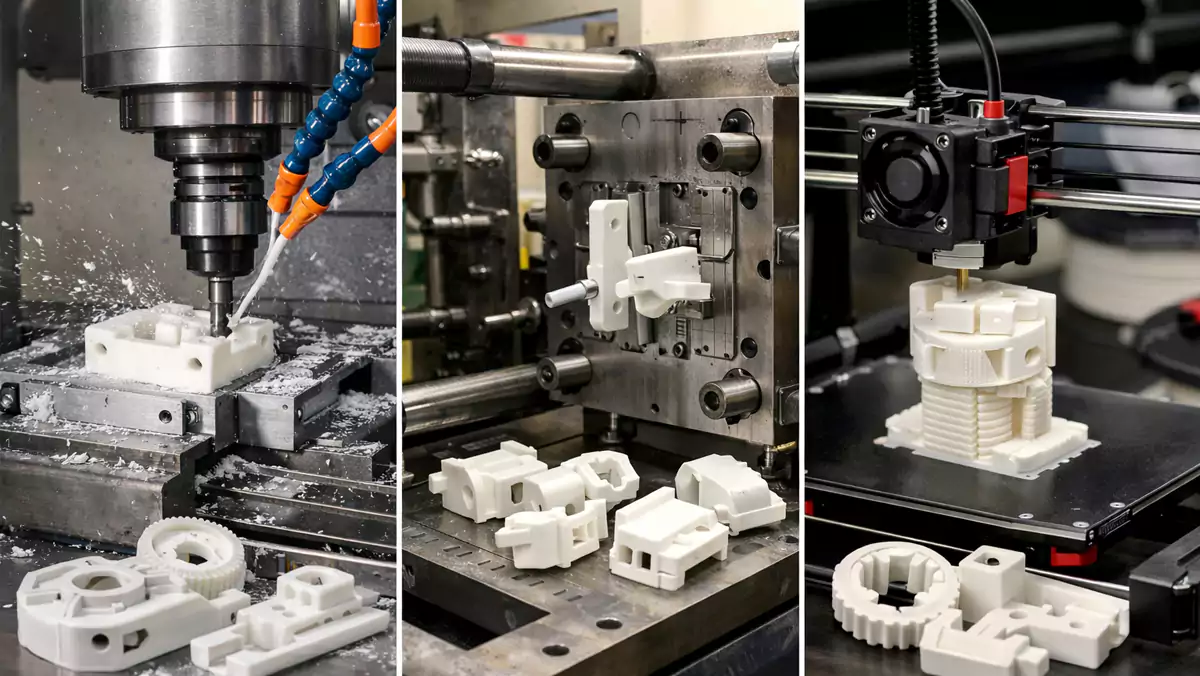
One mistake I often see is choosing a process before understanding production volume. A prototype solution may fail completely during mass production.
CNC Machining
CNC machining removes material using cutting tools controlled by programmed instructions. It works well for high-precision parts and tight tolerances.
Common CNC operations include:
- Milling
- Turning
- Drilling
- Grinding
- EDM machining
CNC machining is widely used in aerospace, robotics, medical devices, and industrial automation.
Casting and Forming
Casting pours molten material into molds. It works well for complex geometries and large production volumes2.
Forming changes material shape without removing material. Examples include:
- Forging
- Stamping
- Rolling
- Extrusion
These methods improve production speed and reduce waste in high-volume manufacturing.
Additive Manufacturing
3D printing builds parts layer by layer. It helps with rapid prototyping and low-volume custom production.
Still, additive manufacturing does not replace CNC machining in many precision industries because surface finish, dimensional stability, and material strength can still vary.
Case Study: Precision Aluminum Housing Production
I once worked with an automation equipment customer that needed lightweight aluminum control housings for robotic systems.
| Parameter | Value |
|---|---|
| Material | 6061-T6 Aluminum |
| Quantity | 2,500 units |
| Tolerance | ±0.02 mm |
| Surface Finish | Ra 1.6 |
| Machining Time Before Optimization | 42 minutes |
| Machining Time After Optimization | 27 minutes |
| Tool Life Improvement | 31% |
| Scrap Rate Reduction | From 4.8% to 1.2% |
| Delivery Lead Time | Reduced from 28 days to 18 days |
We optimized the fixture setup, reduced unnecessary tool movement, and improved coolant flow around deep pocket areas. Those changes reduced machine idle time and stabilized dimensional consistency across production batches.
That project reminded me that manufacturing efficiency usually comes from hundreds of small process improvements, not one dramatic change.
Which Industries Depend on Modern Manufacturing?
Many industries depend on manufacturing, but each industry has different standards, risks, and production priorities.
Industries such as aerospace, automotive, robotics, electronics, medical devices, energy, and industrial automation rely on advanced manufacturing to achieve precision, reliability, scalability, regulatory compliance, and stable production quality.
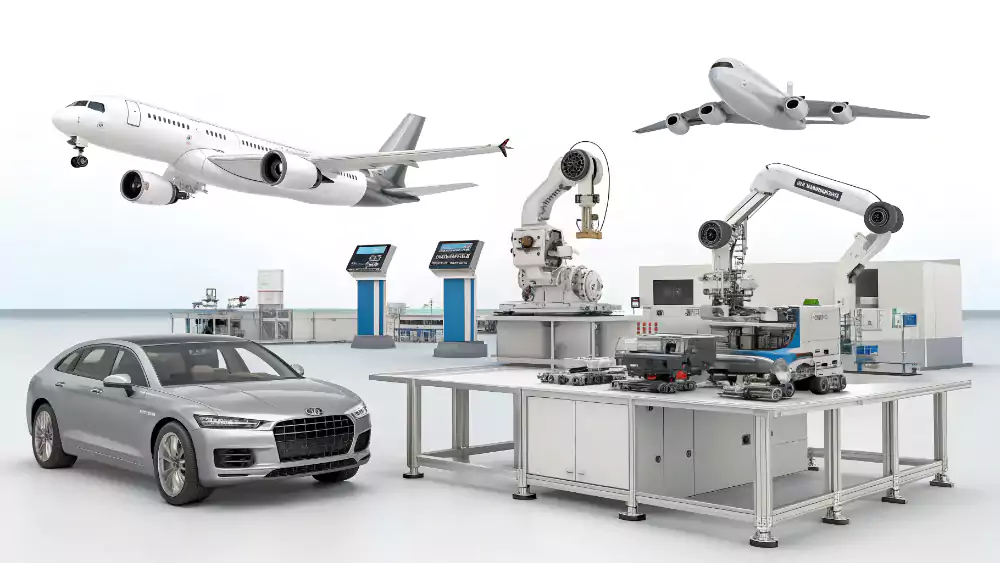
I noticed early in my career that every industry defines "quality" differently. Aerospace buyers care deeply about traceability. Medical customers focus on validation and surface cleanliness. Robotics companies prioritize repeatability and assembly accuracy.
Aerospace Manufacturing
Aerospace parts require:
- Tight tolerances
- Material certification
- Full inspection reports
- Process traceability
Even small dimensional errors may affect safety and performance.
Medical Device Manufacturing
Medical manufacturing requires:
- Biocompatible materials
- Strict cleanliness standards
- Precision finishing
- Regulatory compliance
Surface defects that seem minor in industrial products may become unacceptable in surgical applications.
Industrial Automation and Robotics
This sector depends heavily on custom machining because robotic systems often use:
- Precision brackets
- Servo housings
- Motion control components
- Linear guide assemblies
Engineers in automation industries usually need fast prototype cycles and stable production quality.
Consumer Electronics and EV Industries
Electronics manufacturing emphasizes:
- Lightweight materials
- Miniaturized components
- High-volume scalability
- Cosmetic surface quality
Electric vehicle manufacturing also pushes suppliers toward lightweight alloys and thermal management components.
Reliable suppliers with flexible precision manufacturing capabilities often become long-term partners for companies operating in these fast-moving industries.
What Factors Affect Manufacturing Cost, Quality, and Efficiency?
Many buyers focus only on unit price. That approach often creates hidden costs later through delays, scrap, rework, or assembly failures.
Manufacturing cost, quality, and efficiency are affected by material selection, tolerance requirements, machining strategy, tooling, setup complexity, production volume, inspection standards, and supply chain stability. Optimizing these factors helps manufacturers reduce waste, improve consistency, and shorten lead times.
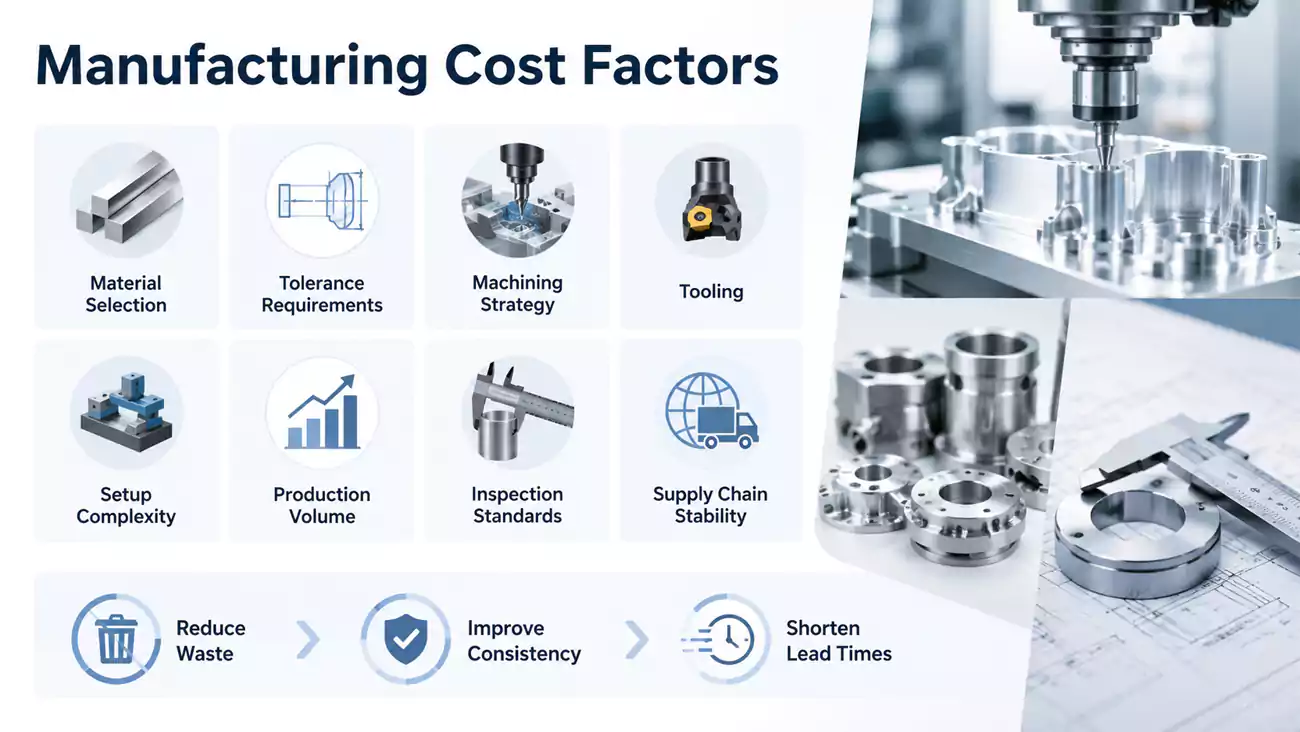
I have seen projects fail because drawings included unnecessarily tight tolerances3. Sometimes a tolerance change from ±0.005 mm to ±0.02 mm reduces machining cost dramatically without affecting function.
Main Cost Drivers
| Factor | Impact on Manufacturing |
|---|---|
| Material Type | Harder materials increase machining time |
| Tolerance Requirements | Tight tolerances require slower machining |
| Production Volume | Higher volume lowers unit cost |
| Surface Finish | Extra finishing increases labor |
| Setup Complexity | More setups increase production time |
| Inspection Standards | Additional QC adds cost |
Quality Control Matters
Strong quality systems reduce production risk. Good manufacturers usually use:
- CMM inspection
- First article inspection
- SPC monitoring
- Material traceability
- Process documentation
Consistent quality becomes especially important during repeat production.
Efficiency Comes from Process Stability
Many people assume faster machining always improves efficiency. That is not always true. Aggressive cutting conditions may increase scrap rates and tool wear.
Stable manufacturing processes usually produce better long-term profitability.
What Is the Future of Manufacturing?
Many factories still operate with old production methods. At the same time, new technologies are changing how products are designed, monitored, and manufactured.
The future of manufacturing will rely on smart factories, AI-assisted production, robotics, digital quality monitoring, automated inspection, and connected supply chains. These technologies help manufacturers improve efficiency, reduce downtime, increase production visibility, and support faster product development cycles.
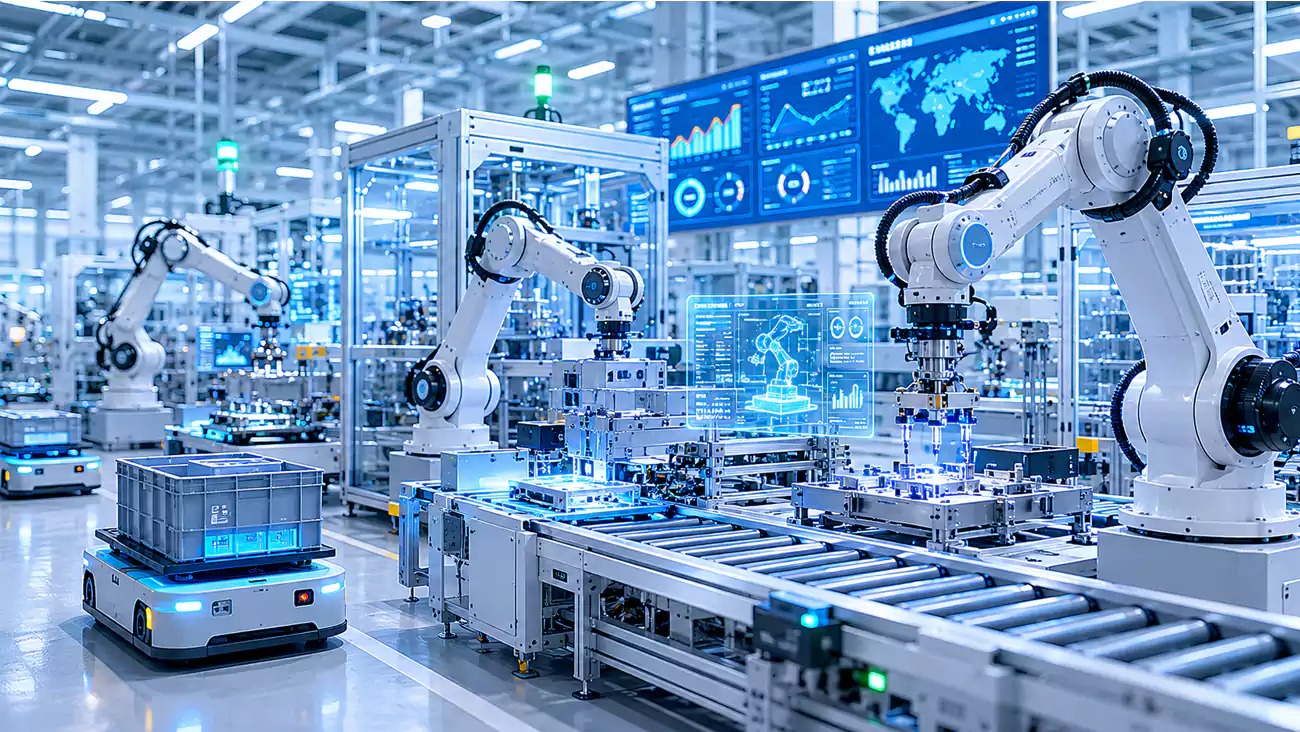
I believe the next major shift will come from connected manufacturing systems. Machines already generate huge amounts of production data. The challenge is turning that data into useful decisions.
Smart Manufacturing
Modern factories increasingly use:
- Real-time machine monitoring
- Predictive maintenance
- Automated inspection systems
- AI-assisted production scheduling
- Cloud-based manufacturing management
These systems reduce downtime and improve production visibility.
Sustainability and Manufacturing
Customers now pay more attention to:
- Material waste reduction
- Energy efficiency
- Recyclable materials
- Sustainable supply chains
Manufacturers that ignore sustainability may face higher operating costs later.
Human Skill Still Matters
Automation is growing fast, but experienced engineers and machinists still matter. Machines follow instructions. Skilled people solve unexpected problems.
The best manufacturing companies combine automation with practical shop-floor experience.
Conclusion
Manufacturing is the bridge between engineering ideas and real-world products. Strong manufacturing combines precision, efficiency, process control, and practical experience to deliver reliable parts on time, inside tolerance, and at production scale. Companies that invest in modern manufacturing systems and dependable production partners will stay more competitive as industries continue to demand faster development cycles, higher quality standards, and greater supply chain stability.
Footnote on evidence:
-
"[PDF] Digital Twins for Part Acceptance in Advanced Manufacturing ...", https://tsapps.nist.gov/publication/get_pdf.cfm?pub_id=933613. A neutral review or standards-oriented source on smart manufacturing supports that simulation, digital twins, and monitoring systems are used to detect process deviations, validate operations, and improve consistency in manufacturing workflows. Evidence role: general_support; source type: research. Supports: Toolpath simulation, digital twins, and machine monitoring can reduce human error and improve repeatability in modern manufacturing.. Scope note: Such sources typically support the general mechanism and intended benefits, but may not quantify error reduction or repeatability improvement for every machining environment. ↩
-
"What is investment casting? Process, Benefits, and Applications", https://alliedcasting.com/what-is-investment-casting/. Foundry and manufacturing literature explains that casting can produce geometrically complex components and is commonly used when tooling costs can be amortized across medium-to-large production runs. Evidence role: mechanism; source type: education. Supports: Casting works well for complex geometries and large production volumes.. Scope note: Casting economics vary by process, alloy, mold type, and tooling cost, so the evidence would contextualize rather than prove suitability for every high-volume part. ↩
-
"How Increasing Design Tolerance Can Cut Costs", https://www.ewmfg.com/post/how-increasing-design-tolerance-can-cut-costs. Engineering design and manufacturing references describe tighter dimensional tolerances as increasing production and inspection difficulty, providing context for the claim that over-specified tolerances can raise manufacturing cost. Evidence role: general_support; source type: education. Supports: Unnecessarily tight tolerances can cause projects to fail or become more expensive, and relaxing tolerances can reduce machining cost without affecting function.. Scope note: The source is likely to support the general relationship between tolerance stringency and cost, not the specific ±0.005 mm to ±0.02 mm cost comparison in this article. ↩
