Last updated on May 13, 2026, by Lucy
The CNC machining market keeps growing fast. Many buyers still struggle to find suppliers who can deliver precision parts, stable quality, and fast lead times at the same time.
The global CNC machining market is expanding because industries now need more high-precision parts, faster product development, and flexible low-volume production. China remains important because many suppliers can combine cost control, scalable capacity, and precision machining for global buyers.

I have worked in CNC machining for many years. I started as a machinist on the shop floor. Later, I built my own machining company. During this time, I saw one clear change. Buyers no longer look only for cheap parts. They now look for suppliers who can solve engineering problems, manage tight tolerances, and deliver stable quality over long production cycles.
Global CNC Machining Market Overview
The CNC machining market continues to grow because modern industries depend on precision manufacturing. Aerospace, robotics, EVs, and medical devices all require complex parts with strict tolerances. Traditional manufacturing methods cannot meet many of these requirements.
The global CNC machining market is growing steadily due to automation, industrial upgrading, and increasing demand for high-precision components across multiple industries. Asia-Pacific leads production capacity, while North America and Europe continue driving high-value demand.
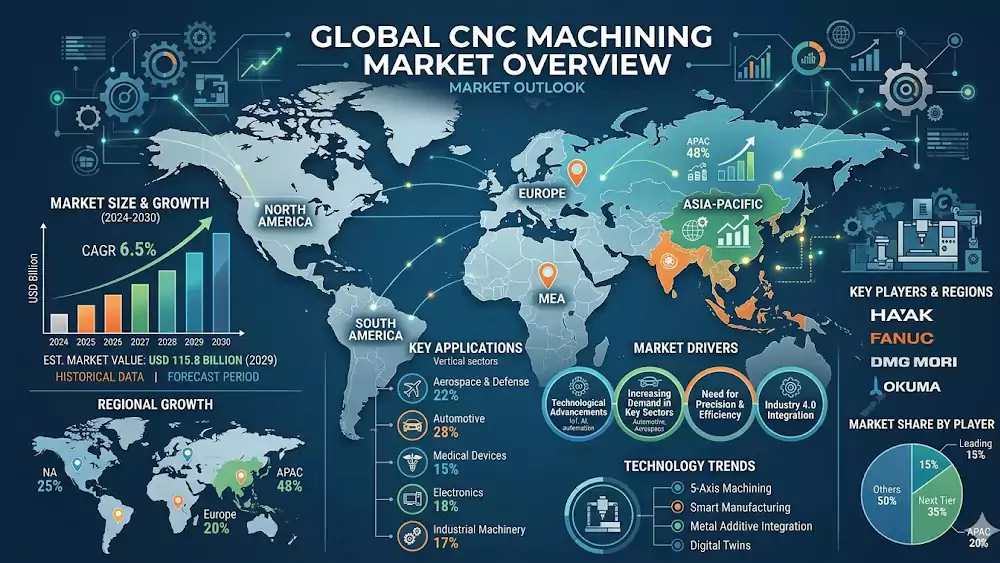
Current Market Size and Growth Rate
The market has expanded steadily during the last decade. More manufacturers now use CNC machining because product designs are becoming more complex. Small-batch production is also increasing. Many companies now launch products faster than before. This creates more prototype work and more engineering revisions.
I noticed this shift clearly after 2020. Customers who once ordered 50,000 identical parts now request smaller production runs with frequent design changes. This trend pushes suppliers to improve programming speed, fixture flexibility, and inspection systems.
Key Regions Driving CNC Machining Demand
North America
North America remains one of the strongest demand markets. Aerospace, defense, industrial automation, and EV manufacturing create stable demand for high-precision machining.
Many American buyers now prefer suppliers that can support both prototyping and production. Fast quoting and engineering communication matter more than before.
Europe
Europe focuses heavily on quality standards and advanced manufacturing. German and Swiss industries especially demand high-tolerance machining for automation, medical devices, and automotive systems.
European customers often prioritize process control and traceability over pure pricing.
Asia-Pacific
Asia-Pacific has become the largest manufacturing region1. China plays a major role because of its mature supply chain and large machining capacity.
Japan and South Korea also contribute strongly in high-end machining and automation equipment.
Major End-Use Industries
Aerospace
Aerospace parts require extreme precision and material control. Titanium, aluminum alloys, and heat-resistant materials are common.
Automotive
The EV transition has increased demand for lightweight precision components, battery housing systems, and thermal management parts.
Medical Devices
Medical components need tight tolerances, clean surface finishes, and strict process control.
Consumer Electronics
Smaller devices require more compact and complex machined components.
Industrial Equipment
Robotics and automation systems continue driving demand for custom machined mechanical parts.
| Industry | Typical Tolerance | Common Materials | Main Demand Driver |
|---|---|---|---|
| Aerospace | ±0.005 mm | Titanium, Aluminum | Weight reduction |
| Automotive | ±0.01 mm | Aluminum, Steel | EV production |
| Medical | ±0.003 mm | Stainless Steel, PEEK | Precision reliability |
| Electronics | ±0.01 mm | Aluminum, Brass | Compact designs |
| Industrial Automation | ±0.02 mm | Steel, Delrin | Custom equipment |
CNC Machining Demand Drivers and Supply Chain Analysis
Many buyers think CNC machining is only about cutting metal. In reality, the industry depends on engineering knowledge, software integration, material science, and supply chain coordination.
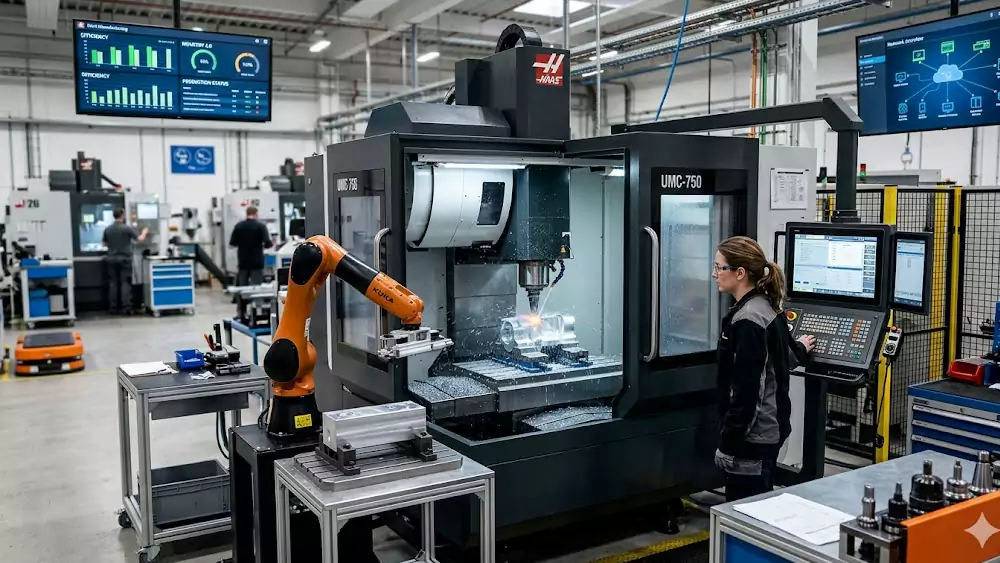
Demand for CNC machining is increasing because manufacturers need faster development cycles, tighter tolerances, and more flexible production methods. Automation and Industry 4.0 also improve machining efficiency and consistency.
Why Demand for Precision Parts Is Increasing
Modern products are becoming smaller and more complex. Robotics, drones, EV systems, and medical equipment all require high precision.
I often see engineers request tolerances that were once only common in aerospace work. Today, these requirements also appear in consumer products and automation equipment.
Impact of Automation and Industry 4.0
Modern CNC shops use automation heavily. Tool monitoring systems, automatic probing, pallet changers, and AI-assisted toolpath optimization improve efficiency.
These systems reduce setup errors and improve repeatability.
A supplier without digital process control now struggles to compete in high-value projects.
CNC Machining Industry Chain Structure
The CNC industry chain is more connected than many buyers realize.
Raw Materials
Material quality directly affects machining stability and dimensional accuracy.
Component Manufacturing
Semi-finished materials2 move into precision machining processes.
CNC Machining Suppliers
Machining shops handle milling, turning, grinding, finishing, and inspection.
Assembly & OEM Brands
Final assemblies integrate machined components into commercial products.
Cost Factors Affecting CNC Part Pricing
Part pricing depends on more than machine time.
Key factors include:
| Cost Factor | Impact on Price |
|---|---|
| Material Type | Titanium costs much more than aluminum |
| Tolerance Requirements | Tight tolerances increase inspection time |
| Surface Finish | Extra polishing or coating adds cost |
| Batch Size | Small runs increase setup cost |
| Complexity | Multi-axis machining raises cycle time |
| Lead Time | Urgent orders require overtime scheduling |
Case Study: High-Precision Robotic Arm Housing Project
A robotics customer once approached us after another supplier failed repeatedly during pilot production.
The part looked simple at first. The real challenge came from the thin-wall structure and tight positional tolerance.
| Parameter | Requirement |
|---|---|
| Material | 7075-T6 Aluminum |
| Part Size | 285 mm × 120 mm |
| Flatness | 0.015 mm |
| Positional Tolerance | 0.01 mm |
| Surface Finish | Ra 0.8 |
| Batch Quantity | 320 pcs/month |
| Machining Center | 5-axis CNC |
| Lead Time | 12 days |
The first supplier had severe deformation problems after anodizing. We changed the machining sequence, optimized stress relief, and redesigned the fixture support points. Final rejection rate dropped from 18% to below 1.5%.
This project taught me that stable process control matters more than simply owning expensive machines.
China CNC Machining Market Advantages for Global Buyers
Many global buyers still ask me why China remains so competitive even as labor costs rise. The answer is simple. China no longer competes only on labor.
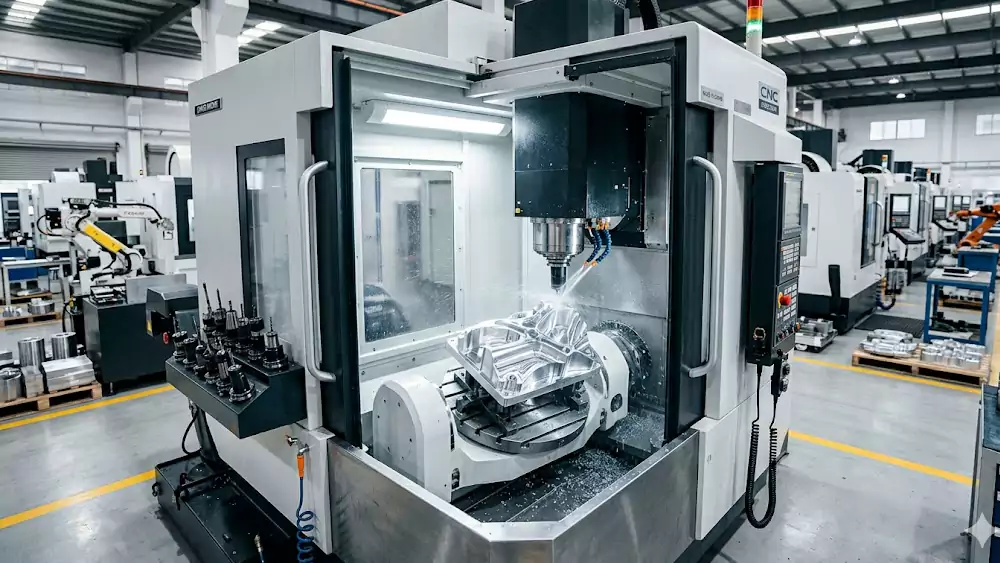
China remains one of the strongest CNC manufacturing hubs because it combines mature supply chains, engineering flexibility, scalable production capacity, and competitive pricing for both prototypes and production runs.
Why China Remains a Leading CNC Manufacturing Hub
China built a complete manufacturing ecosystem3 over many years.
Raw materials, tooling suppliers, surface treatment vendors, and logistics providers are often located close together. This improves speed and coordination.
In many regions, suppliers can source material, machine parts, anodize components, and arrange export shipment within days.
Cost Efficiency vs Quality Balance
The market changed a lot during the last decade.
The cheapest suppliers usually compete on volume production only. The stronger suppliers now focus on precision machining, engineering support, and flexible production.
This creates an important opportunity for global buyers.
A good Chinese machining supplier can often deliver:
- Lower prototype cost
- Faster engineering revisions
- Better scalability
- Competitive precision capability
At the same time, buyers must verify inspection systems and process stability carefully.
Supply Chain Speed and Scalability
China's biggest advantage may be speed.
When customers need urgent prototypes, suppliers can often respond very quickly because the local supply chain is highly connected.
I have seen projects move from CAD file to finished parts in less than one week.
This speed matters greatly for robotics, medical devices, and startup hardware companies.
Key Considerations When Choosing a CNC Supplier in China
Buyers should evaluate more than price alone.
Important areas include:
| Evaluation Area | Why It Matters |
|---|---|
| Inspection Capability | Ensures dimensional consistency |
| Engineering Communication | Prevents production mistakes |
| Material Traceability | Critical for regulated industries |
| Process Stability | Reduces batch variation |
| Capacity Planning | Supports future scaling |
| IP Protection | Protects customer designs |
Future Trends in the CNC Machining Market
The CNC industry is changing quickly. Digital manufacturing and flexible production now shape buyer expectations worldwide.
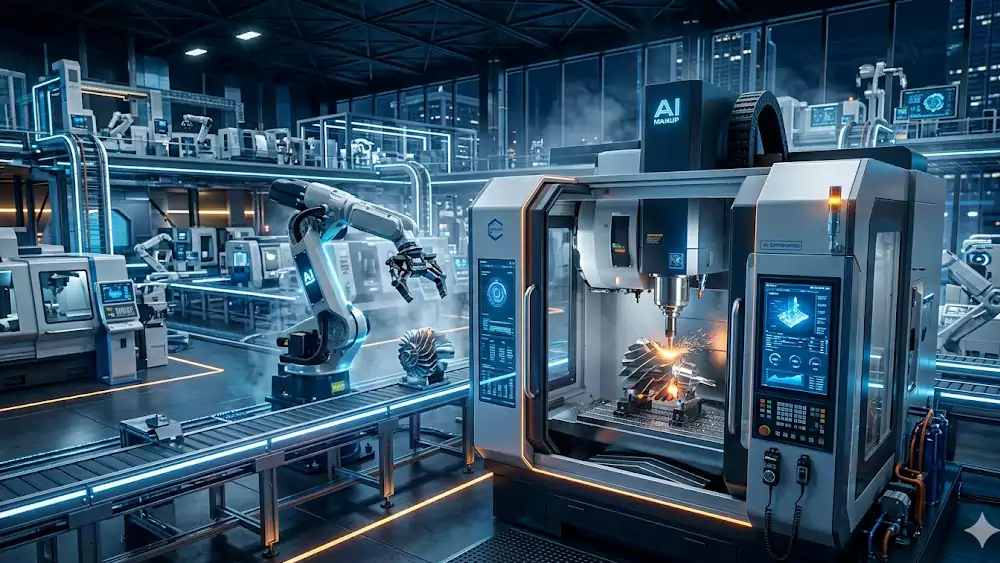
Future CNC machining growth will focus on smart manufacturing, sustainable production, and high-mix low-volume machining rather than only large-scale mass production.
Smart Manufacturing and AI-Assisted Machining
AI-assisted programming already improves machining efficiency.
Modern CAM systems can optimize cutting paths automatically. Machine monitoring systems also predict tool wear before failures happen.
This reduces downtime and improves consistency.
Sustainable Manufacturing and Material Optimization
Manufacturers now focus more on material efficiency and energy reduction.
Better toolpath strategies help reduce scrap and shorten machining cycles.
Some suppliers also recycle chips and coolant systems more effectively.
Growth of Low-Volume High-Mix Production
This trend is becoming very important.
Many industries now require customized products, faster upgrades, and shorter product life cycles.
This creates more demand for flexible CNC suppliers who can handle complex small-batch work efficiently.
Outlook for Global CNC Outsourcing
Global outsourcing CNC machining will likely continue growing.
Still, buyers will become more selective.
Future partnerships will depend more on engineering support, process control, communication quality, and delivery reliability than pure pricing alone.
FAQ
Is the CNC machining market growing?
Yes. The CNC machining market continues growing because industries need more precision components, faster product development, and flexible manufacturing capacity.
Which country has the strongest CNC machining industry?
China currently has the largest overall CNC manufacturing ecosystem. Germany, Japan, and the United States remain leaders in high-end precision manufacturing and advanced automation.
Why do companies outsource CNC machining to China?
Companies outsource CNC machining to China because Chinese suppliers often provide competitive pricing, fast lead times, scalable production, and strong precision machining capabilities.
What industries have the highest demand for CNC machining?
Aerospace, automotive, robotics, medical devices, industrial automation, and consumer electronics currently generate the highest demand for CNC machining services.
Conclusion
The CNC machining market keeps evolving. The biggest opportunities now belong to suppliers who combine precision, flexibility, engineering support, and fast response instead of competing only on low prices.
Are you looking for custom CNC machining services? Send over your CAD files today. I’ll personally review your specifications to ensure you’re getting the most cost-effective and precise manufacturing path available.

-
"East Asia and the Pacific (IFC classification) - World Bank Open Data", https://data.worldbank.org/indicator/NV.MNF.TECH.ZS.UN?locations=C4. UNIDO manufacturing statistics report regional shares of global manufacturing value added and output, supporting the characterization of Asia-Pacific as a dominant manufacturing region; the figures contextualize CNC machining demand but do not measure CNC capacity alone. Evidence role: statistic; source type: institution. Supports: Asia-Pacific has become the largest manufacturing region.. Scope note: The evidence supports the region's manufacturing scale generally, not CNC machining demand specifically. ↩
-
"What Are Semi-Finished Goods Materials and How They Work in ...", https://letstranzact.com/blogs/semi-finished-goods. A manufacturing or materials-engineering source defining semi-finished products as partially processed materials intended for subsequent processing would support the statement that such materials proceed into precision machining operations. Evidence role: definition; source type: institution. Supports: Semi-finished materials move into precision machining processes.. Scope note: The source may define the general role of semi-finished materials in manufacturing rather than describe the specific CNC supply chain in this article. ↩
-
"How do special economic zones and industrial clusters drive ...", https://documents.worldbank.org/en/publication/documents-reports/documentdetail/310891468018256346/how-do-special-economic-zones-and-industrial-clusters-drive-chinas-rapid-development. Manufacturing statistics and studies of Chinese industrial clusters support describing China as a major manufacturing hub with dense supplier networks across inputs, processing, and logistics. Evidence role: general_support; source type: institution. Supports: China built a complete manufacturing ecosystem over many years.. Scope note: This supports the national and regional manufacturing context, but it does not verify the completeness of every CNC-specific supplier chain. ↩
