Last updated on March 12, 2026, by Lucy
Many engineers hear about metal 3D printing but struggle to decide when it actually makes sense for real production parts.
Metal 3D printing is an additive manufacturing process that builds metal components layer by layer from powder or wire feedstock. It allows complex geometries, internal channels, and lightweight structures that traditional manufacturing methods cannot easily produce.
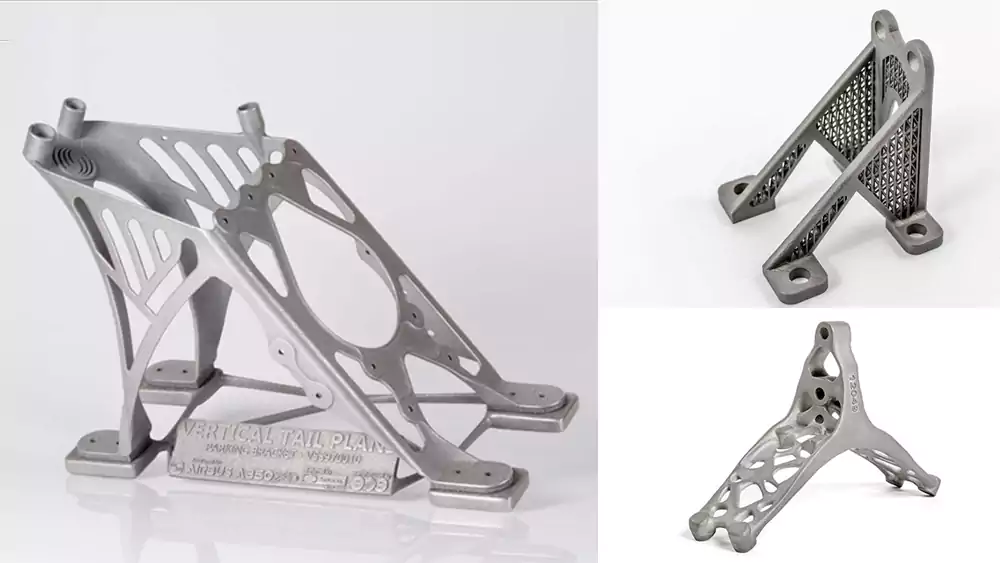
Metal additive manufacturing is now widely used in aerospace, automotive, medical, and industrial equipment. I often see engineers comparing it with CNC machining when they need complex custom parts.
What Is Metal 3D Printing and How It Works in Modern Manufacturing?
Engineers often ask me whether metal 3D printing is just a prototype tool or a real manufacturing process.
Metal 3D printing creates solid metal parts by melting or binding metal powder layer by layer using lasers, electron beams, or binder agents. The process enables complex internal features that cannot be produced with subtractive machining.

Metal Additive Manufacturing Overview
Metal additive manufacturing builds parts directly from CAD models. A machine slices the model into thin layers. The printer then deposits or melts metal powder layer by layer until the final geometry is complete.
Several industrial processes dominate the market today.
| Process | Energy Source | Typical Applications |
|---|---|---|
| Selective Laser Melting (SLM)1 | Laser | Aerospace components |
| Direct Metal Laser Sintering (DMLS) | Laser | Complex mechanical parts |
| Electron Beam Melting (EBM) | Electron beam | Titanium aerospace parts |
| Binder Jetting | Binder + sintering | High-volume metal parts |
| Directed Energy Deposition (DED) | Laser + powder/wire | Repair and large parts |
Each process has its strengths. For example, SLM and DMLS are widely used for precision components. EBM is common for titanium aerospace structures because the vacuum environment prevents oxidation.
Material compatibility2 is another key factor.
| Material | Typical Industry Applications |
|---|---|
| Titanium alloys | Aerospace structures, medical implants |
| Inconel | Turbine components3, high-temperature parts |
| Aluminum alloys | Automotive lightweight structures |
| Stainless steel | Industrial equipment, tooling |
| Tool steels | Mold inserts |
| Cobalt-chrome | Dental and orthopedic implants |
From my experience working with engineers, stainless steel and aluminum are still the most requested materials for functional prototypes. Titanium and Inconel are more common in aerospace and medical projects.
What Design Rules, Tolerances, and Surface Finish Should Engineers Expect?
Many engineers assume metal 3D printing works like CNC machining. In reality, the design rules are very different.
Metal 3D printing allows complex shapes but has limits in wall thickness, overhang angles, and surface finish. Engineers must design parts specifically for additive manufacturing to achieve reliable results.
Design Considerations for Metal Additive Manufacturing
Design freedom is the biggest advantage of metal 3D printing. However, the process still has physical constraints.
Key design rules include:
- Minimum wall thickness4
- Overhang angle limits
- Support structure requirements
- Build orientation
- Internal channel accessibility5
For example, overhang angles typically must remain above 45°. Otherwise the printer needs support structures. These supports must be removed after printing, which adds labor and cost.
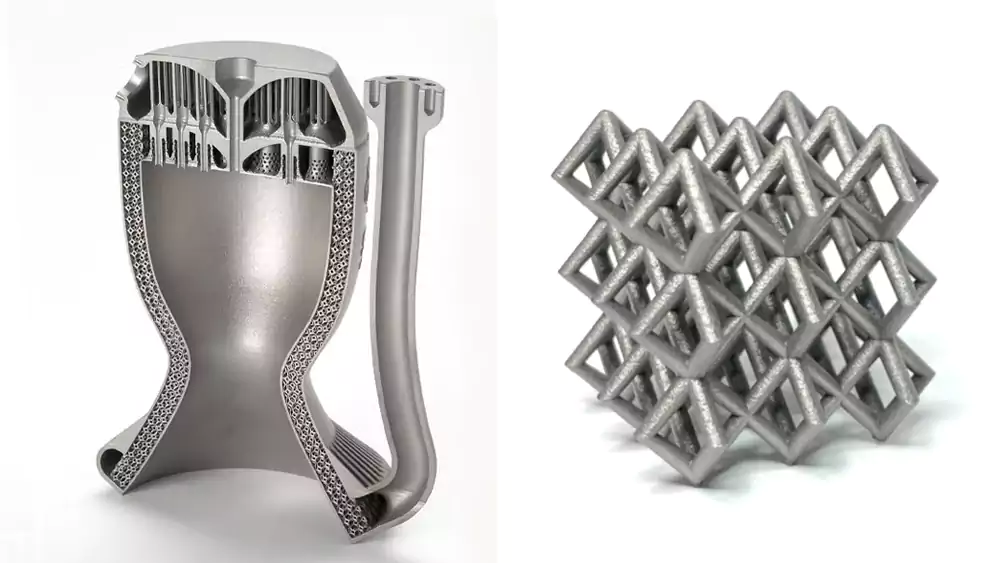
Internal channels are another common feature. Designers can create cooling passages or fluid pathways inside a solid component. This design is nearly impossible with conventional machining.
Lattice structures are also popular. Engineers use them to reduce weight while maintaining strength.
Typical manufacturing limits look like this:
| Feature | Typical Value |
|---|---|
| Linear tolerance | ±0.1 – 0.3 mm |
| Minimum wall thickness | 0.5 – 1.0 mm |
| Minimum hole diameter | 0.8 – 1.5 mm |
Surface finish is another common concern.
| Condition | Surface Roughness |
|---|---|
| As printed | Ra 6 – 15 µm |
| After CNC finishing | Ra 0.8 – 3.2 µm |
Because of this, I often recommend a hybrid approach. The part is printed near net shape first. Then critical surfaces are finished with CNC machining. This step improves sealing surfaces, bearing seats, and precision holes.
What Are the Advantages and Limitations of Metal 3D Printing vs Conventional Manufacturing?
Many engineers ask me whether metal 3D printing will replace machining or casting.
Metal 3D printing excels at complex geometry and internal channels, while CNC machining provides superior precision, surface finish, and cost efficiency for medium or high production volumes.

Manufacturing Method Comparison
When I evaluate a project, I usually compare additive manufacturing with traditional processes such as CNC machining, casting, and forging.
Here is a simplified comparison:
| Factor | Metal 3D Printing | CNC Machining |
|---|---|---|
| Geometry complexity | Excellent | Limited |
| Internal channels | Possible | Very difficult |
| Surface finish | Moderate | Excellent |
| Precision | Medium | High |
| Production volume | Low | Medium to high |
Metal additive manufacturing offers several advantages.
First, it allows extremely complex geometries. Engineers can create organic shapes and internal cooling passages. These features are impossible to drill or mill.
Second, it supports lightweight structures. Aerospace companies use lattice designs to reduce weight while maintaining strength.
Third, it enables part consolidation. Instead of assembling multiple components, a single printed part can replace them.
However, the process also has limitations.
Surface roughness is higher than machined parts. Post-processing is almost always required.
Production cost is also higher for large batch quantities. Build chambers are limited in size, which restricts part dimensions.
Because of these factors, I rarely recommend metal 3D printing for large production runs. CNC machining or casting usually remains the better option in those cases.
When Should You Use Metal 3D Printing Instead of CNC Machining?
The real question most engineers ask me is simple: when does metal 3D printing actually make sense?
Metal 3D printing is best used for complex internal channels, lightweight structures, and low-volume high-value components where traditional machining would require multiple parts or complex assembly.
Typical Scenarios Where Metal AM Works Best
Over the years I have seen three situations where additive manufacturing delivers clear advantages.
1. Complex internal channels
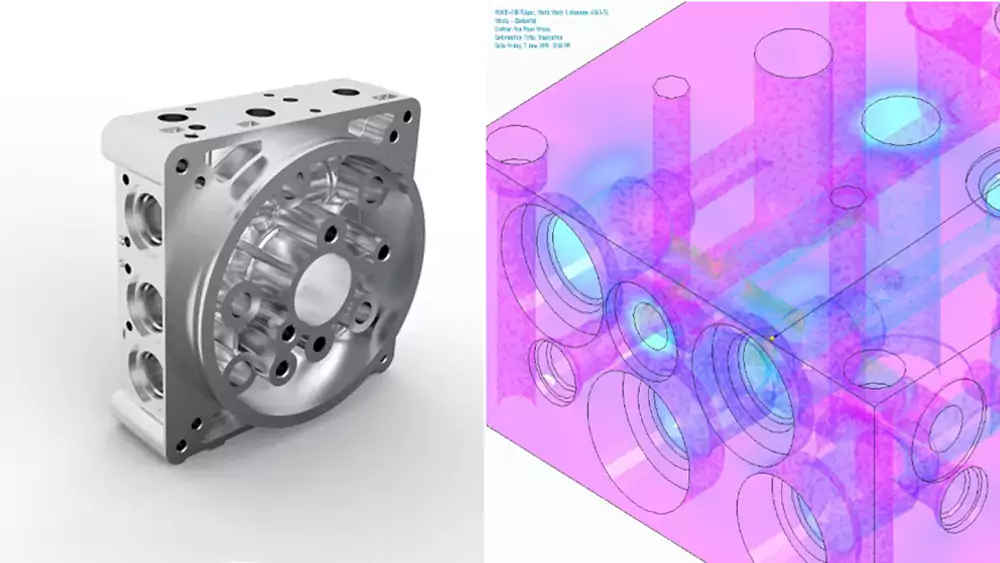
Parts such as hydraulic manifolds or heat exchangers benefit greatly from internal flow paths. Traditional machining requires multiple drilling operations and plugs.
3D printing allows fully integrated channels.
2. Lightweight structures
Aerospace brackets and drone components often require high strength with minimal weight. Lattice structures can reduce weight by 30–50%.
3. Low-volume high-value components
Examples include aerospace spare parts, medical implants, and specialized industrial components.
Case Study: Lightweight Hydraulic Manifold Redesign
A few years ago I worked with an engineer redesigning a hydraulic manifold for an automation system. The original part was heavily machined from aluminum.
| Parameter | Traditional Machined Design | 3D Printed Design |
|---|---|---|
| Material | Aluminum 6061 | AlSi10Mg |
| Weight | 3.2 kg | 1.9 kg |
| Number of drilled channels | 18 | Integrated internal channels |
| Assembly fittings | 12 | 4 |
| Total components | 9 | 5 |
Results after redesign:
- 40% weight reduction
- 30% fewer components
- Significantly lower leak risk
- Simplified assembly
This redesign was only possible because additive manufacturing allowed internal curved channels that drilling could not produce.
Hybrid Manufacturing: 3D Printing + CNC Machining
In practice, many high-performance components combine both technologies.
The workflow often looks like this:
3D print near-net shape → CNC machine critical features
CNC machining is used to finish:
- sealing surfaces
- bearing seats
- precision threaded holes
- mounting interfaces
This hybrid approach combines the design freedom of additive manufacturing with the precision and surface quality of machining.
In my own projects, metal 3D printing is my go-to method for rapid prototyping and complex geometry development. But when production volumes increase and tight tolerances matter, CNC machining still provides the most consistent and cost-effective solution.
Conclusion
Metal 3D printing unlocks complex designs and lightweight structures, but CNC machining remains essential for precision, surface finish, and scalable production.
-
Explore this link to understand why SLM is preferred for precision aerospace components and how it enhances manufacturing accuracy. ↩
-
Learn about the importance of choosing the right materials like titanium, Inconel, and aluminum for specific industrial uses to optimize performance. ↩
-
This article explains why nickel-based superalloys are widely used for turbine blades. ↩
-
Understanding minimum wall thickness is crucial to ensure structural integrity and manufacturability in metal 3D printing. ↩
-
Exploring internal channel accessibility helps designers create complex internal features like cooling passages that are impossible with traditional methods. ↩
