Manufacturers often chase better performance, yet many projects fail when a promising material becomes difficult or expensive to process.
New engineering materials are advanced metals, polymers, composites, and functional materials that deliver better strength, lower weight, improved durability, and enhanced performance than conventional materials. Their true value comes when they can be manufactured consistently, economically, and at production scale.
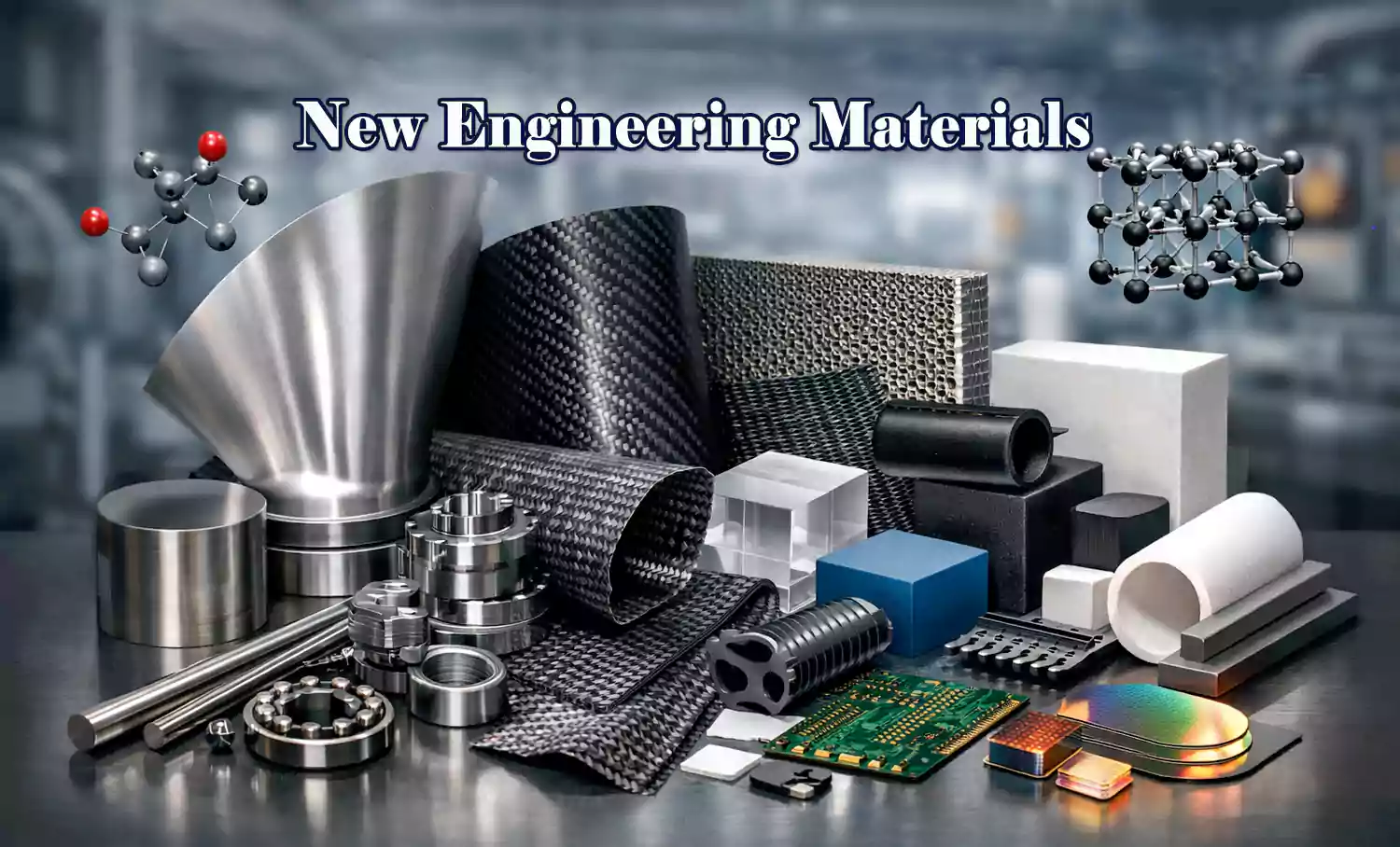
In my years working in CNC machining and rapid prototyping, I have seen many materials arrive with great claims. Some delivered outstanding results. Some created production headaches. The difference was rarely the material itself. The difference was whether the manufacturing process could produce reliable parts at a repeatable cost. That is why I always evaluate material performance and manufacturability together before making a recommendation.
What Are New Engineering Materials?
Many engineers struggle to balance performance, weight, cost, and production speed when traditional materials no longer meet project goals.
New engineering materials are specially engineered materials developed to provide superior mechanical, thermal, chemical, electrical, or environmental properties compared to traditional metals and plastics. These materials help manufacturers achieve lighter, stronger, more durable, and more efficient products across a wide range of industries.
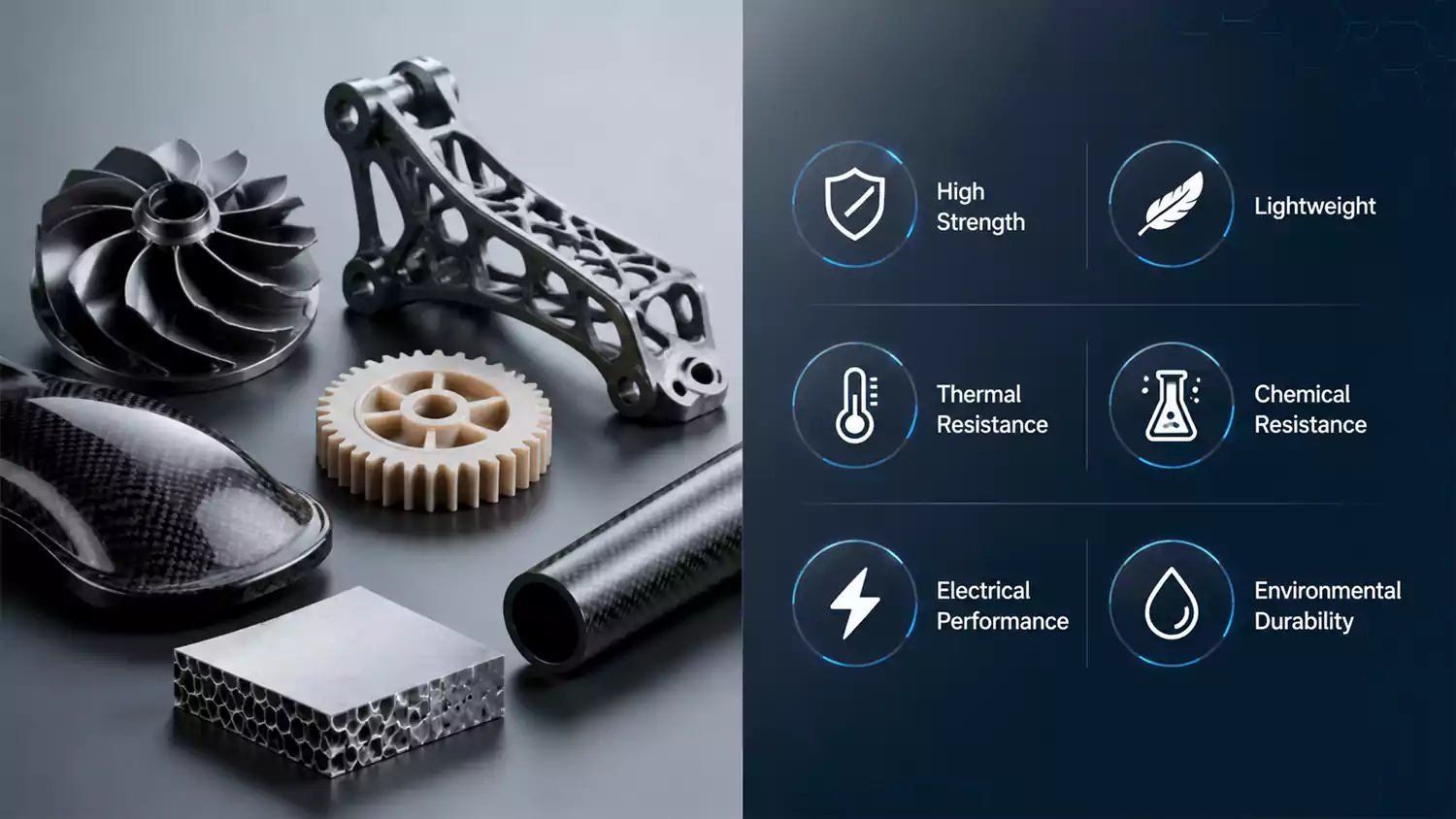
New engineering materials cover a wide range of material families. Some improve strength while reducing weight. Some improve corrosion resistance. Others add smart functions such as sensing, self-healing, or shape memory behavior.
Key Characteristics
| Property | Benefit |
|---|---|
| High strength-to-weight ratio | Reduces product weight |
| Enhanced durability | Extends service life |
| Better thermal performance | Improves heat management |
| Corrosion resistance | Reduces maintenance |
| Sustainability | Supports environmental goals |
I often explain to customers that a material is only part of the solution. A titanium alloy may look excellent on a datasheet. Yet if machining time doubles and tool wear triples, the final cost may become unacceptable. Engineers must evaluate the entire production chain. This includes raw material availability, machining complexity, surface finishing requirements, inspection needs, and production volume.
In modern product development, materials are becoming more specialized. Aerospace companies want lighter structures.1 Medical device companies need biocompatibility.2 Electronics companies need better heat transfer. These demands continue to drive material innovation. At the same time, manufacturers must develop practical production methods that keep costs under control.
Types of New Engineering Materials?
Many engineers know they need better materials, but they often struggle to identify which specific material family best fits their application.
The most widely used new engineering materials include advanced metal alloys, high-performance engineering plastics, fiber-reinforced composites, smart materials, and emerging nanomaterials. Each category offers unique advantages for weight reduction, strength, heat resistance, wear resistance, or functional performance.
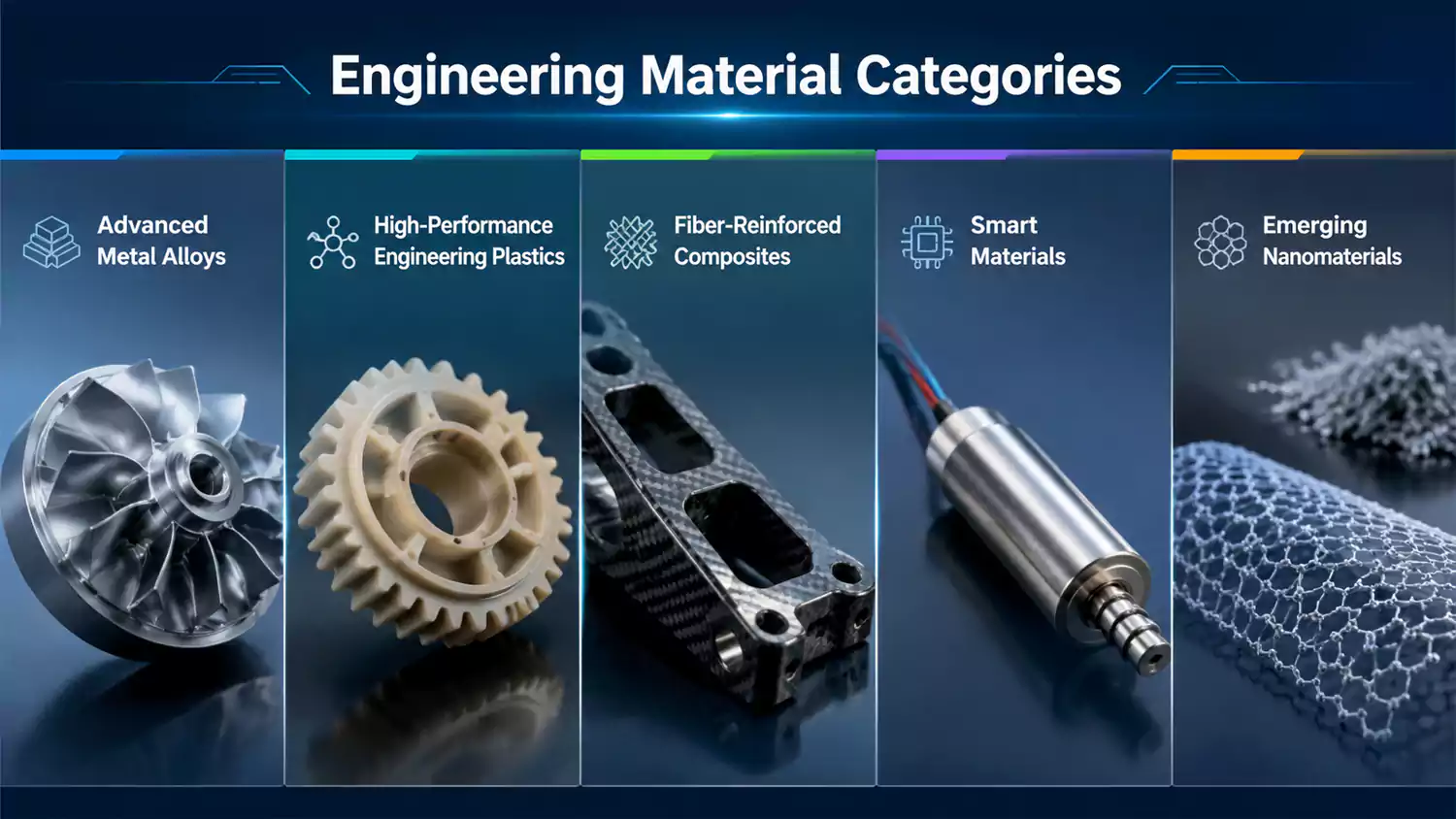
Advanced Metal Alloys
Advanced alloys remain essential when applications require high strength, heat resistance, or corrosion resistance.
Common examples include:
| Material | Typical Applications |
|---|---|
| Titanium Ti-6Al-4V3 | Aerospace brackets, medical implants |
| Inconel 718 | Turbine components, exhaust systems |
| Hastelloy C276 | Chemical processing equipment |
| Aluminum-Lithium Alloys | Aircraft structures |
These materials perform well under extreme conditions. Yet they often require specialized machining strategies. In my experience, tool selection and cutting parameters play a major role in controlling production costs when working with these alloys.
High-Performance Engineering Plastics
Engineering plastics continue to replace metal components in many industries due to their lightweight properties and excellent chemical resistance.
Common examples include:
| Material | Typical Applications |
|---|---|
| PEEK | Medical devices, semiconductor parts |
| PEI (Ultem) | Aerospace interiors |
| PPS | Electrical connectors |
| PTFE Composites | Bearings and seals |
Many engineers use these materials to reduce weight while maintaining dimensional stability. When properly designed, they can significantly lower manufacturing costs. Engineers who are evaluating polymer alternatives often reference an engineering plastics processing guide to better understand machining behavior and design considerations.
Fiber-Reinforced Composites
Composites combine reinforcing fibers with a matrix material to achieve exceptional strength-to-weight ratios.4
Common examples include:
| Material | Typical Applications |
|---|---|
| Carbon Fiber Reinforced Polymer (CFRP) | Aircraft panels, robot arms |
| Glass Fiber Reinforced Polymer (GFRP) | Structural housings |
| Aramid Fiber Composites | Protective equipment |
These materials are widely used when weight reduction directly impacts performance. Aerospace and automotive industries continue to increase their adoption of composite structures.
Smart Materials and Functional Materials
Smart materials can react to changes in temperature, stress, electricity, or magnetic fields.
Common examples include:
| Material | Function |
|---|---|
| Shape Memory Alloys | Return to preset shapes |
| Piezoelectric Ceramics | Generate electrical signals |
| Magnetostrictive Materials | Convert magnetic energy into motion |
These materials support advanced automation systems, sensors, and precision control applications.
Nanomaterials and Emerging Materials
Nanotechnology continues to push material performance further.
Examples include graphene-enhanced composites, carbon nanotube materials, and nano-ceramic coatings. These materials can improve conductivity, wear resistance, and mechanical strength. While adoption is still growing, many industries are actively exploring their long-term manufacturing potential.
Applications of New Engineering Materials Across Industries?
Many companies invest in advanced materials because they need solutions that traditional materials cannot provide.
New engineering materials are used in aerospace, automotive, medical, electronics, energy, and industrial automation applications to improve component performance, reduce weight, extend service life, and increase manufacturing efficiency.
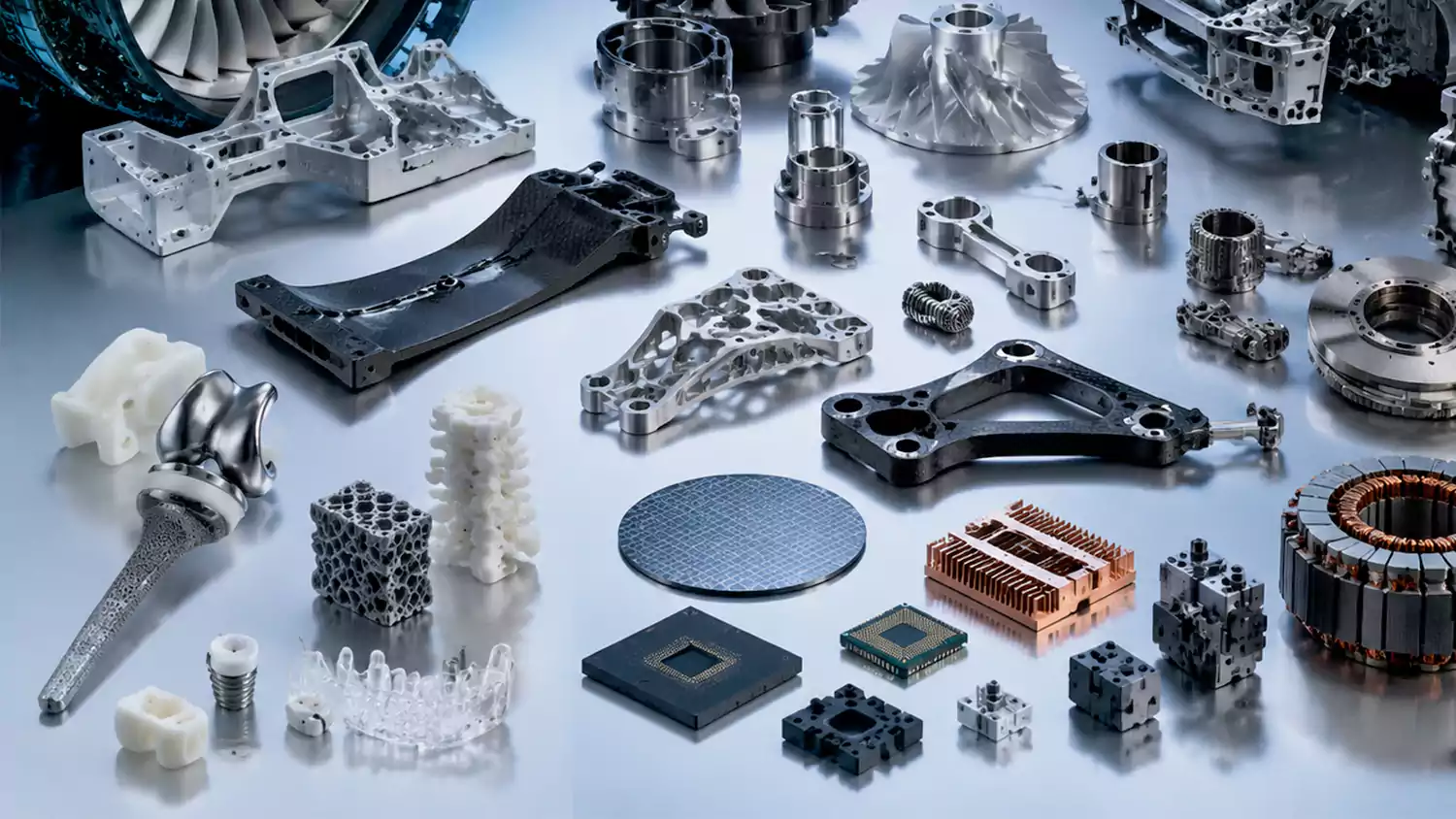
I regularly see material innovation driven by industry-specific requirements.
Common Components Using New Engineering Materials
| Industry | Typical Components | Common Materials |
|---|---|---|
| Aerospace | Structural brackets, turbine blades5, wing ribs | Titanium, CFRP, Inconel |
| Automotive | Battery housings, suspension links, drive shafts | Composites, advanced alloys |
| Medical | Spinal implants, surgical guides, prosthetics | Titanium, PEEK |
| Electronics | Heat sinks, semiconductor fixtures, connector housings | Engineered plastics, aluminum alloys |
| Energy | Turbine vanes, pump impellers, valve components | Superalloys, advanced composites |
| Industrial Automation | Robotic end effectors, grippers, machine frames | Carbon fiber composites, engineering plastics |
Case Study: Lightweight Robotic End Effector Upgrade
A customer in industrial automation approached our team with a weight reduction challenge. The original aluminum assembly worked well. Still, the robotic arm experienced cycle time limitations.
| Parameter | Original Design | New Design |
|---|---|---|
| Material | 6061 Aluminum | Carbon Fiber Composite |
| Weight | 3.8 kg | 1.9 kg |
| Tensile Strength | 310 MPa | 620 MPa |
| Robot Cycle Time | 4.8 sec | 4.1 sec |
| Annual Production | 12,000 units | 12,000 units |
| Scrap Rate | 2.8% | 1.5% |
| Tool Life Impact | N/A | Specialized tooling required |
The project delivered nearly 50% weight reduction. The robotic system achieved faster acceleration and shorter cycle times. The challenge was not the material selection. The challenge was creating a repeatable manufacturing process that maintained dimensional accuracy across thousands of parts.
This project reinforced a lesson I have learned repeatedly. Advanced materials create value only when manufacturing controls are equally advanced.
How to Select the Right Engineering Material?
Choosing the wrong material can increase costs, delay production, and create quality issues that appear long after product launch.
The right engineering material is the one that meets performance requirements while remaining practical to source, machine, inspect, and manufacture at the target production volume and budget.
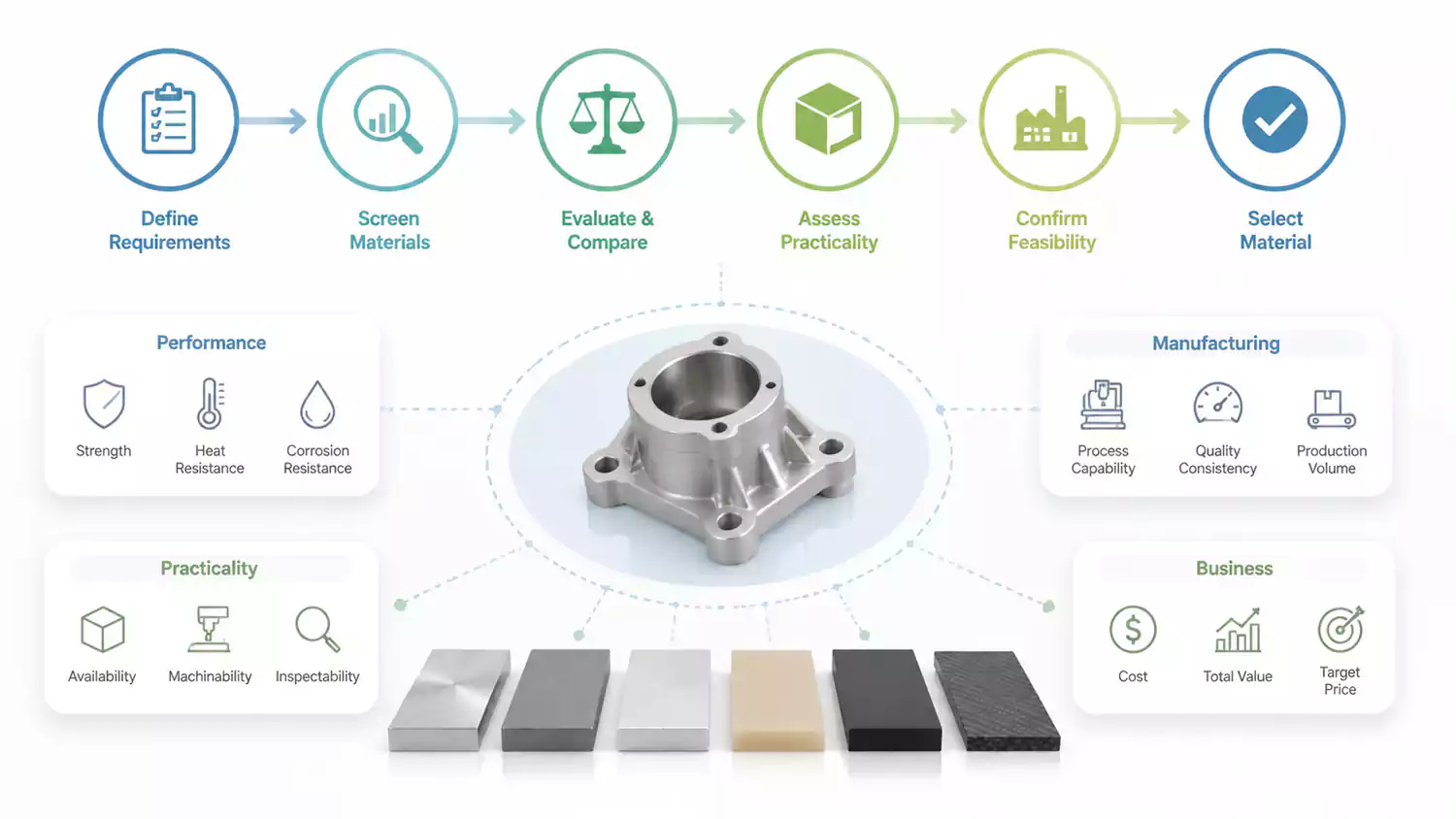
I encourage engineers to avoid selecting materials based only on performance charts. A practical selection process examines the entire product lifecycle.
Material Selection Factors
| Factor | Key Question |
|---|---|
| Mechanical Properties | Can it handle the load? |
| Thermal Performance | Can it withstand temperatures? |
| Chemical Resistance | Will it survive the environment? |
| Cost | Does it fit the budget? |
| Manufacturability | Can it be produced efficiently? |
| Supply Chain | Is material availability stable? |
Many projects begin with performance goals. That makes sense. Yet production realities often determine success. A material may meet every technical requirement while creating excessive machining costs. Another material may deliver 95% of the performance at half the production cost.
I often work with engineers who need rapid prototypes before moving into production. In those cases, material selection should account for both development and manufacturing stages. The ideal choice allows testing, validation, and scaling without major redesigns.
For custom components, material decisions should also align with available CNC machining services and downstream production requirements. This approach helps avoid costly design revisions later in the project.
Good material selection also reduces risk. Stable supply chains, predictable machining behavior, and consistent quality control often create more value than marginal performance improvements.
Manufacturing Solutions for New Engineering Materials?
Advanced materials often introduce processing challenges that can erase their performance advantages if production methods are not optimized.
Successful manufacturing of new engineering materials depends on optimized machining processes, appropriate tooling, automation, inspection systems, and design-for-manufacturing practices that ensure repeatable quality at competitive production costs.
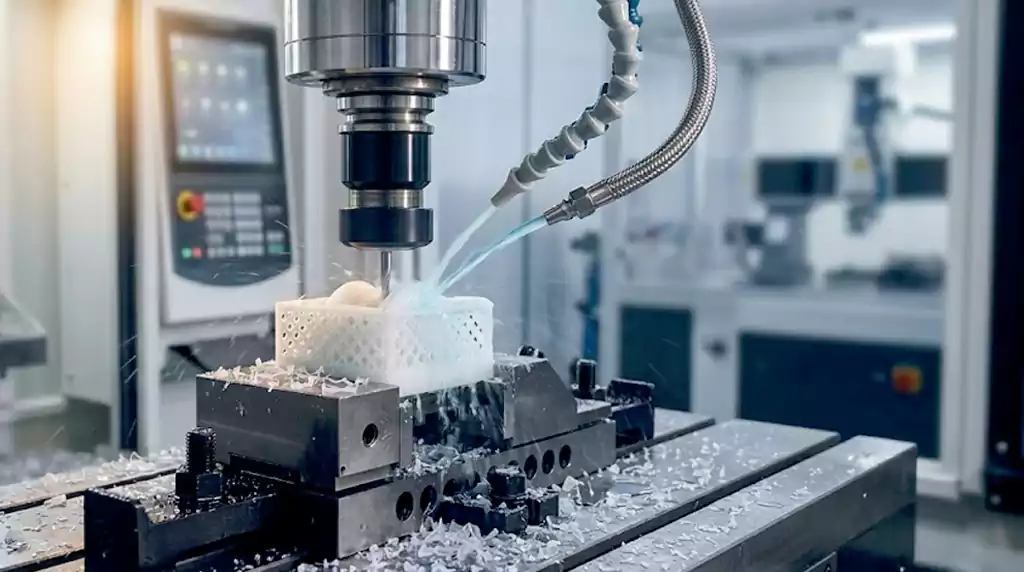
This is where many advanced material projects succeed or fail.
Manufacturing Considerations
| Area | Focus |
|---|---|
| CNC Machining | Tool selection and cutting parameters |
| Additive Manufacturing | Complex geometries |
| Automation | Process consistency |
| Inspection | Dimensional verification |
| Design Optimization | Reduced waste |
From my experience, manufacturability must be discussed at the beginning of product development. Engineers often focus on material performance first. Then they discover machining challenges later. Early collaboration between design and manufacturing teams helps avoid this problem.
Advanced materials frequently require specialized cutting tools, adjusted feeds and speeds, and tighter process controls. Composite materials may need unique fixturing methods. High-temperature alloys often require advanced cooling strategies. Engineered polymers may require careful thermal management during machining.
Automation also plays an important role. Repeatable production depends on stable processes. Automated inspection systems, tool monitoring, and digital manufacturing controls help maintain consistency across large production runs.
The most important lesson I have learned is simple. In manufacturing, new engineering materials are not valuable because they are innovative. They become valuable when their performance advantages can be delivered at a predictable cost, with repeatable quality, and at production scale.
Conclusion
New engineering materials continue to expand what engineers can achieve in aerospace, medical, automotive, electronics, and industrial applications. Yet performance alone does not determine success. The real advantage comes when advanced materials can be manufactured efficiently, repeatedly, and cost-effectively. By balancing material properties with practical production requirements from the start, engineers can reduce risk, improve product performance, and bring innovative designs to market with confidence.

Footnotes:
-
"Superlightweight Aerospace Composites - NASA", https://www.nasa.gov/superlightweight-aerospace-composites/. NASA materials research describes lightweight structures and materials as important for improving aircraft and spacecraft performance, providing institutional context for why aerospace engineering emphasizes lower structural mass. Evidence role: general_support; source type: government. Supports: Aerospace companies want lighter structures.. Scope note: This establishes a broad aerospace priority rather than proving that every aerospace company has the same design objective in every project. ↩
-
"Basics of Biocompatibility: Information Needed for Assessment by ...", https://www.fda.gov/medical-devices/biocompatibility-assessment-resource-center/basics-biocompatibility-information-needed-assessment-fda. FDA guidance on the use of ISO 10993-1 states that patient-contacting medical devices generally require biological evaluation of their materials, supporting biocompatibility as a core materials-selection requirement for medical devices. Evidence role: expert_consensus; source type: government. Supports: Medical device companies need biocompatibility.. Scope note: This supports the regulatory and safety context for patient-contacting devices, not every material used anywhere in medical-device manufacturing. ↩
-
"Ti6AL4V Grade5 Titanium Alloy in Aerospace and Medical Use", https://www.coherentmarketinsights.com/blog/aerospace-and-defense/ti-6al-4v-grade5-titanium-alloy-in-aerospace-and-medical-use-3781. A biomedical or aerospace materials source can document that Ti-6Al-4V is widely used in aerospace structures and biomedical implants because of its strength-to-weight ratio, corrosion resistance, and biocompatibility. Evidence role: case_reference; source type: paper. Supports: Titanium Ti-6Al-4V is commonly used for aerospace and medical implant applications.. Scope note: The source may describe representative uses and properties, not verify the specific bracket example in the table. ↩
-
"Fibre-Reinforced Polymer Composite - ScienceDirect.com", https://www.sciencedirect.com/topics/engineering/fibre-reinforced-polymer-composite. A composites textbook or university materials source can define fiber-reinforced composites as materials made from fibers embedded in a matrix and explain that this architecture can provide high specific strength and stiffness. Evidence role: definition; source type: education. Supports: Fiber-reinforced composites combine fibers and a matrix to provide high strength-to-weight performance.. Scope note: The source would substantiate the general mechanism and property advantage, not quantify every composite system. ↩
-
"What Materials Are Used for Turbine Blades? - Quest Metals", https://alliedcasting.com/what-materials-are-used-for-turbine-blades. Authoritative aerospace materials literature documents turbine blades as aircraft engine components that commonly use high-performance materials such as nickel-based superalloys, including Inconel, and titanium alloys for strength, heat resistance, and weight reduction. Evidence role: general_support; source type: blog. Supports: In aerospace, turbine blades are typical components made using advanced engineering materials such as titanium, CFRP, and Inconel.. Scope note: A source may support titanium and nickel-based superalloys/Inconel for turbine or compressor blades but may not support CFRP for high-temperature turbine blades specifically. ↩
