Many aluminum parts fail early not because of low strength, but because engineers ignore heat buildup until the design is already finalized.
The thermal conductivity of aluminum is one of the main reasons aluminum is widely used in CNC machining, heat dissipation systems, and lightweight industrial components. Aluminum combines good heat transfer, low weight, corrosion resistance, and strong machinability, making it ideal for many engineered parts.
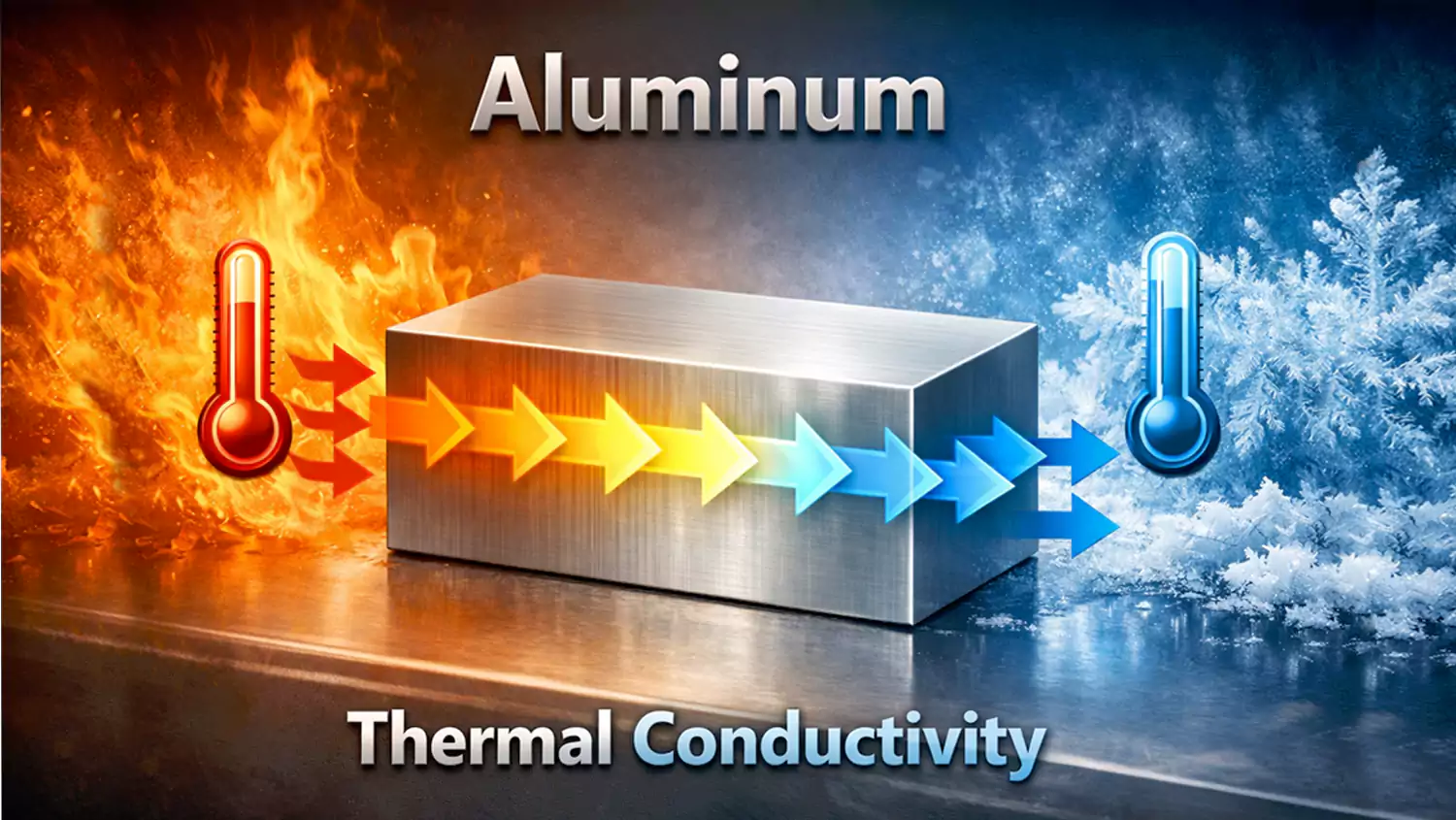
When I work with engineers on custom parts, thermal performance is often discussed too late. Most teams focus first on strength, cost, or corrosion resistance. Then overheating becomes a hidden problem during testing. That is why material selection should begin with thermal requirements, not end with them.
Why Does Thermal Conductivity Matter in Metal Selection?
A material may look perfect on paper, but poor heat transfer can shorten lifespan, reduce reliability, and create dimensional problems under load.
Thermal conductivity measures how quickly heat moves through a material. It is commonly measured in W/m·K, and materials with higher values transfer heat faster, making them better for heat dissipation and thermal management.
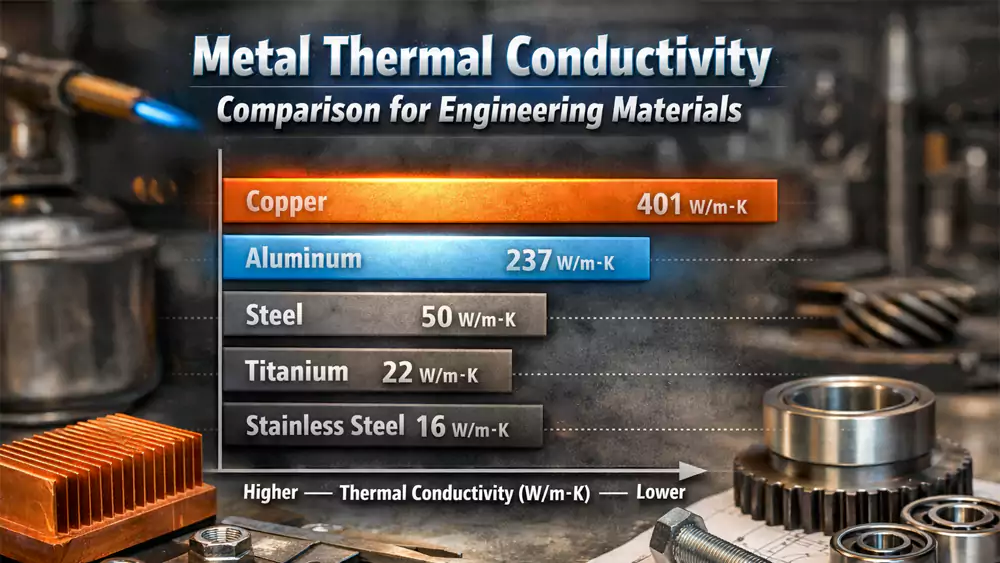
Choosing a material is never only about strength. Heat affects nearly every mechanical system. Motors run hotter. Electronics degrade faster. Tight tolerances shift after long operating cycles. This is why thermal conductivity matters in industries like automotive, robotics, medical equipment, and hydraulic systems.
What Is Thermal Conductivity?
Thermal conductivity describes how efficiently heat passes through a material.1
The standard engineering unit is:
- Watts per meter-kelvin (W/m·K)
A higher value means heat spreads faster through the material.
For example:
- Copper transfers heat extremely fast.
- Aluminum transfers heat very well while remaining lightweight.
- Stainless steel transfers heat slowly.2
This makes aluminum popular in:
- heat sinks
- motor housings
- battery enclosures
- LED cooling systems
- hydraulic manifolds
Why Thermal Conductivity Matters in Manufacturing
In manufacturing, thermal performance affects:
- operating temperature stability
- dimensional consistency
- heat dissipation speed
- product reliability
- component lifespan
A poorly selected material may cause:
- thermal expansion issues
- tolerance drift
- lubricant breakdown
- electronic overheating
Thermal Conductivity vs Heat Capacity
Engineers sometimes confuse these two properties.
Thermal conductivity tells us how fast heat moves.
Heat capacity tells us how much heat a material can store.
A material can store a lot of heat but still transfer it slowly.
For example:
- Aluminum releases heat quickly.
- Stainless steel holds heat longer but transfers it poorly.
This difference matters when designing thermal systems.
Which Aluminum Grade Has the Best Thermal Conductivity?
Not all aluminum grades perform the same. Alloying improves strength, but it usually lowers conductivity.
Pure aluminum has the highest thermal conductivity, but engineering alloys like 6061 and 6063 are often the best balance of heat transfer, strength, corrosion resistance, and machinability.
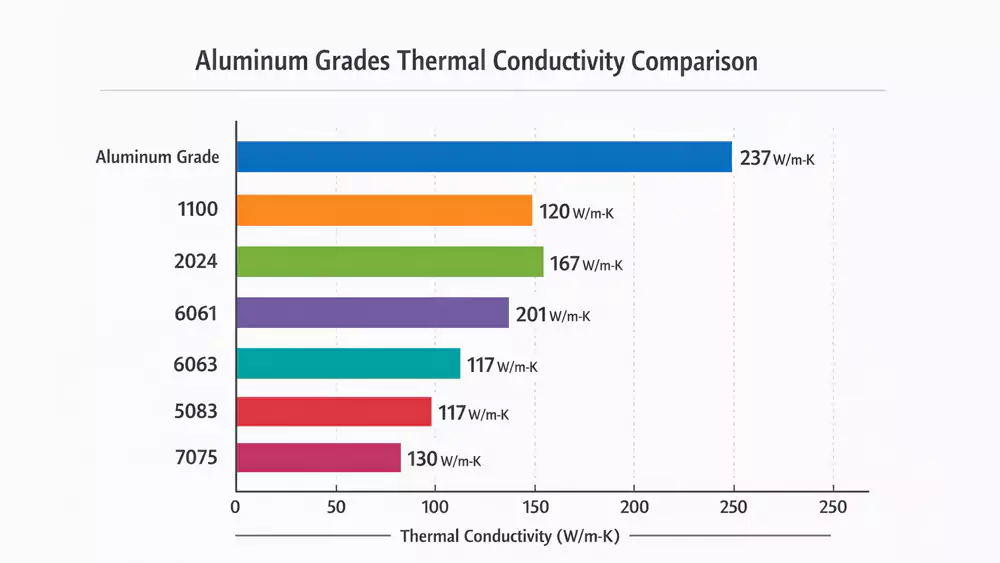
Once engineers understand that conductivity is only one part of the equation, material selection becomes more practical. The goal is rarely maximum conductivity alone. The goal is the best total performance for the actual application.
Pure Aluminum vs Aluminum Alloys
Pure aluminum from the 1000 series offers:
- very high conductivity
- soft material behavior
- lower strength
- limited structural applications
Aluminum alloys offer:
- higher strength
- better wear resistance
- improved dimensional stability
- better CNC machining performance
For most machined components, alloys are the better engineering choice.
Aluminum Thermal Conductivity Chart
| Aluminum Grade | Thermal Conductivity (W/m·K) | Strength Level | Common Use |
|---|---|---|---|
| 1050 | 229 | Low | electrical conductors, heat exchangers |
| 1060 | 226 | Low | busbars, thermal plates |
| 3003 | 193 | Medium-Low | radiators, cookware |
| 5052 | 138 | Medium | marine parts, tanks |
| 6061 | 167 | High | CNC parts, housings, heat sinks |
| 6063 | 201 | Medium | extrusion profiles, LED heat sinks |
| 7075 | 130 | Very High | aerospace, structural components |
Best Aluminum Grades by Application
6061 Aluminum
6061 thermal conductivity is around 167 W/m·K.3
This makes 6061 one of the most balanced engineering materials available.
It offers:
- strong mechanical performance
- excellent machinability
- good corrosion resistance
- good thermal conductivity
Common uses:
- battery housings
- brackets
- manifolds
- electronic enclosures
6063 Aluminum
6063 has better thermal conductivity than 6061.
It is commonly used in:
- heat sinks
- extrusion cooling profiles
- LED housings
1050 and 1060 Aluminum
These grades offer the highest conductivity.
They are best for:
- electrical systems
- heat transfer plates
- low-load thermal parts
Is Aluminum Better Than Other Metals for Heat Transfer?
Copper is famous for conductivity, but conductivity alone does not decide material selection.
Aluminum vs copper conductivity comparisons show copper transfers heat better, but aluminum is lighter, cheaper, easier to machine, and often the better choice for CNC machined thermal components.
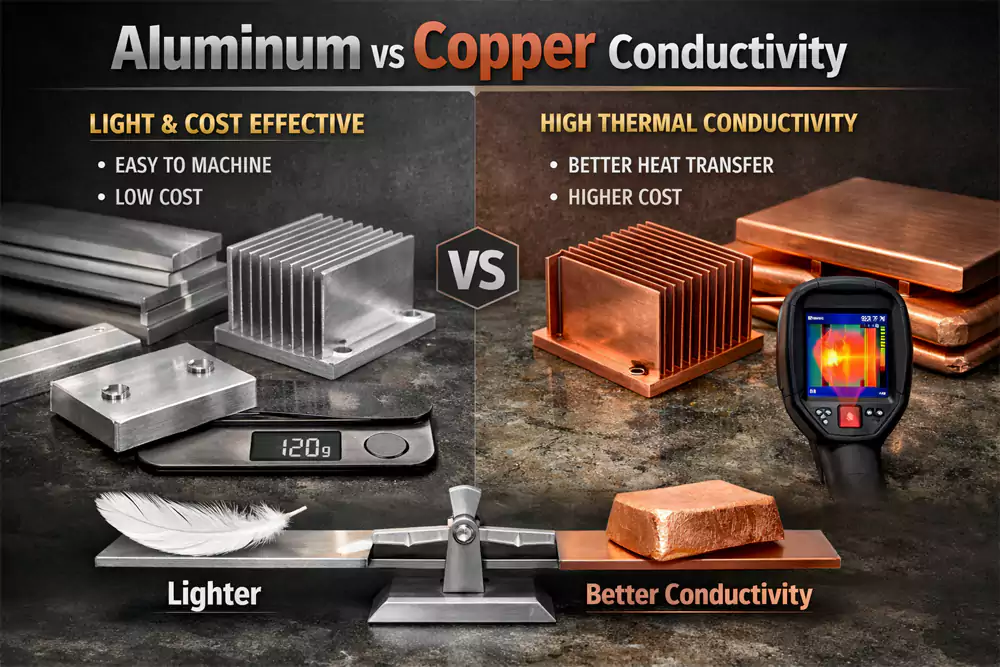
At this stage, most engineers start asking a more useful question. Instead of asking which material is most conductive, they ask which material gives the best overall engineering value.
Aluminum vs Copper Conductivity
Copper conductivity:
- approximately 385–400 W/m·K
Advantages:
- highest heat transfer efficiency
Disadvantages:
- higher cost
- much heavier
- harder machining
- higher material waste cost
Aluminum conductivity:
- approximately 120–235 W/m·K depending on grade
Advantages:
- lightweight
- lower raw material cost
- easier CNC machining
- better cost-performance ratio
In many practical designs, aluminum wins.
Aluminum vs Stainless Steel
Stainless steel has poor thermal conductivity.
Typical value:
- 14–16 W/m·K
Use stainless steel when:
- corrosion resistance is critical
- heat transfer is not a priority
Aluminum vs Brass
Brass offers moderate conductivity.
It is useful for:
- fittings
- decorative parts
- moderate thermal requirements
But aluminum is usually better for:
- lightweight applications
- larger thermal surfaces
How Do You Choose the Right Material for CNC Machined Parts?
Material selection is not only about conductivity numbers. Geometry, airflow, coatings, and machining constraints matter just as much.
The best aluminum for heat dissipation is not always the alloy with the highest conductivity. In most CNC applications, 6061 aluminum offers the best balance of thermal conductivity, strength, cost, and machining flexibility.
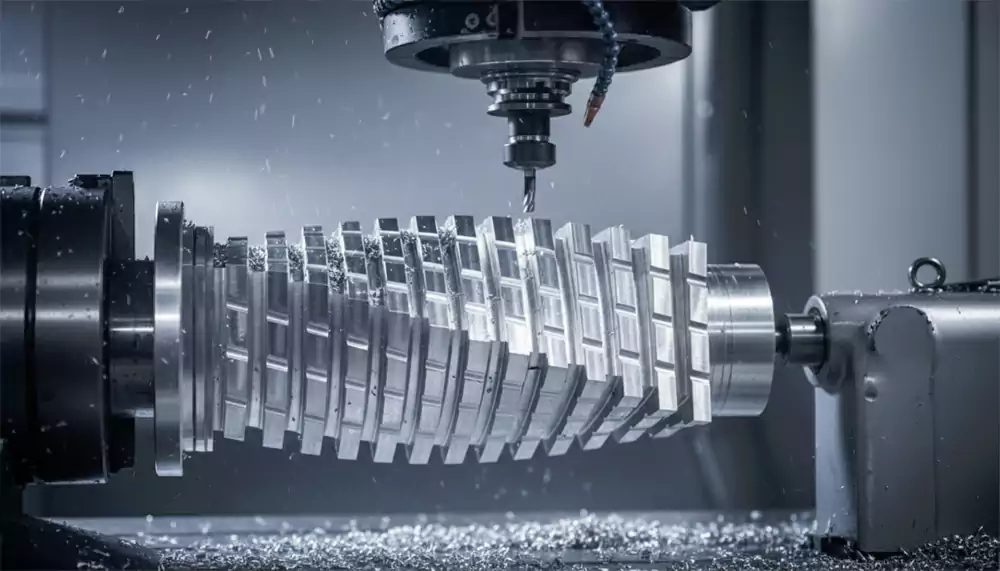
This is where theory becomes real manufacturing. Material data sheets are useful, but actual performance depends on design execution. Surface area, airflow path, wall thickness, and finishing choices can matter just as much as alloy selection.
Choose Based on Application
Automotive and Motorcycle Parts
Recommended alloys:
- 6061
- 5052
- 7075 for high-load parts
Applications:
- ECU housings
- battery enclosures
- cooling brackets
Medical Equipment Components
Recommended alloys:
- 6061
- 6063
Requirements:
- dimensional stability
- clean finishing
- lightweight construction
Industrial and Agricultural Equipment
Recommended alloys:
- 6061
- 5052
Focus areas:
- cost efficiency
- wear resistance
- thermal consistency
Hydraulic Components
Recommended alloys:
- 6061
- 7075
Important factors:
- pressure resistance
- thermal stability
- corrosion resistance
Case Study: Electric Motorcycle Controller Housing
A client needed better cooling for an electric motorcycle motor controller.
Project parameters:
| Parameter | Specification |
|---|---|
| Material | 6061-T6 |
| Part Size | 180 × 120 × 55 mm |
| Wall Thickness | 3.5 mm |
| Cooling Fin Height | 12 mm |
| Surface Finish | Clear anodized |
| Flatness Tolerance | ±0.03 mm |
| Batch Size | 500 pcs |
Results:
- operating temperature reduced by 14.8°C
- machining cycle reduced by 11%
- material cost reduced by 32% compared with copper
This project reinforced something I see often.
Heat dissipation is not only about material conductivity. Geometry matters just as much. Better fin design, airflow, and surface area often outperform chasing the highest conductivity number.
Does Anodizing Affect Thermal Performance?
Yes, slightly.
Anodizing adds an oxide layer that introduces some thermal resistance.
Benefits still include:
- corrosion resistance
- wear resistance
- appearance improvement
For most CNC parts, this tradeoff is acceptable.
Avoid thick hard anodizing when maximum thermal transfer is critical.
FAQ
What aluminum has the highest thermal conductivity?
1050 and 1060 aluminum usually have the highest thermal conductivity, often above 225 W/m·K.
Is 6061 aluminum good for heat dissipation?
Yes. 6061 thermal conductivity is strong enough for most industrial applications while also providing excellent strength and machinability.
Why is copper more conductive than aluminum?
Copper has a denser electron structure that allows heat to transfer more efficiently.
Does anodizing reduce aluminum thermal conductivity?
Yes, slightly. The oxide layer adds minor thermal resistance.
Which aluminum alloy is best for heat sinks?
6063 and 1050 are common for heat sinks. 6061 is preferred when machining strength is also needed.
Conclusion
The best aluminum is not always the one with the highest conductivity, but the one that performs best in your real application. In most CNC projects, balancing thermal performance, strength, corrosion resistance, and machinability matters far more than chasing theoretical values.
Need help selecting the right aluminum grade for your custom parts? Contact Allied Metal for material guidance and precision CNC machining support.

-
"Thermal conductivity and resistivity", https://en.wikipedia.org/wiki/Thermal_conductivity_and_resistivity. A standard thermodynamics or materials reference defines thermal conductivity as the material property that quantifies heat flow through a material under a temperature gradient. Evidence role: definition; source type: encyclopedia. Supports: Thermal conductivity describes how efficiently heat passes through a material.. ↩
-
"Comparing the Thermal Conductivity of Stainless Steel to other Metals", https://www.stainless-structurals.com/blog/comparing-the-thermal-conductivity-of-stainless-steel-to-other-metals/. Materials data tables list stainless steel thermal conductivity values that are substantially lower than those of high-conductivity metals such as copper and aluminum, supporting the statement that stainless steel transfers heat comparatively slowly. Evidence role: general_support; source type: education. Supports: Stainless steel transfers heat slowly compared with metals such as copper and aluminum.. Scope note: The comparison depends on the stainless steel grade and temperature, so the source should be used as contextual support rather than a universal value for all stainless steels. ↩
-
"Aluminum 6061-T6 (UNS AA96061) | NIST", https://www.nist.gov/mml/acmd/aluminum-6061-t6-uns-aa96061. A materials-property reference for aluminum alloy 6061 reports room-temperature thermal conductivity values in the approximate range of 167 W/m·K, supporting the stated order of magnitude for the grade. Evidence role: statistic; source type: institution. Supports: 6061 aluminum has a thermal conductivity of about 167 W/m·K.. Scope note: Thermal conductivity can vary by temper, temperature, and source methodology, so the cited value should be treated as approximate rather than universal. ↩
