Author's Note: Last updated on May 20, 2026, by Lucy
Many manufacturers want faster product development. Yet long lead times, tooling costs, and repeated design changes still slow down innovation and increase project risk.
3D printing is an additive manufacturing process that creates parts layer by layer from digital CAD files. It helps engineers and manufacturers produce prototypes, functional test parts, and low-volume custom components faster and with lower upfront cost than many traditional manufacturing methods.

I have worked with many engineers who first saw 3D printing as a replacement for CNC machining. In real industrial projects, I rarely see it that way. I see 3D printing as a fast validation tool. It helps teams reduce development risk, improve product testing speed, and shorten the path from concept to production.
What Is 3D Printing and How Does It Work?
Many companies know the term “3D printing.” Still, many engineers and sourcing teams are unsure how the process actually works in industrial manufacturing.
3D printing, also called additive manufacturing, builds physical parts by adding material layer by layer from a digital 3D model. Unlike CNC machining, which removes material from solid stock, 3D printing creates parts directly from CAD data with minimal material waste.
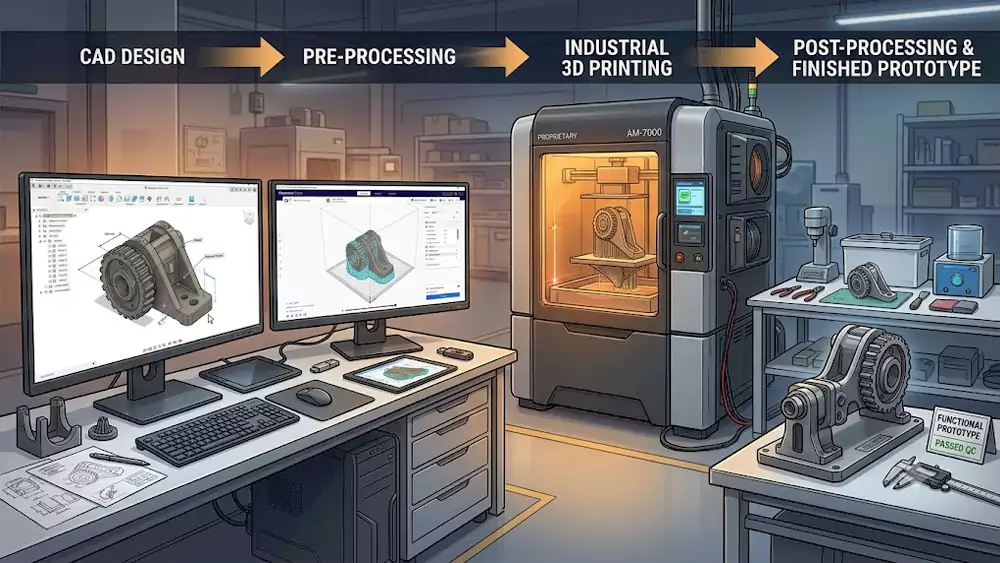
When I first introduced 3D printing into prototype projects, the biggest change was not cost. It was speed. Engineers could finally test ideas in days instead of waiting weeks for machining schedules and tooling preparation.
3D printing starts with a digital CAD model. The file is converted into machine-readable instructions through slicing software. The printer then builds the part layer by layer using plastic, resin, metal powder, or composite materials. After printing, the part may go through sanding, machining, polishing, or coating depending on the final application.
Definition of 3D Printing and Additive Manufacturing
Additive manufacturing creates objects by adding material only where needed. This is very different from subtractive processes such as CNC machining.
| Manufacturing Method | Material Usage | Tooling Needed | Geometry Freedom |
|---|---|---|---|
| CNC Machining | Higher waste | Yes | Medium |
| Injection Molding | Medium | Expensive molds | Limited |
| 3D Printing | Low waste | No tooling | Very high |
One reason engineers like additive manufacturing is design freedom. Internal channels, lightweight lattice structures, and complex organic shapes1 are much easier to produce with 3D printing.
Step-by-Step 3D Printing Workflow
CAD Modeling
The process begins with a 3D CAD model created in software such as SolidWorks or Fusion 360.
Slicing and File Preparation
The model is exported into STL or 3MF format. Slicing software converts the model into printable layers and machine instructions.
Layer-by-Layer Fabrication
The printer builds the part one layer at a time using heat, lasers, UV light, or bonding agents depending on the technology.
Post-Processing and Finishing
Industrial parts often require additional finishing such as support removal, polishing, machining, bead blasting, or coating.
Advantages of 3D Printing
3D printing offers several major benefits for industrial product development:
- Faster prototype turnaround
- Lower tooling costs
- Easier customization
- Reduced material waste
- Faster design iteration
- Better support for complex geometries
Limitations Engineers Should Consider
3D printing also has practical limits that engineers should understand before production begins.
Common limitations include:
- Slower mass production speed
- Layer-based surface texture
- Limited material choices for some processes
- Mechanical strength variation by print orientation2
- Smaller build size compared to traditional manufacturing
For many precision parts, CNC finishing is still required after printing.
Before selecting any process, I usually tell customers to focus on the real purpose of the part first. A concept model, a functional prototype, and a production component often need very different manufacturing strategies.
Common 3D Printing Technologies and Their Applications
Many buyers think all 3D printers work the same way. In reality, each technology solves different engineering problems and production goals.
FDM, SLA, SLS, MJF, and metal 3D printing each provide different advantages in cost, speed, strength, accuracy, and surface finish. The best technology depends on the part function, material requirements, and production volume.
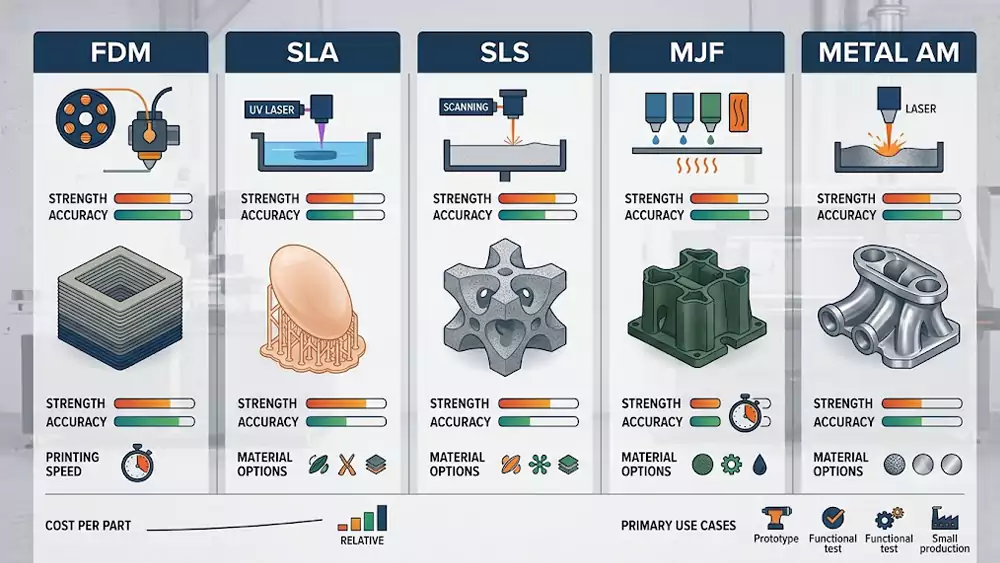
In many projects, I see engineers focus too much on machine type first. I usually recommend starting with the application instead. Once the part function is clear, the technology choice becomes much easier.
FDM (Fused Deposition Modeling)
FDM 3D printing is one of the most widely used additive manufacturing processes. It melts thermoplastic filament and deposits material layer by layer.
Best applications:
- Concept models
- Assembly validation
- Low-cost prototypes
- Fixture testing
Common materials:
- PLA
- ABS
- PETG
- Nylon
SLA (Stereolithography)
SLA uses UV lasers to cure liquid resin into highly detailed parts3.
Best applications:
- Cosmetic prototypes
- Medical models
- Fine-detail components
- Transparent parts
SLS (Selective Laser Sintering)
SLS fuses nylon powder with lasers and does not require support structures.
Best applications:
- Functional testing
- Snap-fit assemblies
- Complex industrial parts
- Low-volume production
MJF (Multi Jet Fusion)
MJF is widely used for durable nylon production parts with consistent mechanical properties.
Best applications:
- End-use components
- Industrial housings
- Functional production runs
- Rapid manufacturing
Metal 3D Printing (DMLS/SLM)
Metal additive manufacturing fuses metal powder using high-powered lasers.
Best applications:
- Aerospace components
- Lightweight metal structures
- Internal cooling channels
- High-performance industrial parts
Accuracy and Surface Finish Comparison
| Technology | Typical Accuracy | Surface Finish |
|---|---|---|
| FDM | ±0.3 mm | Rough |
| SLA | ±0.1 mm | Very smooth |
| SLS | ±0.2 mm | Slightly textured |
| MJF | ±0.2 mm | Fine matte |
| Metal DMLS | ±0.1 mm | Rough before finishing |
Production Speed and Cost Comparison
| Technology | Relative Speed | Relative Cost |
|---|---|---|
| FDM | Medium | Low |
| SLA | Medium | Medium |
| SLS | Fast | Medium-High |
| MJF | Very fast | Medium-High |
| Metal DMLS | Slow | Very high |
Best Use Cases for Each Technology
Rapid Prototyping
FDM and SLA are excellent for quick design validation.
Functional Testing
SLS and MJF provide stronger engineering-grade parts.
Low-Volume Production
MJF is often ideal for short-run production without tooling investment.
Custom Industrial Parts
Metal additive manufacturing is valuable for complex geometries that are difficult or expensive to machine.
Real Industrial Case Study
A robotics customer once needed lightweight gripper arm prototypes within one week for assembly testing. Traditional machining would have exceeded the project deadline.
We switched to MJF nylon production.
| Parameter | Value |
|---|---|
| Material | PA12 Nylon |
| Technology | MJF |
| Part Size | 240 × 85 × 60 mm |
| Layer Thickness | 80 microns |
| Prototype Quantity | 12 pcs |
| Weight Reduction | 37% |
| Lead Time | 4 days |
| CNC Equivalent Lead Time | 14 days |
| Final Surface Finish | Bead blasted |
The customer completed fit testing ahead of schedule and later moved into CNC aluminum production after several design revisions.
That project reinforced something I often tell engineers: the biggest value of 3D printing is not always the final part itself. The real value is how quickly you can learn, improve, and reduce development mistakes before production begins.
Materials Used in Industrial 3D Printing
Many engineers focus heavily on printer specifications. In actual industrial projects, material selection often matters even more than the machine itself.
Industrial 3D printing materials include plastics, engineering thermoplastics, resins, metals, and composite materials. The right material depends on strength, temperature resistance, dimensional stability, appearance, and production requirements.
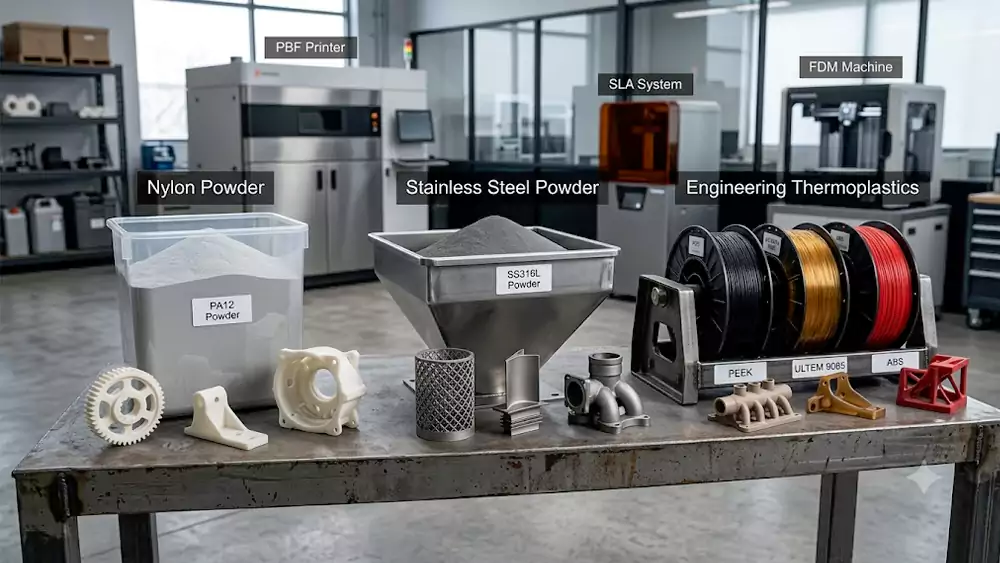
I have seen good-looking prototypes fail functional testing simply because the wrong material was selected. A part may print perfectly but still crack, warp, or deform under real operating conditions.
Plastic Materials
Basic thermoplastics are affordable and easy to print.
Common options:
- PLA
- ABS
- PETG
These materials work well for visual prototypes and simple functional testing.
Engineering Thermoplastics
Engineering plastics provide stronger mechanical performance and better heat resistance.
Popular materials:
- Nylon PA12
- Polycarbonate
- PEEK
- ULTEM
These materials are common in aerospace, industrial automation, and automotive applications.
Resin Materials
Resins provide excellent detail and smooth surface finish.
Applications include:
- Medical devices
- Transparent parts
- Cosmetic prototypes
- Fine-detail models
Metal Materials
Metal additive manufacturing supports demanding industrial applications.
Common metals:
- Stainless steel
- Titanium
- Aluminum alloys
- Tool steel
- Inconel
Composite Materials
Carbon fiber reinforced materials are increasingly used for lightweight industrial applications that require better stiffness and lower weight.
How to Choose the Right Material
Material selection should always match the actual operating environment.
Strength Requirements
Load-bearing components require stronger engineering materials.
Heat Resistance
High-temperature applications may require PEEK or metal materials.
Surface Quality
SLA resin often provides the best cosmetic appearance.
Cost Considerations
Advanced materials increase both printing and post-processing costs.
| Material Type | Strength | Heat Resistance | Cost |
|---|---|---|---|
| PLA | Low | Low | Low |
| Nylon PA12 | Medium-High | Medium | Medium |
| PEEK | Very high | Very high | Very high |
| Aluminum | High | High | High |
As projects move closer to production, material performance becomes even more important. This is usually where engineers begin comparing additive manufacturing against traditional CNC machining more seriously.
3D Printing vs CNC Machining: Which Is Better?
Many engineers ask whether 3D printing will replace CNC machining. In real manufacturing environments, I rarely see one process fully replacing the other.
3D printing is better for rapid prototyping, design validation, complex geometries, and low-volume customization. CNC machining is better for tight tolerances, superior surface finish, predictable material strength, and stable production consistency.
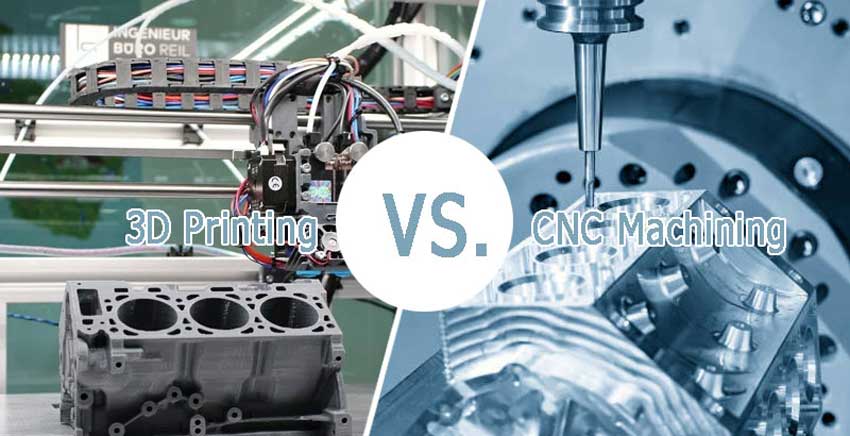
I usually explain this with a simple rule. If learning speed matters most, 3D printing is often the better choice. If production stability and precision matter most, CNC machining usually wins.
Many customers comparing CNC machining vs 3D printing eventually discover that the best solution is often a combination of both technologies.
Additive vs Subtractive Manufacturing
3D printing adds material layer by layer. CNC machining removes material from solid stock using cutting tools.
Precision and Tolerances
CNC machining generally delivers tighter tolerances.
| Process | Typical Tolerance |
|---|---|
| Standard FDM | ±0.3 mm |
| Industrial SLA | ±0.1 mm |
| CNC Machining | ±0.01 mm |
Surface Finish Comparison
Machined parts typically provide smoother surfaces directly from the machine.
Printed parts often require:
- Sanding
- Vapor smoothing
- Coating
- CNC finishing
Material Performance Comparison
CNC machined materials usually provide more predictable mechanical performance because they are fully dense and isotropic.
3D printed parts may show weaker strength along layer lines depending on orientation and process settings.
Cost Comparison for Prototypes and Production
| Production Volume | Better Choice |
|---|---|
| 1–20 pcs | 3D Printing |
| 20–200 pcs | Depends on geometry |
| 1000+ pcs | CNC or molding |
When to Use 3D Printing
3D printing works best for:
- Rapid prototypes
- Lightweight structures
- Design validation
- Complex internal channels
- Custom parts
When CNC Machining Is the Better Choice
CNC machining is ideal for:
- Tight-tolerance parts
- Precision metal components
- Aerospace applications
- Long-term production consistency
When Combining Both Processes Makes Sense
Hybrid manufacturing is becoming more common in industrial projects.
I often see customers prototype parts with industrial 3D printing services first, validate assembly fit and functionality, and later move to CNC machining for production. This approach reduces engineering risk while controlling development cost and lead time.
Once a project reaches this stage, the supplier itself becomes just as important as the manufacturing technology.
How to Choose a Reliable 3D Printing Partner
Many suppliers own industrial printers. Far fewer suppliers truly understand engineering requirements, production consistency, and long-term manufacturing support.
A reliable 3D printing supplier should provide stable process control, engineering support, quality inspection, material traceability, and the ability to scale from rapid prototyping into production manufacturing.
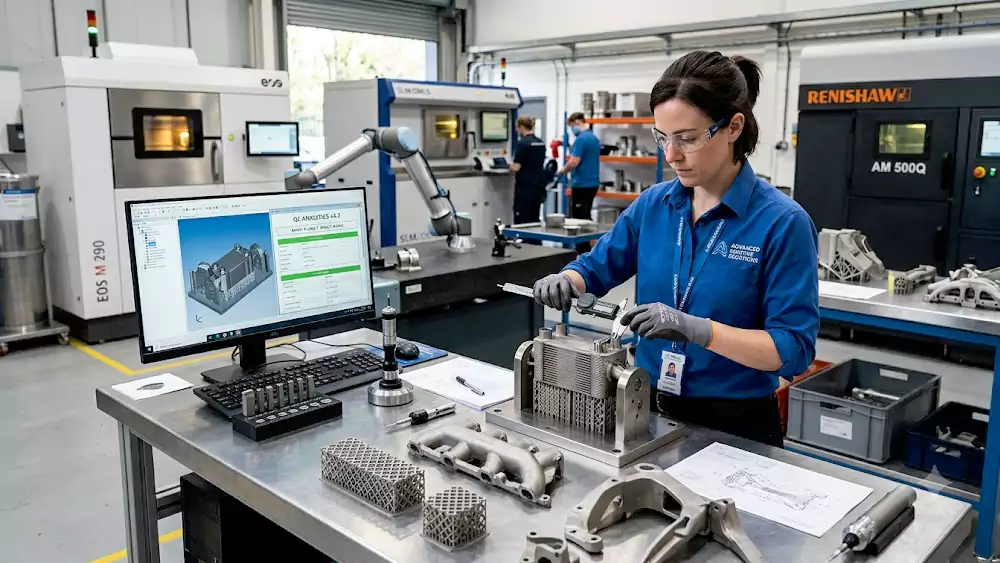
I have worked with buyers who selected suppliers based only on low pricing. Later, they faced delays, unstable tolerances, poor communication, or inconsistent part quality. In industrial manufacturing, reliability matters more than the lowest quote.
Technical Capabilities to Evaluate
A capable supplier should support:
- Multiple printing technologies
- DFM analysis
- Engineering consultation
- Quality inspection
- Post-processing services
Material and Quality Certifications
For industrial applications, certifications are important.
Common examples:
- ISO 9001
- Material traceability reports
- Inspection documentation
Prototype-to-Production Support
A strong manufacturing partner should support both rapid prototyping and scalable production.
Lead Times and Global Shipping
Fast communication and stable logistics are critical for international manufacturing projects.
Questions Engineers and Buyers Should Ask Suppliers
Tolerance Capability
Can the supplier consistently achieve the required tolerances?
Minimum Order Quantity
Can they support both prototypes and low-volume production?
File Format Support
Do they accept STEP, STL, and native CAD formats?
Post-Processing Options
Can they provide machining, polishing, coating, or assembly services?
| Supplier Evaluation Factor | Why It Matters |
|---|---|
| Engineering Support | Reduces design risk |
| Quality Inspection | Improves consistency |
| Material Knowledge | Prevents application failure |
| Production Scalability | Supports future growth |
Conclusion
3D printing is not a universal replacement for traditional manufacturing. I see it as one of the fastest ways to validate ideas, reduce development risk, and accelerate product innovation. When combined with CNC machining and strong engineering support, it becomes a powerful tool for building better industrial products faster and more efficiently.

-
"design for internal lattice structures with application in", https://repositories.lib.utexas.edu/bitstreams/a17e7382-7a18-4580-861d-089f5d5de06c/download. A peer-reviewed review or university source should support that additive manufacturing enables complex geometries such as internal channels and lattice structures that are difficult or impractical to fabricate with conventional subtractive or molding methods. Evidence role: mechanism; source type: paper. Supports: Internal channels, lightweight lattice structures, and complex organic shapes are much easier to produce with 3D printing.. Scope note: The source would support design capability in general; manufacturability still varies by printer type, material, support strategy, and post-processing constraints. ↩
-
"Investigation of the Effect of Built Orientation on Mechanical ...", https://www.sciencedirect.com/science/article/pii/S2211812814005112. A peer-reviewed materials study should support that additively manufactured parts can show anisotropic mechanical properties, with tensile strength or failure behavior varying according to build orientation and layer bonding. Evidence role: mechanism; source type: paper. Supports: Mechanical strength can vary by print orientation in 3D-printed parts.. Scope note: The magnitude and direction of strength variation depend on the material, printing process, parameters, and post-processing treatment. ↩
-
"SLA and MSLA 3D Printing - UC Davis Tech Foundry", https://techfoundry.ucdavis.edu/sla-system. A technical reference should support that stereolithography uses ultraviolet light, commonly a laser, to photopolymerize liquid resin layer by layer; any statement about high detail should be treated as a typical capability rather than a guaranteed result. Evidence role: mechanism; source type: encyclopedia. Supports: SLA uses UV lasers to cure liquid resin into highly detailed parts.. Scope note: Detail and accuracy depend on printer optics, resin, layer height, calibration, and post-processing. ↩
