Last updated on March 4, 2026, by Lucy Wang
Titanium looks perfect on paper. Many teams select it for strength and weight. Then machining delays and tool failures start. Costs rise fast and schedules slip.
CNC machining titanium requires choosing the right alloy, controlling heat at the cutting edge, using rigid setups, and planning for higher tool wear. Success depends more on process control than raw material strength.
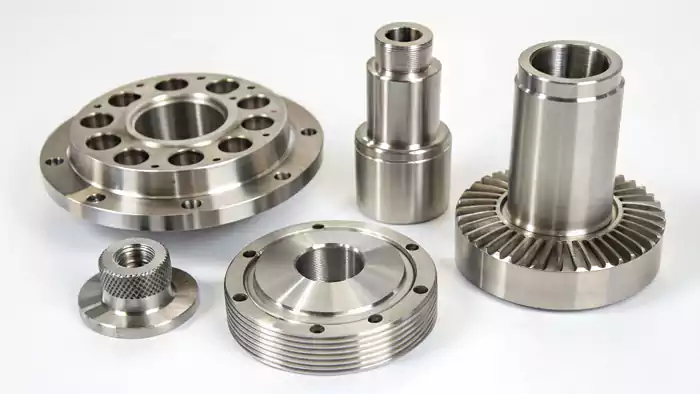
When working with engineering clients like David, I do not treat titanium as exotic. I treat it as predictable material with strict rules. If I respect the heat and control engagement, I get stable results. If I ignore those rules, scrap rates rise. So I always begin with titanium alloy selection and machining strategy together.
Titanium Grades & Engineering Properties: Choosing the Right Alloy?
Many buyers focus only on “titanium.” That is too general. Titanium grades behave very differently in machining and in service.
Commercially pure titanium (Grade 1–4) offers corrosion resistance and formability, while Ti-6Al-4V (Grade 5) provides high strength and fatigue resistance. Grade 23 (ELI) improves ductility and biocompatibility for medical use. Choosing the wrong grade increases cost and machining difficulty.
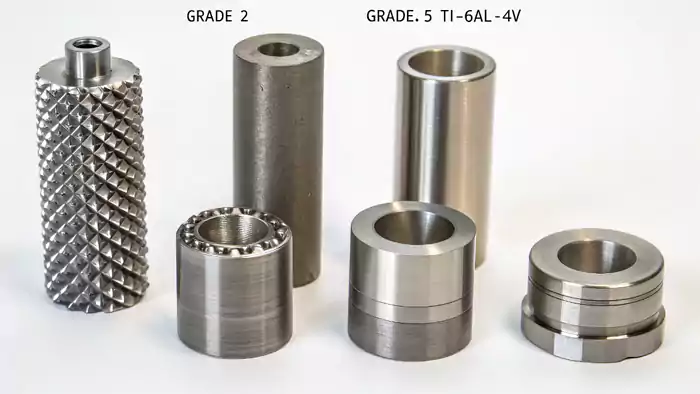
Common Titanium Grades
| Grade | Standard (ASTM) | Typical Hardness | Strength Level | Relative Machinability* |
|---|---|---|---|---|
| Grade 2 | ASTM B348 | ~160 HB | Moderate | 45% |
| Grade 5 (Ti-6Al-4V) | ASTM B348 | ~36 HRC | High | 22% |
| Grade 23 (ELI) | ASTM B348 | ~34 HRC | High | 20% |
*Relative to free-cutting steel = 100%
Engineering Considerations
- Strength-to-weight ratio1: Grade 5 delivers excellent load capacity with low density.
- Fatigue resistance: Critical for aerospace brackets and rotating parts.
- Corrosion resistance2: Grade 2 performs well in chemical and marine environments.
- Biocompatibility: Grade 23 supports implant-grade requirements.
I always remind clients that choosing Grade 5 “just to be safe” may raise machining cost without improving performance. In automation systems, Grade 2 often meets the load requirement at lower cost and easier machining. In aerospace, Grade 5 is often justified. Alloy choice drives both service life and cycle time. Selecting the wrong grade is more dangerous than dealing with machining difficulty.
Why Is Titanium Difficult to Machine? Heat, Tool Wear & Stability?
Many engineers ask me if titanium can really be CNC machined. The answer is yes. The real issue is heat control.
Titanium is difficult to machine because it has low thermal conductivity, causes heat to concentrate at the cutting edge, work hardens quickly, and accelerates tool wear. Heat stays in the tool instead of the chip.
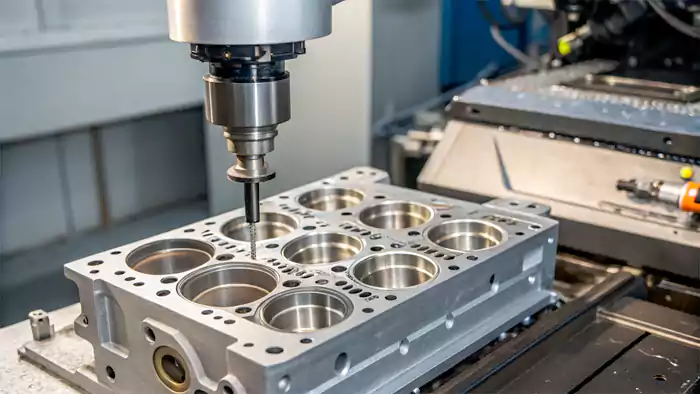
Key Technical Challenges
-
Low thermal conductivity3
Heat does not leave with the chip. It stays at the tool tip. -
Work hardening
If I dwell or rub, the surface becomes harder. The next pass becomes harder to cut. -
Built-up edge and galling
Titanium sticks to the tool edge. Surface finish degrades. -
Poor chip breakage
Long stringy chips affect stability.
Machinability Comparison
| Material | Relative Machinability | Heat Behavior |
|---|---|---|
| Aluminum 6061 | 300% | Heat leaves with chip |
| 304 Stainless | 45% | Moderate heat retention |
| Ti-6Al-4V | 22% | Heat stays at tool |
Rigidity requirements are higher than aluminum or steel. If the setup is weak, chatter begins quickly. Titanium machining is not impossible. It is unforgiving. If feed is too low, rubbing increases heat. If speed is too high, tool life drops sharply. Respecting heat is the core rule.
Proven CNC Strategies for Machining Titanium Efficiently & Precisely?
Many shops blame tools. I see the issue as system control. Titanium machining is a system problem, not a tool problem.
Efficient titanium machining requires controlled cutting speed, constant tool engagement, rigid clamping, coated carbide tools, and high-pressure coolant to remove heat from the cutting zone.
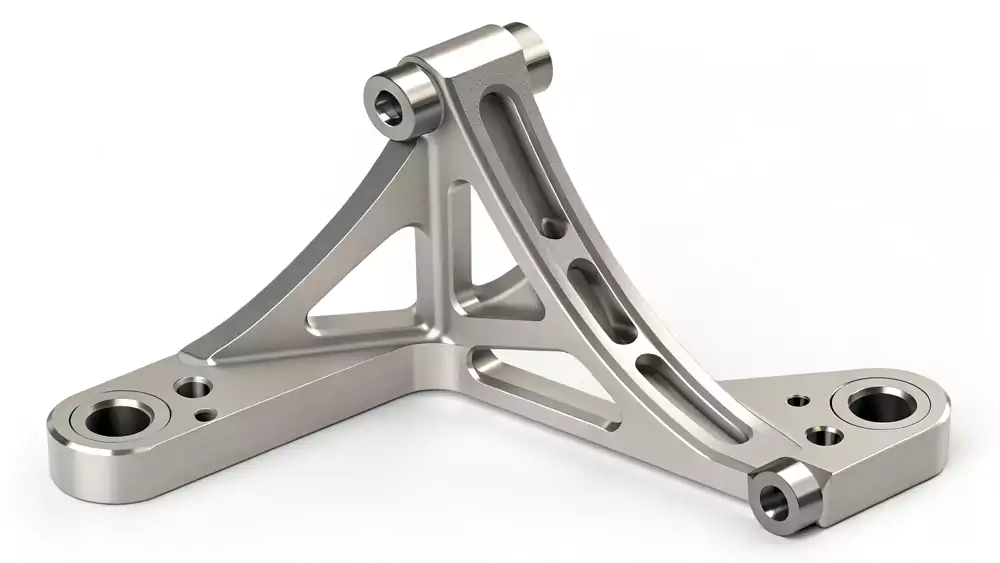
Cutting Strategy
- Lower cutting speeds than steel
- Stable feed rate to avoid rubbing
- Trochoidal milling4 for constant engagement
- Avoid sudden entry and exit
I prefer steady engagement over aggressive peak removal.
Tooling Strategy
- Sharp, coated carbide inserts
- Short tool overhang
- Tool life monitoring
- Avoid reusing worn tools
Coolant Strategy
- High-pressure coolant for deep pockets
- Flood cooling for general milling
- Avoid dry cutting in most cases
Machine Requirements
- High rigidity spindle
- Stable fixturing
-5-axis capability for complex aerospace parts
Case Study: Aerospace Bracket
A client required a Ti-6Al-4V bracket.
| Parameter | Value |
|---|---|
| Material | Ti-6Al-4V Grade 5 |
| Size | 180 × 120 × 40 mm |
| Tolerance | ±0.01 mm critical bore |
| Surface Finish | Ra 0.8 μm |
| Batch Size | 250 units |
Initial cycle time was 62 minutes with frequent tool failure. After optimizing toolpath and coolant pressure:
| Metric | Before | After |
|---|---|---|
| Cycle Time | 62 min | 48 min |
| Tool Life | 18 parts | 42 parts |
| Scrap Rate | 6% | <1% |
The key change was constant engagement milling and improved clamping rigidity. Heat control reduced wear dramatically.
Cost Drivers, Surface Finish & Procurement Risks in Titanium Machining?
Many buyers focus on titanium bar price. That is only part of the cost.
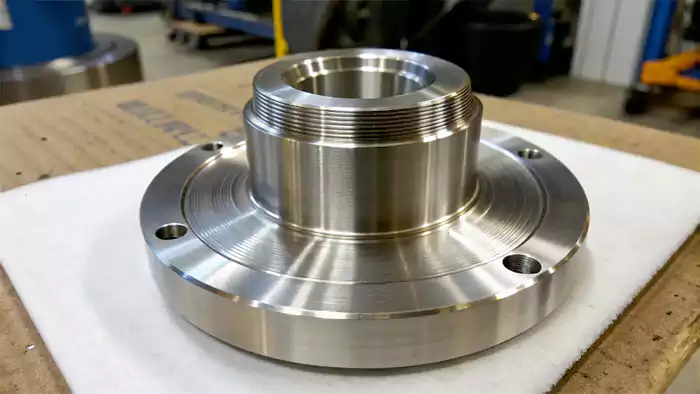
Titanium machining cost is driven more by tool wear, cycle time, scrap risk, and process control than by raw material price alone.
Cost Drivers
- Tool wear and insert replacement5
- Slower cutting speeds
- Increased inspection time
- Scrap risk due to heat distortion
Tolerance & Surface Finish
Typical achievable tolerances:
- ±0.01 mm for critical features
- ±0.02 mm general
Surface roughness:
- Ra 0.8–1.6 μm standard
- Ra 0.4 μm achievable with fine finishing
Post-processing options:
- Anodizing
- Passivation
- Polishing for medical components
Procurement Risk Questions
I ask simple questions:
- Is Grade 5 over-specified?
- Is aluminum sufficient for this load?
- What is the batch consistency plan?
- How is tool life tracked?
Titanium is tough, but it is not a mystery. I pick the right alloy. I respect the heat. I keep my speed steady. That is the whole game.
Conclusion
Titanium machining succeeds when alloy choice, heat control, and system stability align. Smart planning reduces cost and turns titanium strength into real performance.

-
Explore this to understand why Grade 5 titanium is preferred for high load capacity with low density, crucial for aerospace and engineering. ↩
-
Learn why Grade 2 titanium is ideal for chemical and marine environments due to its superior corrosion resistance. ↩
-
Explore this link to understand how low thermal conductivity impacts heat management during titanium machining, crucial for tool life and surface quality. ↩
-
Explore how trochoidal milling ensures constant tool engagement, reducing wear and improving cycle times in aerospace part manufacturing. ↩
-
Explore this link to learn how managing tool wear and insert replacement can reduce costs and improve machining efficiency. ↩
